Article
Search results:
-
3 Special Ming Dynasty Ornaments You Never Knew About
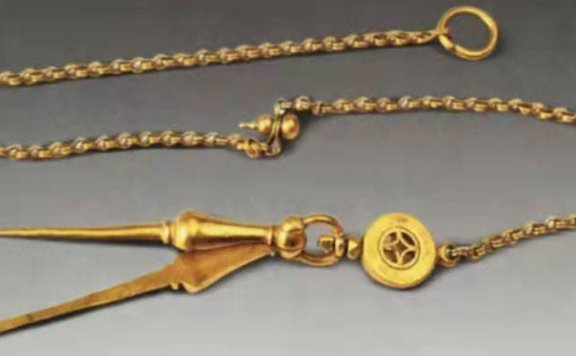
During the Ming dynasty, the categories and styles of gold and silver ornaments had greater innovation and development based on the Song and Yuan dynasties, showing different visual aesthetic experiences and artistic styles. Among the various types of gold and silver in the Ming dynasty ornaments, "San Sher (三事儿, sān shèr, three things)" is a unique example. Unlike other ornaments, the "San Sher" are daily life tools, used for repairing and cleaning, and their main components include hooks, chains, connectors, pendants, etc. Some of them also have storage tubes, and the pendant objects are usually toothpicks, ear picks, and tweezers, which can be worn by both men and women. The "San Sher" is a common name in the Ming Dynasty, but in fact, the number of pendants can be increased or decreased, and the types are also different. The Ming Dynasty gold and silver "San Sher" are exquisite and unique, reflecting the high design aesthetic appeal, and also have a rich cultural connotation. Design aesthetics of Ming dynasty Ornaments - San Sher 01 Small and applicable: the form of pendant design The gold and silver "San Sher" of the Ming Dynasty pursued unity in form, and the pendant… -
Zimu Kou - Exquisite Ming Style Hanfu Button
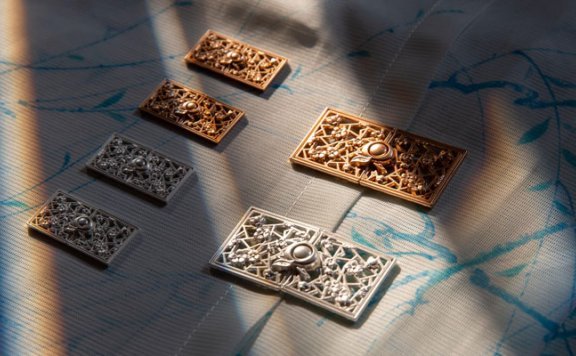
Zimu Kou (子母扣, metal clasp button) is the most common accessory for making Ming-style Hanfu, and if you make a Ming Hanfu yourself, they are a must-buy material. Usually, you need about 7-10 buttons to make a Duijin Duan Shan (对襟短衫) with a stand-up collar. A good-looking Zimu Kou can become the highlight of the clothes, adding texture and a sense of sophistication, and good clothes should find a matching button to complement each other. About Zimu Kou's selection Metal Zimu Kou is more suitable for autumn and winter Shan and Ao and other outer clothing, but sometimes too thin fabric to support too heavy Zimu Kou. Pifeng's Zimu Kou larger (only one, so need a larger one, can do embellishment, or highlight). Zimu Kou applied to the collar should choose easy to buckle on, the size of the buttons than the size of the garment is a little smaller. Gorgeous button style, more suitable for clothes with woven gold, dark pattern and so on. About the care of Zimu Kou General copper and silver-plated material button are easier to oxidation, over time will become black. Usually to keep clean, dirty to wipe as soon as possible. If… -
5 Steps to Figure Out the Chinese Female Outfits (Ming)
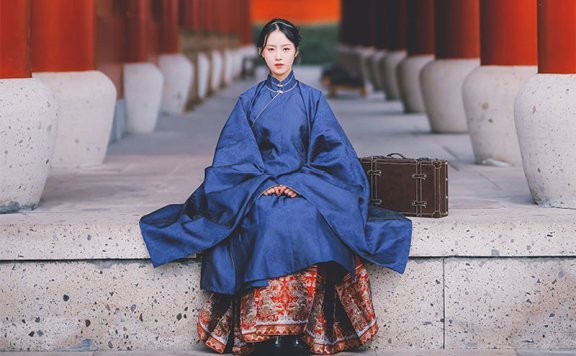
Perhaps you often see some Ming styles of Chinese female outfits with complicated names, such as: Duijin Shuling Pipa Xiu Duan Ao (对襟竖领琵琶袖短袄, short jacket with vertical lapels and pipa sleeves), Xiejin Shuling Long Ao (斜襟竖领长袄, long jacket with slanting lapels). But if you break these names down and analyze them, they are actually very easy to understand. In this article, Zhua Xiao Ye will introduce to you the structure and naming rules of the Ming Chinese female outfits for women, and hope it will help you if you are particularly fond of the Ming-style Hanfu. Step 1: Ling (领, collar) Ling is the collar of the clothes. There are more kinds of collars in Hanfu, the most common one is the Jiaoling (交领, cross collar), which is characterized by Jiaoling Youren (交领右衽), that is, the left lapel covers the right lapel (when wearing, but if viewed from the front, that is the right lapel covers the left lapel), showing a "y" shape, which started from the Shang and Zhou period and was used until the Ming Dynasty. In addition to the cross collar, more types of collars were developed in the Ming Dynasty: Yuanling (圆领, round collar), Fangling (方领, square… -

Guide to Hanfu Types Summary & Dress Codes (Ming Dynasty)
1. Hanfu Types Summary The ancient Chinese costume Hanfu system can be divided into two categories: the "Fa Fu (法服)", which was based on the ritual and music system and the "Bian Fu (便服)", which was not limited by the rank system. In contemporary society, the ancient ranking system has died out, but the dress culture behind the "Fa Fu" should still be respected. Based on the dress etiquette requirements of the majority of people in each ancient era (i.e., the ancient scholar and citizen class), some historical costumes are selected and summarized into a contemporary Hanfu system. Among them, the dresses for the Guan Ji Li (冠笄礼) and wedding are based on the basic requirements of the rituals inherited from the Ming Dynasty, while the informal dresses are based on the dresses of the late Ming Dynasty. The Hanfu system and dress codes and mentioned in this article was proposed by Zun Zhou Cheng Ming (尊周承明) 1.1 Hanfu Menswear System 1.1.2 Li Fu (礼服, formal dress) It belongs to the outer clothing layers. It is one of the most solemn dresses in the contemporary men's Hanfu system and is not suitable for daily wear (the same applies to the… -
What You Need to Know About Ming Dynasty Clothing
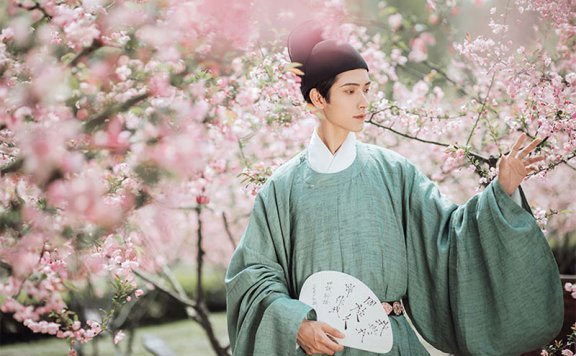
In recent years, Hanfu has received more and more attention. More and more Hanfu cultural festivals are being held in different cities in China, and worldwide, and thousands of Hanfu enthusiasts are participating in them. The Beauty of Hanfu Is in the Heritage So why is Hanfu so popular? In today's society, people have higher and higher requirements for aesthetics, and the special classical beauty of Hanfu attracts countless people to love it, and then to pay attention to it and understand it. So it is no wonder that Hanfu is so popular. And the beauty of Hanfu is not just on the surface, but in the thousands of years of traditional etiquette and civilization of the Chinese nation that it carries. Today we bring you some of the Hanfu collections from "Yi Guan Da Cheng-Ming Dynasty Costume Culture Exhibition", these collections come from the Shandong Museum and Confucius Museum, most of them are Ming Dynasty clothing, which is not only beautifully made and complete sets, but also very significant for costume research. I hope you can also learn something from these collections. Detailed video about "Yi Guan Da Cheng-Ming Dynasty Costume Culture Exhibition": Based on the previous dynasty,… -
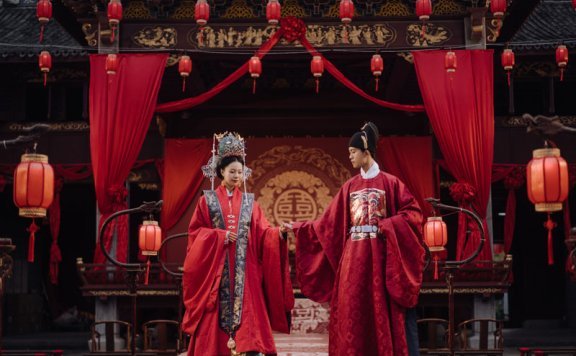
How to Prepare a Chinese Hanfu Wedding (Ming-style)?
In the New Year when everything is reviving. There is nothing better than a wedding banquet to bring people joy. It is undoubtedly the dream of many Hanfu lovers to hold a Hanfu wedding. In a traditional Hanfu wedding, the vintage costumes and rituals, the dreamlike wedding scenes, the unchanging love, and vows, are revisited again and again in the traditional ceremony, becoming more profound and ritualistic. The blogger "Jingzhishisui (静知时岁)" spent two years preparing a Ming-style wedding for herself, from etiquette, clothing, to the process, are very attentive, rich in detail and full of ritual are breathtaking, let's take a look. 01 Costumes for Chinese Hanfu Wedding Thousands of years ago, the old ancestors gave us the main color of the Chinese wedding scene - red. In order to better prepare for this Chinese Hanfu wedding, the first thing that "Jingzhishisui" did was to choose and match the wedding costumes, the main wedding costume was a Mangpao (蟒袍) and a Dashan Xiapei (大衫霞帔) , while the groom's main wedding costume was a Douniu round neck robe (斗牛圆领袍). The headdress is also very elaborate, the bride's headdress is "Sanlongliangfengguan (three dragons and two phoenix crown)", using traditional techniques, the style… -

Women’s Clothing Changes During the Ming and Qing Dynasties
This article focuses on the changes in the popularity of traditional Chinese women's clothing from the Ming and Qing dynasties to the early Republic of China. The early Ming dress continues the style of the Yuan dynasty Duanyi (短衣, short clothes), inherited the style of dressing with Duijin (对襟, symmetrical lapels) worn as Jiaojin (交襟, cross lapels) in Song and Yuan Dynasty At this time, also called Dui Jiao Chuan (对交穿). There is also a Jiaoling Youren (交领右衽, wrapping the right side before the left) style. In the mid-Ming period, the sleeve type and skirt door gradually widened, and there was a Tao sleeve (裪袖, sleeve edge protruding from the cuff) structure. According to cultural relics, the stand collar Duijin Shan appeared in the palace system during this period, and was fixed with metal sub-buttons. The style of Dui Jiao Chuan (对交穿) was also excavated in this period, and the more special one is the Mamian skirt with narrow sleeves and thin pleats. Regarding the style of the Mamian skirt, according to the research of excavated cultural relics, the structure of [trapezoidal pleat] and [wide sleeve door] was popular in the mid-Ming period, so there are often drawings showing the outline… -
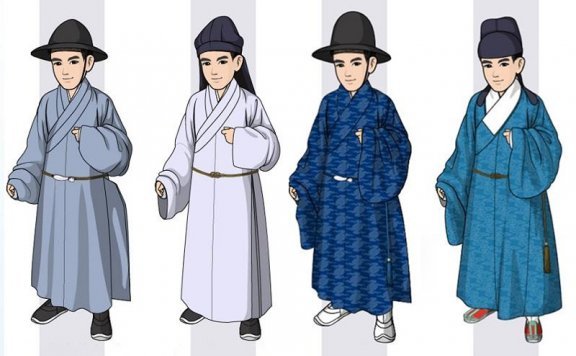
Men’s Clothing Changes During the Ming and Qing Dynasties
This article focuses on the changes in the popularity of traditional Chinese men's clothing from the Ming and Qing dynasties to the early Republic of China. The early Ming dynasty clothing continued the style of the Yuan dynasty, men's clothing in addition to Zhishen (直身), but also have Changshan (长衫) style. At this time the Daopao (道袍) has not yet formed, because the Changshan pleated structure on both sides, inferred that may be the Daopao predecessor. The prototype of the Yisan (曳撒) came from the Yuan Dynasty, and the sleeve shape and silhouette gradually changed in the Ming Dynasty, and developed an outer hem structure, which was one of the common styles of Bianfu (便服)/army clothing or Jifu (吉服) in the Ming Dynasty. The more significant change in the mid-Ming men's clothing is the gradual widening of the sleeve type, the structure of the outer hem is also different from the initial period. Late Ming dynasty men's clothing popular with the Daopao, the initial sleeve type for the bias to straight sleeves, with the structure of the Shoumei (收袂). At the end of the Ming Dynasty, the robe has developed into wide sleeves, and the structure of the inner and… -
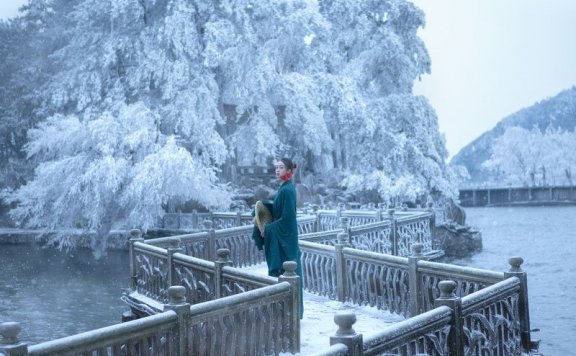
Why Ming Dynasty Hanfu Appropriate for Winter Wear?
Today there is an almost universally accepted saying among Hanfu enthusiasts that the Ming dynasty Hanfu is suitable for autumn and winter and the Tang dynasty Hanfu for summer. The Song style is best for modern times and can be worn in every season. But why is this? Could it be, simply because historically the Tang dynasty was hotter, the Ming dynasty colder, and the Song dynasty closer to the present? Follow along with Dongfang Zhuangdao to find out more! In fact, in the light of current phenological studies, this statement does correspond to historical climate trends. Mr. Zhu Kezhen (竺可桢先生), the founder of modern Chinese geography and meteorology, and a leading figure in the field of phenology, has studied the main trends of climate change in China over the last 5,000 years, using the 20th-century climate as a benchmark for comparison, and concludes: in ancient China, there were four warm periods, the Yangshao periods (仰韶时期, 5000 BC to 3000 BC), Yinxu periods (殷墟时期), the Spring and Autumn & Warring State periods, the Sui and Tang periods, and four cold periods, the late Shang and early Western Zhou periods, the late Northern Song and early Southern Song periods, and the… -
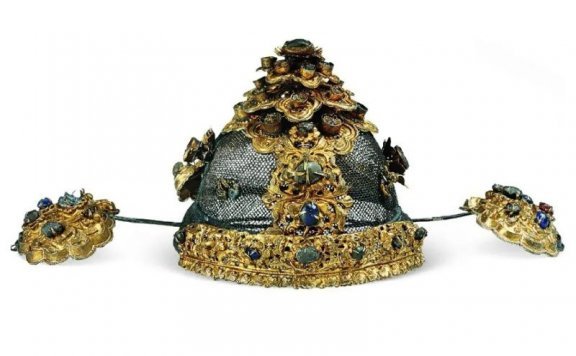
Traditional Chinese Hair Jewelry - Ming Style Diji & Tiaopai
Diji and Tiaopai are two magnificent pieces of traditional Chinese hair jewelry, often paired with Ming-style Hanfu. The Ming dynasty was one of the most commercialized periods in ancient Chinese history, particularly in the Jiangnan region. From the point of view of hair jewelry, the most significant change shown in gold and silver jewelry during the Ming dynasty, compared to the Song and Yuan dynasties, was an increase in the number of types and styles, and a more detailed distinction in names. Various types of traditional Chinese hair jewelry, have different names, depending on where they are worn, or on their decoration, style, and even their length. Today we will focus on the Diji and Tiaopai. Diji (䯼髻, dí jì) [History and structure] Diji is a new type of wig bun that appeared in the Ming Dynasty, generally made of gold and silver wire or horsehair, and hair, covered with soap-colored yarn and worn over the top bun. The appearance of the Diji was influenced on the one hand by the wearing of Guan by women from the Northern Song Dynasty onwards, and on the other by the popularity of the 'Baoji (包髻)' hairstyle during the Jin and Yuan Dynasties.… -
Chinese Traditional Costume - Ming Style Daofu for Male
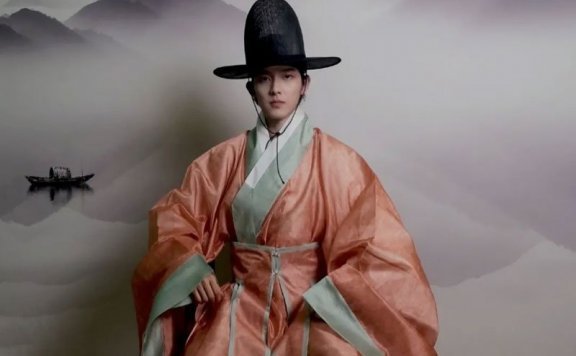
Previously we have discussed the Ming Dynasty men's clothing: Zhiduo (直裰), Zhishen (直身), and Taoist robe (道袍). And today we are going to discuss the Daofu. Daofu (道服, Dào fú) has two meanings in Chinese: refers to Taoist clothing, the robes worn outside by Taoists; one of the Chinese traditional costume Hanfu styles: Ming Dynasty costume for males. Obviously, they are different kinds of clothes, today, let's learn about the traditional sense of "Daofu" through the Hanfu Culture Society! [Structure and History] Daofu, Jiaoling Youren (交领右衽, wrapping the right side before the left), wide sleeves, with dark edging at the collar edge, sleeve edge, and placket, sometimes with a Huling (护领, collar protector) in collar edge. Daofu: Jiaoling Youren (交领右衽, wrapping the right side before the left); wide sleeves; with dark edging at the collar edge, sleeve edge, and placket; sometimes with a Huling (护领, collar protector) in collar edge; the slit is embellished with an inner hem; both inner and outer have the strap; In simple terms, it can be seen as a "Taoist robe" with edges added. In fact, the similarity between Daofu and Shenyi can be seen through its appearance, it is a style inherited from… -
Hanfu Festival - The 8th Xitang Hanfu Culture Week is Coming
The eighth Xitang Hanfu Culture Week this year demands the origin of the word "Hanfu" and its connotation of the same lineage. Promoting the significance of Hanfu clothing is consistent with our consistent beginnings. Hanfu is more than just a piece of clothing, so we need to delve into the realm of traditional culture and combine it with contemporary expression and content. Introducing dynastic carnivals, Hanfu runway shows, weddings, coming of age ceremony, and more. Integrating the thinking of etiquette and aesthetics, advocating the rule, integrity, balance, and harmony of the Han clothing culture. Traditional renewal, innovative Chinese style. Xitang Hanfu Culture Week is willing to spread Hanfu culture with positive energy and experience the ritual of life in the culture with you. https://youtu.be/iGvJ6JJWUQQ Event Time: 2020 the Eighth Chinese National Costume Exhibition & Xitang Hanfu Culture Week: October 31 to November 3, as scheduled How to Register: Registration for all events of Xitang Hanfu Culture Week will be opened soon, so stay tuned! Appreciation of Previous Activities: -
Details of Zhishen - Ming Style Hanfu Outerwear
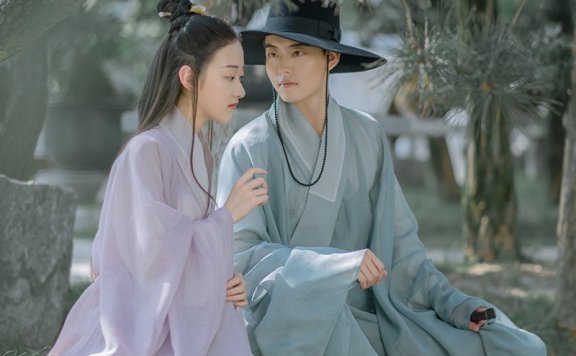
More than a decade ago, when the Hanfu movement was just gaining momentum, the more popular style of Hanfu outerwear was Shuhe (短褐). To this day, Hanfu has entered a shift to sophisticated and fashionable, and all we consider is what kind of shape is sophisticated, how to wear good-looking, and how to realize the two at the same time. As daily casual outerwear, it was clear that Duanhe could no longer meet this demand. In contrast, Zhiduo, Zhishen, round neck gown, and other forms will be more advantageous, today bring you the introduction of style is the Ming style Hanfu outerwear: Zhishen. [The structure and history of Zhishen] Zhishen, also known as Changyi (长衣), Haiqing (海青). Its structural features are very similar to "Taoist robes (道袍)". Ming Dynasty Liu Ruoyu "Zhuozhongzhi (酌中志)" records: "Zhishen, the system is the same as the Taoist robe, but hem swing in outside." Zhishen has several key features: The collar shape is Jiaoling Youren (交领右衽), also called "straight collar" because the collar style is slanting straight; Generally, one pair of laces is attached to the inner lapel and two pairs of laces are attached to the outer lapel to secure the lapel; Large sleeves; Slits… -

Daopao - Ming Style Hanfu Taoist Robe
What is the image that comes to your mind when you think of a Taoist robe? Is that a priest's robe? Or a Japanese cardigan? When we talk about traditional Chinese Hanfu, Taoist robes are usually referred to as one of the men's traditional Chinese costumes, also popular among the Ming Dynasty scholar's costumes. If there is any style of men's Hanfu that can be versatile, the robe must be the obvious choice. As you can see from its appearance, it is a very stylish Chinese man costume. Different styles of Taoist robes are suitable for people of all ages and temperaments, and Taoist robes with different clothing accessories will bring a completely different visual experience, which can be said to be the essential clothing for boys who are new to Hanfu. We'll start with a few photos to get a visual of the contemporary traditional Taoist robe. So let's learn more about the Daopao together! [Structure and History of the Taoist Robe] Taoist robe, once popular in the mid to late Ming Dynasty, developed from an earlier garment called "Zhe (褶)"; The collar shape is Jiaoling Youren (交领右衽), most collars will have an extra Huling (护领) sewn into them;… -
4 Chinese Traditional Performing Arts You Need to Know
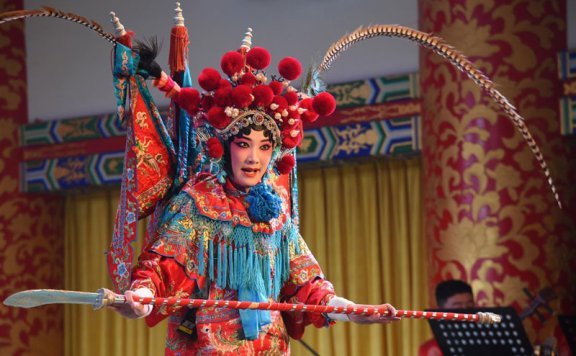
China is an ancient multinational country, with a long history and brilliant culture. For thousands of years, many abundant forms of traditional performing arts have been formed under the wisdom and industriousness of workers. Each art form has various styles and schools, including opera, puppetry, Chinese shadow, acrobatics, and quyi. Chinese traditional performing arts are important representatives of the national spirit, showing the quintessence of ancient culture, and some of them are registered in the list of Intangible Cultural Heritage of Humanity. Opera China's opera, enjoyed incomparable fame, is known as one of the world's three ancient dramatic cultures, the others being Greece's tragicomedy and India's brahman drama. It is an art form of long history, originating from primitive song and dance. With steady development, it has become a complete system in the Song and Jin dynasties. It is composed of literature, music, dance, fine arts, wushu, and acrobatics, nearly 360 kinds. As it evolves and innovates in the long run, the five most distinguished types of operas appear: Beijing opera, Yue opera, Huang Mei opera, Pingju opera, and Yu opera. History of opera In primitive society, original singing and dancing arise in the tribes. In fact, the ancient tradition… -
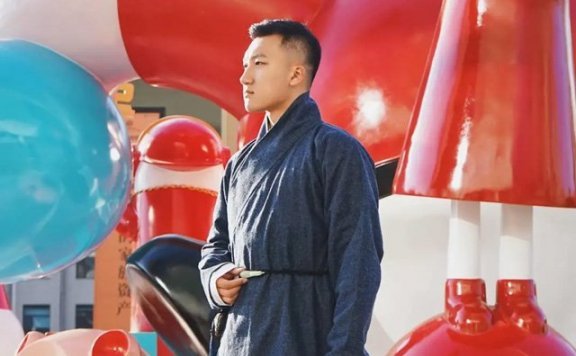
Details of Zhiduo - Ming Style Hanfu Jacket
If you like Hanfu, you may have seen all kinds of Hanfu jacket, But maybe you can't tell the difference between Zhiduo (直裰), Daopao (道袍), and Zhishen (直身), because they all look almost the same from the outside, but in fact, there are a lot of differences in the details, so let's get to know the "Zhiduo" today! [Structure and History of the Hanfu Jacket: Zhiduo] Zhiduo (直裰, also be called 直掇), has several key features: The collar shape is Jiaoling Youren (交领右衽, mean: crossed collars, tying to the right), Can be sewn a Huling (护领, sewn-on the collar area, mostly white and varying in width, to protect the collar from wear and tear and stains. In ancient times, the Huling was easy to dismantle and often replaced. Most of the Huling in contemporary Hanfu costume is preserved as a traditional feature.) on the collar. The making method of Zhiduo: Tongcai (通裁, cut in one piece, no seams on top and bottom). Usually narrow sleeves, but also straight or pipa sleeves. It is knee-length, and the length of the garment and the width of the sleeves vary according to the wearer's needs. The body of the garment is slit… -
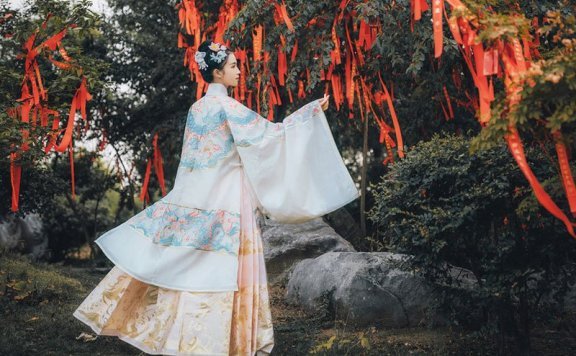
How to Wear Hanfu (9) – Ming Dynasty Ma Mian Skirt
This article introduces a typical outfit from the late Ming Dynasty, which is around the 16th to 17th century for you. Let's see how to wear Hanfu - the long shirt and Ma Mian skirt suit. The top is a long shirt with a standing collar also known as a Mandarin collar, pairing it with a Ma Mian skirt which translates to horse face skirt, it’s the single most representative skirt of the Ming Dynasty. The History of Ma Mian Skirt & the Meaning Behind the Name Ma Mian Qun literarily means Horse Face Skirt, but it actually has nothing to do with a horse’s face, the term 'Ma Mian' in ancient China has another meaning, it refers to the defensive structure that projects outward on city walls, which are located at regular intervals. A Ming Dynasty scholar labelled the rectangular area of the skirt Ma Mian because it looks like the structure. And today we call this type of skirt Ma Mian skirt. Characteristic of Ma Mian Skirt? When the skirt is laid flat, we can see three such structures, we call it Qun Men (裙门) or skirt door today, with another door hiding behind in the… -

How to Wear Hanfu (8) – Ming Dynasty Sheer Fabric Shirt
Today's article introduces a Ming Dynasty style Hanfu suitable for summer, it is a sheer fabric parallel opening Hanfu shirt with a standing collar. Now let’s take a look at the history of this outfit and how to wear it. History of Sheer Fabric Shirt In ancient China, it was quite common for men to be bare-chested during the summer, but of course, this was not the case for ladies, so they would wear fewer layers and sheer fabrics inside of their homes. You might have seen this particular style of Hanfu been called many different names in Chinese, so let’s first quickly go through these names and their origins. The standing collar was a popular element in women’s fashion during the late Ming Dynasty, so according to the naming conventions of the Ming Dynasty, this style can be described as "竖领对襟纱衫", which translates into sheer fabric parallel opening shirt with standing collar. Ladies commonly wore this inside of their homes or in private areas as it is sheer and informal. During the Qing Dynasty, this style was labeled as Pi Feng (披風), which is a type of outerwear, the materials used became thicker and heavier, making them more… -
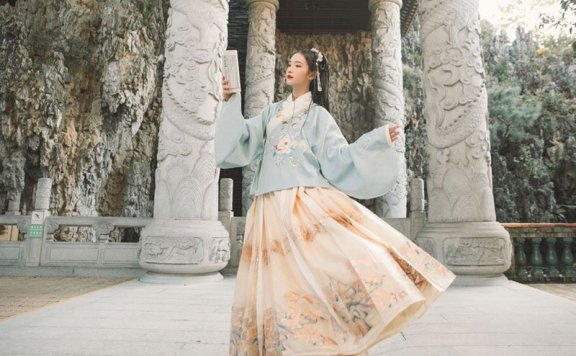
How to Wear Hanfu (7): Ming Dynasty Jiaoling Aoqun
Aoqun(袄裙), most commonly wore during the Ming Dynasty. Let’s take a look at the individual pieces and how to wear them. The History of Aoqun The word Aoqun translates into a lined top and skirt, it is one of the earliest and most basic forms of Hanfu. This style was developed as early as The Warring States period (475 BC) as seen on these clay figurines, and it evolved throughout the dynasties. By the mid to late Ming Dynasty, it had become the most commonly-seen design for fall-winter clothing among wealthy families and the royal court. There are also many historical relics available for us to study. Wear the Skirt of Aoqun Aoqun is outerwear, so people usually wear inner garments made of cotton or linen material underneath. During the Ming Dynasty, women usually wear Mamian skirts or pleated skirts, this one is a one-piece half-pleated skirt with the pleats only on top, and embroideries on the bottom, as well as on the belts. There are usually two types of one-piece skirts, one style you insert the belt through a hole in the middle, the other style uses an extra set of ties. This skirt doesn’t have either… -
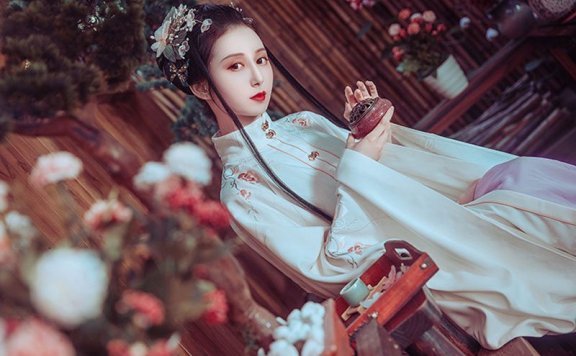
How to Wear Hanfu (6): Ming Style Standing Collar Jacket
As winter approaches, more and more Hanfu enthusiasts are focusing their attention on the Ming style Hanfu. Whereas in the Ming style Hanfu costume, the combination of an Ao (袄, jacket) on top and a Qun (裙, skirt) on the bottom is especially popular. Ao has several types of collars, and today we are focusing on the standing collar today, briefly introduce the history and how to wear it. History of the standing collar Some of you might recognize the standing collar as the mandarin collar, most people think the standing collar is derived from Qing Dynasty Manchurian dress, also known as the cheongsam or qipao, but it is actually originally invented and passed down from the Ming Dynasty, the dynasty before the Qing Dynasty, it is a part of the hanfu system and was later on adapted into Manchurian dresses, and today it’s widely known in the world as the mandarin collar, and recognized as one of the most distinctive features of Chinese clothing. Do you remember this Ming Dynasty painting? Almost every woman and child are wearing the cross collared Aoqun, showing how popular this style was at that time. However, when we look more closely at…