-

The Crown Controversy in The Road to Splendor
In a recently released still from the historical drama The Road to Splendor (花开锦绣), young actress Deng Enxi (邓恩熙) appears in full bridal regalia. Atop her head sits a gilded ceremonial crown, its base inlaid with kingfisher feathers, decorated with intertwining dragon and phoenix motifs, and flanked by cascading pearl tassels. This striking image has sparked a spirited debate among costume drama enthusiasts: is that a legitimate Phoenix Crown, or is it the lesser-known Flycatcher Crown? The distinction matters because, in the rigid social hierarchy of the Ming dynasty, wearing the wrong hat was not a fashion faux pas—it was a potential political crime. Royal Rules The Phoenix Crown was the ultimate status symbol for the empire's top-tier women. It was not an accessory one could simply purchase or borrow. Strictly reserved for the empress dowager, the empress, and the crown prince's consort, it could only be worn during the grandest state occasions: enthronements, imperial audiences, and the emperor's own weddings. Its construction was a marvel of meticulous craftsmanship. The framework was woven from lacquered bamboo silk, over which a base of kingfisher feather inlay was applied. Gold-crafted dragon and phoenix components were then soldered on, followed by the setting…- 0
- 0
- 19
-
Why Do Chinese Movie Zombies All Dress Like Qing Dynasty Officials?
Every year during the Hungry Ghost Festival, a particular image haunts Chinese screens and memories: a stiff, hopping figure in a dark blue official robe, arms stretched straight forward, wearing a peaked hat with a red tassel. This is the Jiangshi (僵尸), China’s most recognizable cinematic monster. But have you ever wondered why these creatures, unlike their Western vampire cousins in capes, are almost always clad in the formal attire of Qing Dynasty bureaucrats? The answer weaves through ancient mythology, political satire, and the practical economics of filmmaking, revealing that the zombie's outfit is far more than a costume choice—it is a historical statement. The Ancient Origins of a Hopping Monster The concept of a reanimated corpse didn't start with the Qing. Its earliest ancestor can be found in the Classic of Mountains and Seas (山海经), where it is called Hanba (旱魃), a drought demon. According to legend, the Yellow Emperor summoned his daughter, Hanba, to defeat the storm god Chiyou (蚩尤). Her power dried up the rains, securing victory, but she was then banished from heaven. Wherever she dwelled, the land turned to dust. Here, the creature wasn't a mindless seeker of blood, but a cursed being of elemental…- 0
- 0
- 28
-
How Textbooks Reshaped the Qixi Festival Legend
Qixi Festival (七夕) arrives every summer, yet millions of children open their Chinese textbooks and read a story that is neither historically accurate nor culturally innocent. Parents across the country are now speaking out, not against romance, but against a distorted tale that has quietly replaced a far richer tradition. The familiar plot – a poor cowherd steals a fairy’s robe and forces her to stay – does not come from ancient stargazers or classical poetry. It is a much later patchwork, stitched into school readers only a few decades ago. The real Qixi, however, has nothing to do with forced marriage or tearful reunions. It was never meant to be Valentine’s Day in any traditional sense. Instead, it celebrated skill, friendship, and quiet ambition among young women. By confusing myth with morality, and commerce with culture, modern textbooks have not only misled generations but also erased a festival that once empowered girls rather than sold them flowers. Before we buy another heart-shaped box, it is time to ask: should we not return Qixi to the women who owned it for over a thousand years? A Girls’ Day Lost in Translation If we travel back to the Eastern Jin Dynasty,…- 0
- 0
- 51
-
Why Qixi Was a Festival for Women Only
Every year on the seventh day of the seventh lunar month, a flurry of pink marketing campaigns and romantic clichés floods the internet, urging couples to celebrate "Chinese Valentine's Day." But this modern interpretation misses the point entirely. The actual historical and spiritual essence of Qixi (七夕) has nothing to do with candlelit dinners or romantic getaways. In fact, it is a day that strictly forbids romantic indulgence. Instead, this ancient festival belongs exclusively to women—a day for them to celebrate their skills, sharpen their minds, and channel their inner power. It is a day for the "Sisters of the Galaxy" to reclaim their narrative. The Wrong Date for Romance The confusion surrounding Qixi stems from a fundamental misunderstanding of traditional Chinese cosmology. The seventh lunar month is traditionally considered the "Ghost Month," a time when the spiritual world is closest to ours. To designate the seventh day of this month as a day for passionate love would be energetically incongruent. Historical texts explicitly warn against such behavior. Records from ancient medical and folkloric books, such as Jiexu Tongfeng Lu (节序同风录), clearly state that this day is for moral cultivation and abstaining from physical desires. To engage in intimacy on… -
What Happened to the Real Qixi Festival?
Forget the flowers and chocolates. The modern commercial spectacle of Qixi (七夕) as a Chinese Valentine's Day barely scratches the surface of its true story. This festival, which falls on the seventh day of the seventh lunar month, is a tapestry woven from ancient astronomy, a myth of star-crossed lovers, and a vibrant celebration of female skill. It was never just about romance. It was a night when the most brilliant star in the summer sky became a symbol of hope and dexterity for women across the land, connecting the divine with the daily toil of the loom. Before it was a day for couples, it was a night for young women to prove their worth under the watchful gaze of a goddess. The Lovers in the Stars The magic of Qixi begins not on earth, but in the heavens. Its origin is rooted in the observation of two specific stars: Altair and Vega. In Chinese mythology, they are the cowherd and the weaver girl, lovers separated by the Milky Way, a celestial river that the gods placed between them. Their union is permitted only once a year, on the seventh night of the seventh month, when a bridge of… -
Were Scent‑Producing Body Pills Real in Old China
Forget synthetic sprays. Long before Parisian perfumers bottled their first concoctions, ancient Chinese elites were already mastering the art of personal fragrance—not as a luxury, but as a language of power, ritual, and identity. From jade-adorned sachets to ingestible pills that made one's very sweat smell of orchids, the quest for a "natural" body scent was anything but natural. It was a meticulous craft, a political statement, and a daily discipline. So, what exactly was in those fragrant pouches, and why did emperors care more about a minister's breath than his policies? The answers lie in a history that spans millennia, where aroma wasn't just about smelling pleasant—it was about being fully human in a civilized world. Ritual Beginnings The earliest evidence of fragrance use in China dates to the Neolithic era, where shamans burned aromatic woods to send prayers skyward through curling smoke. But it was the Zhou dynasty's rigid etiquette that codified scent into daily life. According to the Book of Rites (礼记), young men and women undergoing coming-of-age ceremonies had to rise at cockcrow, wash their faces, rinse their mouths, comb their hair, and finally—fasten a scented pouch called a "rong chou" (容臭, literally "container of smell")… -
Viral Tang Restroom Signs Win National Praise
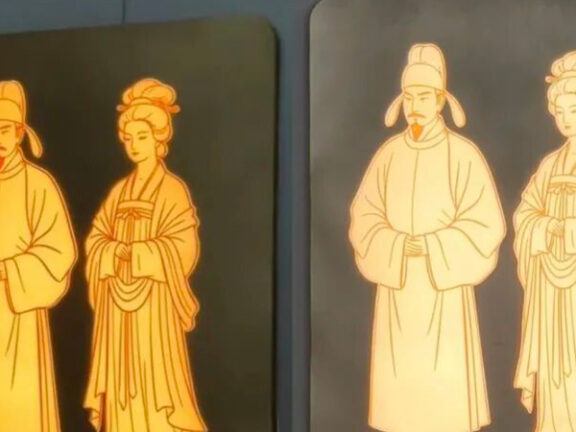
Ancient fashion meets modern infrastructure, and the internet can’t stop talking. At Xi'an East Railway Station, restroom signs no longer rely on the usual stick figures in pants or skirts. Instead, a mustachioed man in a round-collar robe and a Futou (幞头, black gauze cap) points one way, while a woman with an elaborate coiled hairdo in a chest-high Shanqun (衫裙, shirt-skirt) gestures the other. The design has gone viral, earning a nod from the state-run Renmin Daily. For many, it is more than a quirky civic upgrade—it is a vivid, everyday manifestation of cultural confidence. Yet as the trend spreads from train stations to museums and even storefront restrooms, it raises an interesting question: can a symbol from the Tang dynasty (618–907) reliably guide a modern traveler to the correct door, or does creativity sometimes come at the cost of clarity? Tang Dynasty Posters Xi'an has essentially turned its public facilities into a miniature Tang dynasty fashion gallery. The viral signs at the railway station draw directly from historical murals and figurines. The male figure, sporting a Futou and a practical round-collar robe, and his female counterpart, wearing a layered skirt with a long draped shawl, are not generic… -
Stolen Heritage on the Red Carpet
Was an Ancient Persian Artifact Really Turned into Red Carpet Jewelry? That is exactly what happened when Zendaya (赞达亚) wore a pair of earrings featuring 3,000-year-old gold discs to promote her film The Odyssey (奥德赛). The outcry from archaeologists and netizens was immediate and fierce. While blending historical aesthetics with modern style is a popular trend, using a looted artifact as a fashion accessory crosses a clear line. The discs were not legally acquired museum pieces; they were part of an illegal excavation, smuggled out of their country of origin, and then purchased by a jeweler who drilled holes into them to create earrings. This incident has ignited a crucial debate about the line between cultural appreciation and the destruction of our shared human heritage. The Red Carpet Heist The controversy centers on the provenance and treatment of the artifact. The gold discs were originally part of a larger ancient Persian object. They are not simply old; they are a primary source of historical data. Their value lies in their context, their craftsmanship, and the story they tell about a civilization that thrived millennia ago. By drilling into them to set them in a modern piece of jewelry, the jeweler… -
Dakar Welcomes Shandong Museum Ming Costume Exhibition
For audiences in Dakar, the robe on the mannequin is not only a garment — it is a set of rules in silk. Shandong Museum opened "Confucius' Hometown, Hospitable Shandong: Exhibition of Ancient Chinese Costume Culture" at the Museum of Black Civilizations on July 29, 2026, the first exhibition the Chinese museum has staged in an African national museum. It runs for three weeks in Dakar before touring Senegal. Chinese diplomatic and provincial bodies backed the project: the Chinese Embassy in Senegal, the Shandong Provincial Foreign Affairs Office and the Shandong Provincial Department of Culture and Tourism. Senegal's Minister of Culture, Crafts and Tourism Alpha Tiam (阿尔法·蒂亚姆), Chinese Ambassador Li Zhigang (李志刚), Museum of Black Civilizations Director Abdou Diatta (阿卜杜·迪亚塔) and Shandong Museum Director Liu Yanchang (刘延常) spoke at the opening before more than 100 guests — foreign ministry and Dakar city officials, the parliamentary friendship group, the alumni association of Senegalese students in China, resident diplomats, reporters from Le Soleil and Xinhua, and members of the local Chinese community. Ten Replicas, Twenty Panels, Three Themes Twenty illustrated panels and ten replicas of Ming-dynasty costumes make up the display. Three sections — the thought behind Chinese dress culture, Ming dress…- 0
- 0
- 23
-
Tianjin's Laomeihua Rolls Out a 115th-Anniversary Craft Line
Laomeihua (老美华), the Tianjin clothing house founded in 1911, marked its 115th anniversary on August 9 with an ancestor ceremony in the morning and a three-way product launch at the Tianjin Museum in the afternoon. The event paired the museum's collection with the brand's own crafts, releasing a collaboration series that spans men's connected-sleeve jackets, Tianjin-style qipao, handmade Pankou (盘扣) buttons and silk-scarf paintings. China National Radio's Tianjin bureau reported the launch on August 11, listing the partners as Laomeihua, the Tianjin Museum and Jinyun New Media, which operates the Haihe MCN network. Morning ceremonies stayed restrained by old-brand standards: staff stood in line to bow, the board chairman read the memorial text, senior managers offered tea in turn, and everyone paid respects to the founders. Laomeihua was created by Pang Henian (庞鹤年), a Tianjin native, in 1911. Four of its shoemaking techniques, camel-saddle shoes, pointed-toe shoes, embroidered shoes and the Hangyuan type (杭元鞋), are on the national intangible-heritage list, while its Tianjin-style qipao and men's connected-sleeve jackets are recognized at the municipal level. Four Product Lines Drawn From Museum Relics The afternoon launch, titled "Ancient Charm Reborn, Tianjin Crafts Passed On," built four product lines around the museum's holdings:…- 0
- 0
- 19
-
Liyi Huaxia Hanfu Model Contest Debuts in London
The 2026 London Hanfu Day, featuring the Liyi Huaxia (礼衣华夏) Hanfu Model Contest in its UK London regional round, took place on June 14 at the Indra Gallery in London. It was the first time the competition had been staged outside China, and the London round drew 28 contestants of Chinese and other nationalities — the oldest entrant 75 years old — a vivid demonstration of Hanfu culture's reach across age groups and borders. First Overseas Round for a Major Domestic Hanfu Event Liyi Huaxia had already held eight editions in China before this year's London debut, which anchored the 2026 London Hanfu Day program. The London round ran under the Sohu Video "focus stream" platform, which has carried the contest since its founding. Founded in 2019, the competition bills itself as China's first large-scale professional Hanfu model contest and a pioneering effort to bring traditional Hanfu onto professional runways. Its footprint now covers 28 provinces and more than 70 cities, with over 100 events staged nationwide each year; more than ten thousand enthusiasts of Chinese traditional style have entered over the years, and related topics have drawn over 100 million views online. Past editions have been staged at landmarks…- 0
- 0
- 32
-
Qixi 2026 Group Weddings: Luoyang and Yulin Lead
With the Qixi Festival (七夕), the seventh day of the seventh lunar month — August 19, 2026 on the Gregorian calendar — approaching, cities across China are rolling out group wedding recruitment almost in concert: a Han-style national wedding pageant in Luoyang, Zhangjiakou's "New Customs, Good Fate, Love Set in Rivers and Mountains," Xinyu's Fairy Lake "Love Set at Fairy Lake, Happiness Sets Sail Anew," and Yulin's "Civilized New Weddings, Happiness Awaits You." The combination of Chinese wedding rites, Hanfu styling, and destination wedding tourism is shaping up as the most concentrated cultural-consumption focus of this Qixi. Luoyang: A Han-Style National Wedding, Aug 18-19, Across Five Landmarks On August 19, Luoyang will hold a Han-style national wedding pageant, with events running August 18-19 and the wedding itself on the 19th. The ceremony spans five landmark sites: Luopu Park, a love-themed park ringed by water and greenery where couples complete the Han-style ritual sequence — tying their hair together, drinking the nuptial cup, and performing the hejin, xieying, and facing-bows rites (合卺礼、解缨礼、对拜礼) as they pledge a century together; the Hall of Heaven, Empress Wu Zetian's personal Buddhist shrine; the Hall of Brightness, where Wu conducted affairs of state and communed with…- 0
- 0
- 28
-
Grand Canal Collective Wedding Aug 19: Hangzhou Recruits 15 Couples
As the Qixi Festival approaches, the Banshan Subdistrict of Gongshu District, Hangzhou, is preparing a romance blending ancient and modern — the "Love on Qixi, Hearts Set at Wangchen" (爱在七夕·情定望宸) 11th Grand Canal Collective Wedding and Qiaoshan Qiqiao folk event, set to open on August 19 at the Hanggang Park on the Grand Canal and the Banshan National Forest Park. From now until the deadline, the organizers are recruiting newlywed couples citywide and "steel anniversary" couples married for 11 years nationwide to join the celebration as "sweet partners," with a surprise gift package for every selected participant. Gongshu District, recognized as an effective unit of Zhejiang Province's second batch of marriage-custom reform pilot zones, has spent years cultivating the Grand Canal wedding brand along the Canal cultural belt. In 2026, the 11th edition moves to Banshan and for the first time adopts a dual-park model combining the Hanggang Park on the Grand Canal with the Banshan National Forest Park, while upgrading its "Sweet Map" to version 3.0. Banshan's endowment is a "one mountain, one water" landscape: the legendary tenderness of King Qian Liu of Wuyue — "When the flowers bloom on the roadside, you may take your time returning home"…- 0
- 0
- 26
-
LV Sues Molly Tea Over Floral Trademark
LV (Louis Vuitton) finally broke its silence on July 28, 2026. During the group's first-half earnings call, CFO Cécile Cabanis addressed the high-profile trademark lawsuit against the tea beverage chain Molly Tea — and her words did more than confirm the billion-yuan claim. They lit a fire under a question that has burned across Chinese social media: “If a pattern comes from ancient murals and temple windows, how can one brand own it forever?” The case, now on appeal in Suzhou, pits a century-old luxury monogram against a floral logo that millions of consumers see every day. But beneath the money and the memes lies a sharper dilemma: where does legitimate protection end, and where does cultural monopoly begin? The Lawsuit On June 29, 2026, the Suzhou Intermediate Court ordered Molly Tea to pay 10.3 million yuan ($1.4 million) for using a four-petal flower graphic on its storefronts, cup sleeves, packaging, and brand logo. The court found that design "highly similar" to seven registered four-flower marks that LV has held in China since 1986. The tea brand must also stop using the graphic immediately and publish public apologies across all platforms. Molly Tea's founder has appealed, so the ruling is… -
Why Did a Professor See Red Over a Comedy Film?
The latest sports comedy from director Stephen Chow has unexpectedly ignited a firestorm in South Korea. Following the release of Kung Fu Soccer (功夫女足), a prominent professor and a wave of netizens have expressed outrage, claiming the film deliberately insults their national women's football team. While some viewers are confused—seeing only a humorous underdog story—others believe Chow's signature satirical style is at play once again. At the heart of this debate lies a fundamental question about artistic freedom and national pride. This reaction reveals more about the sensitivity of cultural appropriation than it does about the film's actual content. The Allegation Professor Seo Kyung-duk from Sungshin Women's University launched a public attack on the movie. He argues that the film's villainous team, named the "Pear Blossom" squad, is a malicious caricature of South Korean athletes. According to him, the players are depicted as cheaters who use foul play, lack athletic discipline, and are more interested in makeup and colored contact lenses than the game itself. He insists that the use of broken Korean for comedic effect crosses a line from fiction into national defamation. His statements were quickly amplified by local media, leading to calls for censoring the film's overseas…- 0
- 2
- 27
-

Age-Old Chinese Motif Mistaken for Modern Brand Symbol
Why is a simple decorative pattern on a residential building in Xiamen causing such a stir? The debate erupted when online critics mistook an ancient Chinese architectural motif for a modern luxury brand's design. They saw a four-lobed flower and immediately thought of a famous French fashion house's monogram. But here is the twist: that pattern has been carved into Chinese stone and wood for over two thousand years. This is not a story of plagiarism or imitation. It is a story of how a culture's most enduring symbols become so deeply rooted in the visual language that they are mistaken for something new. The controversy forces a critical question: when does a universal geometric form belong to everyone, and when is it undeniably a piece of cultural DNA? The Qin-Han Roots The story of this iconic four-lobed pattern, known as the persimmon calyx motif, begins not in a Parisian atelier, but in the workshops of ancient China. During the Qin and Han dynasties, it was a standard feature on the eaves tiles of the most important buildings. It was the architectural signature of power, gracing the palaces and ceremonial halls of the empire. The symmetrical four lobes were not…- 1
- 3
- 104
-

Were Flip-Flops a High-Fashion Statement in Ancient China?
Before global luxury houses slapped retro labels on chunky sandals and woven slides, your ancestors had already perfected every silhouette—from jeweled court slippers to mountain-climbing clogs with detachable teeth. Yet period dramas rarely show them, and most fashion followers assume flip-flops are a modern import from tropical beaches or Japanese ryokans. The truth is far more dazzling: ancient Chinese footwear, collectively called Sa Xie (靸鞋) or simply worn "sà" (slip-on without heel-fastening), spanned 5000 years of continuous evolution. They weren't lazy-day afterthoughts; they were statement pieces, utilitarian marvels, and even dance props. One line from the classic novel Dream of the Red Chamber (红楼梦) casually mentions the hero “tying his robe and slipping on his sa shoes” while visiting a sick cousin—proof that these open-back designs were everyday staples in aristocratic chambers. So before you pay a premium for that "cutting-edge" gladiator sandal, consider this: the original blueprint has been under our feet all along, and it's time we reclaimed the narrative. Prehistoric Roots Archaeology shatters the myth of the modern flip-flop. The earliest surviving specimen—a pair of wooden clogs unearthed from the Liangzhu Culture (良渚文化) site—dates back nearly 5,000 years, making them the oldest known sandals on the planet.… -

Valentino Pig-Trotter Shoes Echo Foot Binding Trauma
The fashion world recently stumbled upon a peculiar sight: a high heel that looks like a cloven hoof. Valentino's latest design, a shoe with a long central seam and a single thin strap, forces the toes into two distinct, distorted halves. It was immediately dubbed the "pig trotter shoe" by netizens, who drew a shocked parallel to the historical practice of foot binding. The question isn't just about ugly design; it's about why a global brand would appropriate a symbol of deep historical trauma while completely missing its meaning. The internet's reaction was swift and brutal. Many pointed out the uncanny resemblance to the "Three-Inch Golden Lotus", the ideal of bound feet in feudal China. It isn't just a fashion faux pas; it's a cultural and historical insult. The brand seemed to cherry-pick a visually striking, albeit grotesque, aesthetic from Chinese history, ignoring the horrific human cost and the patriarchal oppression it represented. This incident serves as a masterclass in what happens when cultural borrowing goes wrong—it becomes a form of ignorance on display. The Reality of a Twisted History The first step to understanding this blunder is to separate myth from historical fact. The popular narrative often pins the…- 1
- 0
- 77
-
Louis Vuitton Sues CNIPA in Trademark Pattern Battle
When a global luxury titan takes the country's top trademark authority to court, the public often expects a David-versus-Goliath spectacle. Yet the upcoming hearing between Louis Vuitton and the China National Intellectual Property Administration (CNIPA, 国家知识产权局) scheduled for July 16, 2026, reveals a more routine—yet equally fascinating—legal reality. This is not a reckless brand rebellion but a calculated administrative appeal that could reshape how we view traditional patterns in modern commerce. The case, filed by Louis Vuitton Malletier against the CNIPA, with a Guangdong garment worker named Huang Minyao listed as the third party, seems to have emerged from a simmering debate over who truly owns the visual symbols of a culture. Can a Brand Really Sue the Government? At first glance, taking a state administrative body to court appears audacious, but in the realm of intellectual property, it is a standard procedure. Under Chinese administrative and trademark law, if a trademark owner disagrees with the CNIPA's decision—such as upholding a rival's trademark registration—they have a statutory right to seek judicial review. This is exactly what LV is doing: appealing to the Beijing Intellectual Property Court to overturn or modify the administration's previous ruling. It is a legal pathway, not… -
Can LV Trademark China’s Centuries-Old Motifs?
How did Louis Vuitton’s Monogram find its roots in ancient China? The controversy is not just about lawsuits over tote bags; it is about who owns the visual language of human civilization. When a French fashion house claims ownership over a four-petal flower, a checkerboard, or an interlocking circle, they are not just protecting a logo—they are stepping into a cultural heritage that predates their brand by over a thousand years. This isn't a story about counterfeits; it is a story about origins, appropriation, and the uncomfortable question of whether a global giant can trademark a universal idea. The Eastern DNA of Western Luxury The core of the dispute lies in the Louis Vuitton Monogram, designed by Georges Vuitton in 1896. The company's own archives admit the design was inspired by Japanese family crests, which were all the rage in 19th-century Europe. But tracing the lineage further back reveals a clear path: these crests were derivatives of the Tang Dynasty's Shidi pattern (柿蒂纹) and Baoxiang flower (宝相花), brought to Japan by envoys. The Shosoin Repository in Nara holds a five-stringed Pipa (琵琶) gifted by Emperor Xuanzong (玄宗) to Emperor Shomu, its body covered in a four-lobed floral motif that is…- 1
- 0
- 285
-
China-Europe Youth Camp Tries Hanfu, Tea, and Calligraphy
A group of young campers from the 2026 China-Europe Youth Camp recently visited the Confucius Classroom at Dongying Vocational College in Shandong province. The visit was part of a cultural immersion program that included tea ceremony, hanfu, guqin music, calligraphy, and Chinese painting — a compact introduction to several pillars of traditional Chinese culture. Hanfu as a Hands-On History Lesson Led by Confucius Classroom instructors, the students began with tea ceremony basics: warming the cup, adding tea leaves, pouring water, and serving tea. The exercise introduced the values of harmony, respect, purity, and stillness associated with tea culture. The hanfu session followed, with students trying on different styles of traditional dress while learning about the clothing systems behind them. The instructors explained the cultural logic behind major hanfu forms, including the upper-and-lower garment system, the deep robe, and the skirt-and-jacket ensemble. For many of the European students, this was the first time they had worn layered traditional clothing rather than simply seeing it on a stage or screen. The experience turned a piece of fabric into a lesson about ritual, aesthetics, and social hierarchy. Beyond Dress: Guqin, Calligraphy, and Painting The program also included a guqin class, where students plucked…- 0
- 0
- 21
-

2026 Beijing Fashion Week: ICH Embroidery in Liuli and Zhuzifu
The AW2026 Beijing Fashion Week, themed "A New Chapter Begins," concluded its seven-day main venue run on March 23, presenting over 120 fashion activities with new-product debut sessions up 75% year-on-year. Intangible Cultural Heritage (ICH) embroidery emerged as the season's defining highlight, as designers moved beyond surface-level cultural motifs to interrogate the roots and spirit behind traditional craft. Liuli and Zhuzifu: A Dual-Chapters Opening Statement The opening show was delivered by Shangze International with its two heritage brands, Liuli and Zhuzifu, under the theme "Splendid Attire, Dual Chapters." Eighty couture looks traced the deep lineage of Chinese sartorial ritual — Liuli drawing on traditional wedding culture, restructuring the "six rites of marriage" through contemporary design language, while Zhuzifu resurrected the dignity of ancient ceremonial dress in red and purple, recasting that regal gravitas for modern social occasions. One vermilion embroidered gown featured layered gold-thread cloud-and-thunder motifs that preserved the solemnity of imperial court dress while aligning with the clean geometry of modern fashion. The brand's design director stated: "We want Chinese sartorial culture to be seen and inherited by more people. Every stitch of embroidery is reverence for tradition; every design is an interpretation of contemporary aesthetics." ICH Embroidery Reimagined…- 0
- 0
- 11
-
Dalang Hosts 10th Textile ICH Conference With Knitwear
The 10th Textile Intangible Cultural Heritage Conference concluded on June 25 in Dalang (大朗), Dongguan (东莞), bringing together heritage artisans, industry leaders, and scholars under the theme "ICH Coexistence · Weaving the Future." Co-hosted by the China National Textile and Apparel Council (CNTAC) and the Dalang Town Government, the two-day event was designated a key activity of the 2026 Consumer Brands National Tour and set a new benchmark for weaving intangible heritage into modern knitwear manufacturing. Three Global Events Merge for the First Time This year's conference shared the stage with the 23rd China (Dalang) Knitwear Trade Fair and the 95th International Wool Textile Conference — the first time these three major industry gatherings have run concurrently. The twin themes "Smart Weaving the Future — Wool, Health and Digital Life" and "Weaving Aesthetics · Intelligence Leading Fashion" guided a programme of keynote speeches, expert forums, fashion showcases, and business matchmaking that drew more than 30,000 visitors and buyers from around the world. Dongguan's textile and garment sector is one of the city's deepest manufacturing roots. Dalang, recognised as the nation's first "China Wool Sweater Town," produces roughly 900 million sweaters annually — meaning one in every five sweaters sold globally…- 0
- 0
- 7
-
China Liaocheng Hanfu Wedding Festival 2026
On June 27 to 28, 2026, the 2026 "Twin River Pearl" China Liaocheng Hanfu Wedding Culture Festival was held in the city's Water City, an old town area built on canal networks. The two-day festival, organized by Liaocheng's cultural and tourism authorities in partnership with the wedding industry, distinguished itself from typical hanfu flash events by staging a careful restoration of the Three Books and Six Rites (san shu liu li), the classical Chinese marriage protocol. The phrase Three Books and Six Rites refers to a set of written agreements and ceremonial procedures that governed formal marriages through much of the imperial period. Liaocheng's restoration used professional reenactors, classical instrument ensembles, and water-procession choreography to make the protocol legible to a contemporary audience. A wedding sedan chair carried by water wound through blue-brick lanes and the Dongchang Lake shoreline, producing the much-noted "red bridal reflected on water city" tableau. Beyond the formal wedding, the festival ran a daytime hanfu garment parade and a non-ICH heritage procession through the old town, then transformed the same streets into a "guofeng secret realm" after dark, with ICH craft markets, hands-on workshops, and outdoor costumed performances. Festival organizers described the day-to-night structure as a…- 0
- 0
- 2
News









Scan to open current page
-
$CouponsLimitation of use:Expired and UnavailableLimitation of use:
before
Limitation of use:Permanently validCoupon ID:×Available for the following products: Available for the following products categories: Unrestricted use:Available for all products and product types