Xiangyunsha, the gambiered silk dyed in Lunjiao, a town in Shunde district of Foshan, Guangdong, reached the APEC summit table on November 19 as one half of a gift scarf. The 33rd APEC Economic Leaders’ Meeting opened in Shenzhen that morning, and the accessory laid over each leader’s shoulders carried two silks: a red version in Xiangyunsha and a blue one in Song brocade woven in Suzhou. The piece is named Tongxin Hejin, or Shared Brocade, and it packs four national-level intangible heritage techniques into one object, namely Song brocade weaving, Xiangyunsha dyeing, Su embroidery and Yue embroidery.
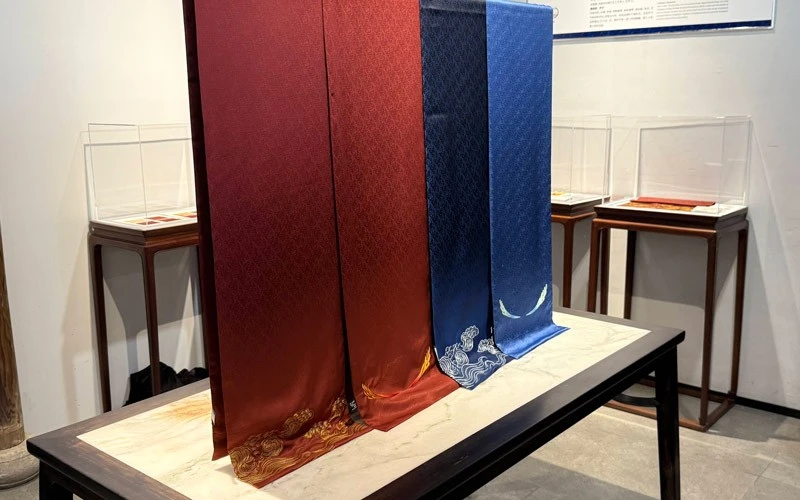
Labour split along a north-south line. Wu Jianhua, a Song brocade inheritor, directed the weaving in Suzhou. Huang Tiansheng, who has worked the dye yards for forty years, oversaw the Xiangyunsha. Ruan Xian’e of Shunde embroidered the cloud motifs in the Yue manner, with heavy close stitching and open layers, while Zou Yingzi handled the summit emblem in Su embroidery, fine and even at the edges. Twenty-one strands of wild silk went into the weave, one for each APEC economy.
Twenty-One Scarves Out of Five Thousand Metres
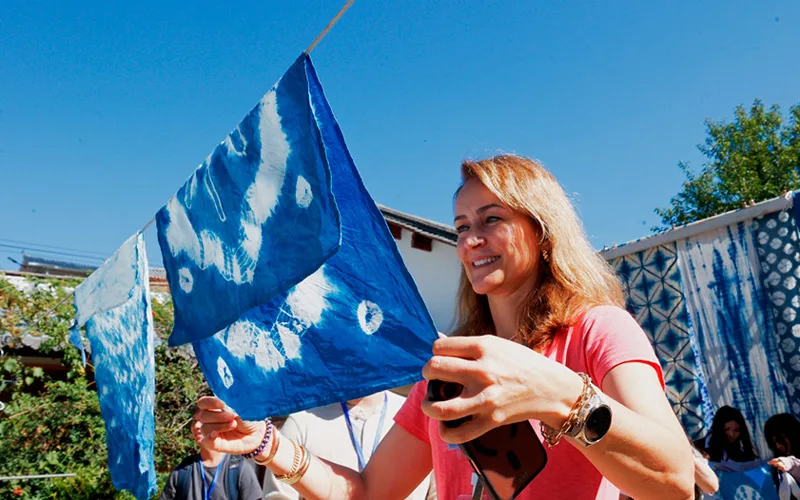
Xiangyunsha is known in older texts as Liangchou and Yunsha, and it has been made in Shunde for more than five hundred years. The technique was added to the national intangible heritage list in 2008. What makes it unusual is that the finish comes from sunlight, river mud and the juice of the shuliang yam rather than from a dye house. Silk is soaked in the yam juice, dried on grass, coated with iron-rich mud dredged from the Pearl River delta, then washed and dried again, and the sequence repeats.
Huang’s usual cycle is described as three soaks, nine boils and eighteen suns. This time it had to fit into forty-seven days. He ran more than two hundred trials, each one passing through preparation of the greige, soaking and sunning, the mud coat and washing, some thirty hand stages in all. The two-tone result, dark brown on one face and ochre on the other, comes from tannins in the yam juice reacting with iron in the mud. The process cannot be sped up. It can only wait for weather.
The gift numbers were tighter still. More than three hundred dye trials and over two hundred samples consumed some five thousand metres of fabric, and the final cut yielded twenty-one Xiangyunsha scarves and twenty-one Song brocade scarves, a selection rate near one per cent. Wu told Xin Kuai Bao it was the largest single project of his career. Zheng Yin, who leads the Guangxiu Zhuang craft team in Foshan, said the first sample used a double-sided embroidery that had to keep pattern and hand identical on both faces under a compressed schedule.
Demand moved as soon as the photographs did. Speaking on November 21, Wu said the calls arriving were either interviews or orders, for scarves, for derivative products and for raw fabric, and that buyers included overseas chambers of commerce routed to him through contacts. The scarf made the material visible. It did not, on its own, make it exportable.
Turning a Master’s Eye Into a Ruler
Lunjiao’s answer to that gap is written in three things: standard texts, drying fields and design studios. In an industry where quality has usually been judged by an experienced eye and hand, the town built a three-part governance frame that combines a geographical indication protection product, a geographical indication certification trademark and a multi-level standard system. It led the drafting of the national standards for Liangchou and for Xiangyunsha as a protected product, issued a specification for grading the fabric, and set up an assessment that pairs laboratory indices with sensory panel scores. Xiangyunsha is sorted into three grades.
Masters still judge. Their judgement now sits inside a frame that can be compared and traced, which is what a buyer at the top of the market needs before a fabric enters a purchasing list. Deng Zhaoping, a member of the Guangzhou municipal political advisory body and a winner of the Golden Top Award in Chinese fashion design, called the Lunjiao model, with masters on the senses and instruments on the tests, a frontline sample that national standard setting can draw on.
Wu sits on the national technical committee for standards, and his company drafted the Song brocade standard. Two years ago it registered Shangjiukai Shunde Xiangyunsha as a local company. His summary of the whole approach runs to four characters, and in English it is simply that standards are the foundation.
A Two Billion Yuan Market and Its Ceiling
The production base is not small. Lunjiao counts seventeen dyeing enterprises and fifty-five drying yards spread over more than 1,600 mu, roughly 107 hectares, with about 1,200 workers. Output in 2025 passed ten million metres and the market is valued at around two billion yuan. A full-chain park that combines fabric production, design research, brand incubation and trade now runs in the town, and the district now holds three national designations along with sixteen recognised inheritors across national, municipal and district levels.
Scale has a ceiling, though, and Wu names it plainly. Land in Shunde limits how far the industry can grow, so growth has to be managed rather than maximised, and he has asked for a planning document to set the frame. Cost is the second constraint. Shunde runs dearer than other provinces and cannot compete on price, which is why he argues the positioning has to be high-end.
Deng looks at the map instead of the town. Production clusters in Lunjiao, in Xiqiao of Nanhai district and in Lanhe town of Nansha district in Guangzhou, and she describes the operators as working separately at cross purposes. Her proposal keeps the historical division of labour: Xiqiao weaves high-grade greige, Lunjiao handles dyeing, grading and the transmission of craft, and Lanhe develops a different line, so that weaving, dyeing, design, garment making and trade form one chain across the delta.
From Admired to Worn
The red scarf settled the aesthetic question. Whether a fabric lives depends on how many people wear it. Wu remembers when Xiangyunsha read as dated, dull in colour and hard to place, and credits recent cutting and styling with making it wearable for younger buyers. For now the cloth sits closer to occasion wear than to the everyday trade in traditional Chinese clothing, which is the gap between a Chinese dress bought once for a wedding and a jacket worn to work.
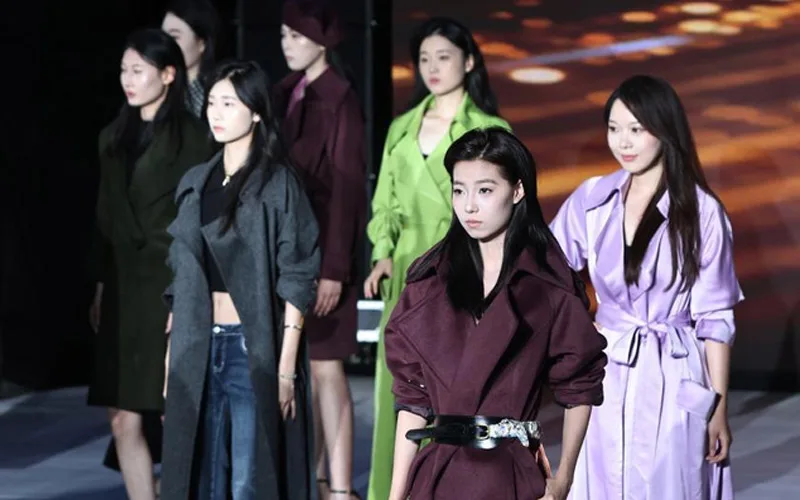
A gift-grade scarf is not a mass product, so his route down is through the existing greige: derivative lines with machine embroidery replacing hand work, and no embroidery at all on the Song brocade, which brings the price to a level ordinary customers will pay. Deng is cooler about the runway. Shows display aesthetics, she argues, but the market decides whether an intangible craft survives, and what she wants is light-luxury innovation built on the material’s own character.
Scarcity here is not marketing. Qu Tingnan, a Guangxiu inheritor, keeps an old length of the cloth that he dates to the Xianfeng to Guangxu reigns of the Qing dynasty, still crisp enough to rustle when folded. Ouyang Fengting, a district-level inheritor of the dyeing technique, calls it a trade that lives off the sky, workable only in good weather and impossible in rain, cloud or strong wind.
The plan put forward by the town runs from a single appearance to a standing export position: use the gift standard to pull the whole chain up, extend the motifs into garments, home goods and cultural products, unify the regional brand under one mark, push for mutual recognition of the standard in overseas markets, and turn a 2027 design and order fair into a recurring international trading floor. Wu’s version is shorter. Make the product well, then the design, then the story.