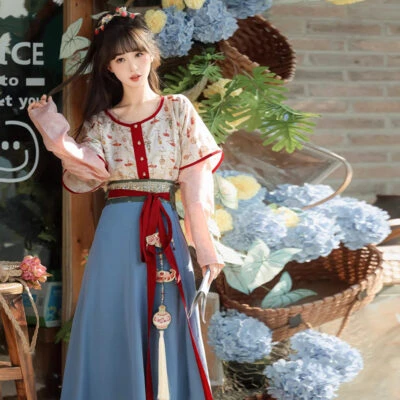
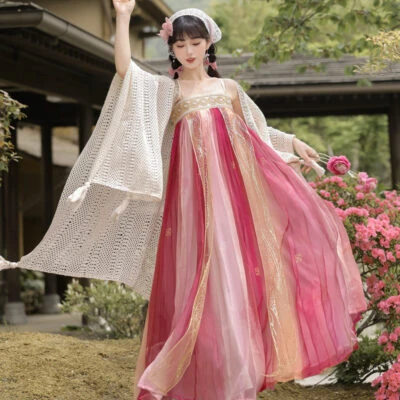
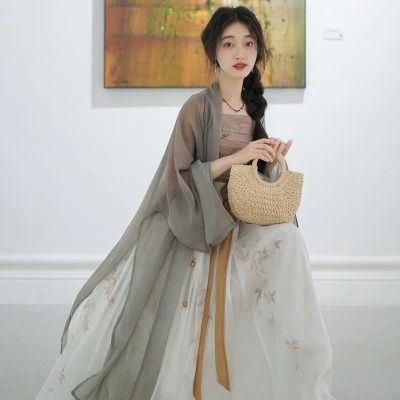
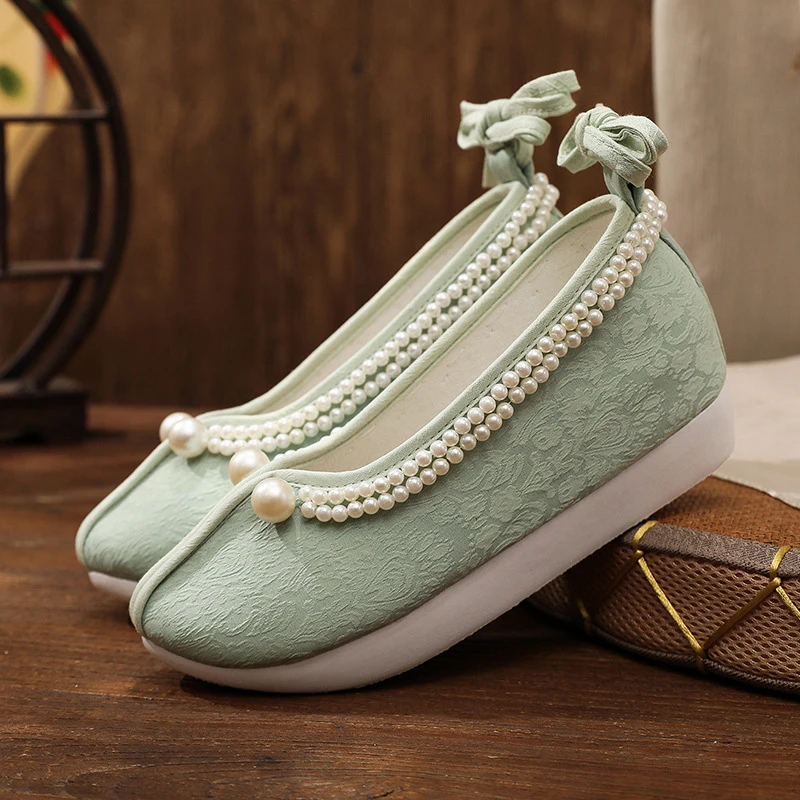
The second Zhanguo robe photo season in Jingzhou closed on November 21 with a ceremony at the old south gate square, where fifteen finalists who had come through five offline rounds collected awards in front of a crowd of about 150 students from local Hanfu societies. The season had opened on December 21, 2025, at the Jingzhou sports centre, and ran 338 days to the closing night. Organisers counted more than a thousand submitted entries and over 200 million topic impressions across the year, double the 100 million of the first edition.
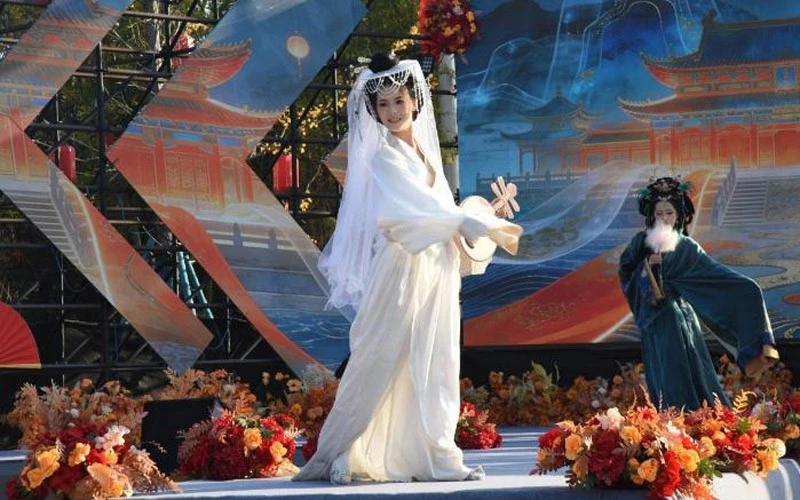
Zhanguo means Warring States, the period from roughly 475 to 221 BCE when Jingzhou was the capital region of the state of Chu, and the robe in question is the deep-collared, wide-sleeved cut associated with Chu finds. For one evening the city used it as a stage prop, then signed a supply contract on the back of it.
A Footballer in a Robe, and a Robe on the Wall
The evening began with a dance titled Phoenix Singing Over Chu, built from Nuo ritual blessing and an armoured formation, followed by a twelve-model runway of Zhanguo robes and a segment in which an actor playing Qu Yuan walked out with the court behind him and led the audience through a Chu salute. Awards ran from nine commemorative prizes through five category prizes to the annual grand prize, which went to an entrant working under the handle Qiqi Zi.
Then came the crossover that the organisers had planned as the evening’s argument. Jiang Erhan, top scorer and Golden Boot winner in the first Chu Super League season, walked out not in his number 62 shirt but in a Zhanguo robe designed by the Jingzhou Zhanguo robe industry alliance, with ramie worked into the cloth. Xiong Shihao, captain of the Jingzhou Henglong side, wore one too, and the under-16 and under-17 boys who won the provincial title came out in kit for a freestyle contest. Two kinds of uniform, separated by more than two thousand years, stood on the same stage.
One Robe, Two Supply Chains
After the prizes came the part with a contract in it. The Jingzhou Zhanguo robe industry alliance signed a strategic cooperation agreement with the Jingzhou ramie industry association, formally connecting Chu costume design to local ramie weaving. Hubei Xinhua Bookstore used the same slot to present a study of Chu food and dress, giving the design side a written reference to cite.
Both halves of that pairing have local grounding. The Mashan tomb number one, excavated in Jingzhou, yielded thirty-five Warring States garments in crossed-collar right-over-left construction with dragon-and-phoenix embroidery, a group often called a pre-Qin silk treasury. Ramie is a crop the region already grows. Put together, design, fabric and garment making can close inside one prefecture instead of importing finished goods from elsewhere.
Jiang Erhan’s robe makes the direction legible, since both design and the ramie content are local. For a city whose largest asset is a wall, this is an attempt to push traffic downstream, from wearing a robe for a photograph to having the robe designed and woven at home.
The Lightest Entry Point, the Longest Chain
Photo tourism became Jingzhou’s entry point because it pulls four things at once: styling, photography, tickets and merchandise. The numbers line up. Over the May Day holiday, visits to the old city rose 28.72 per cent year on year and combined revenue rose 23.45 per cent. More than forty styling studios now cluster near the Binyang Tower at the east gate, advertising Zhanguo robe shoots, and they support over two hundred jobs; senior photographers are said to clear a thousand yuan on a good day, and sales of Chu-style jade pendants and lacquer-pattern scarves have grown.
One studio owner’s line has been quoted repeatedly: visitors used to come and look, and now they want to become someone from Chu. That explains why a single garment can lift secondary spending. The customer is not renting fabric for an hour. The customer is buying a change of identity, and will pay again for styling, a photographer, prints and accessories.
The second edition also adjusted the mechanics. It launched a virtual mascot, set up an official registration mini-programme, published guides to seven core shooting locations, and announced free entry to several scenic sites in 2026 for anyone wearing the robe. Each of those lowers the threshold for an ordinary tourist, which is what turns a prop into something repeatable. Seen against the millions of pieces of traditional Chinese clothing sold online each year, most of them Hanfu styles ordered from stock, the city’s claim is modest, and it is the one the alliance can actually keep.
Distribution followed the festival calendar. At Spring Festival, lion dancers led a parade down Zhang Juzheng Street and international students from Yangtze University’s school of international education joined in robes, so that Chu king and queen costumes stood beside foreign faces. At Dragon Boat, flower boats lined the moat and a Qu Yuan character traded verses with people on the bank. Over the Mid-Autumn and National Day break, nearly five hundred enthusiasts formed square formations under drone footage. Earlier still, fashion bloggers had photographed the robe at the Eiffel Tower and in Times Square.
Li Zhengyu, a former deputy director of the Jingzhou culture and tourism bureau, offers the method in one sentence: when history is heavy, the telling has to be light, or the public will not listen. Photo tourism works exactly that way, putting the garment on before saying anything about ritual, and letting the clothes speak afterwards. The closing call for the third edition went out to Hanfu wearers worldwide, which for a season that has already run five events and a full year of distribution means starting from depth rather than from zero.