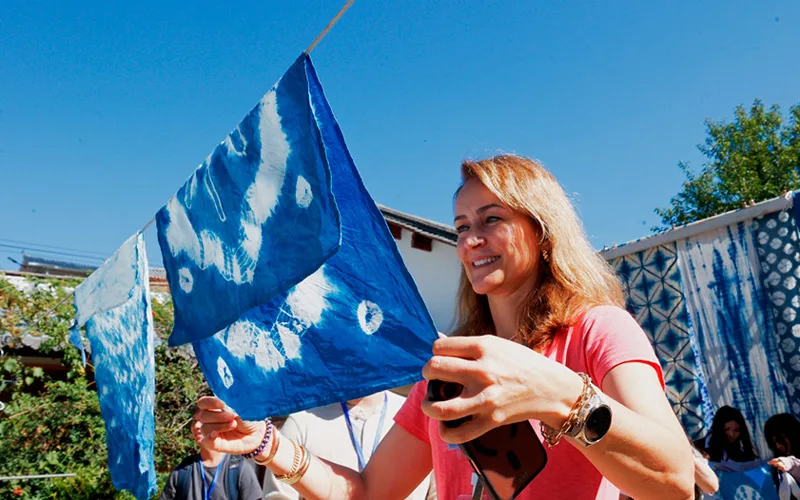
Steam hangs over the courtyard of the Lanxu workshop in Zhoucheng, a village inside Xizhou Town in Yunnan’s Dali prefecture, and the air carries the faint green smell of dried indigo. Yang Julan, 69, works through the sequence in order: folding and binding the cloth, soaking it, rinsing it, hanging it out. A length of coarse cotton goes in pale and comes out banded in blue and white, and the pattern is only visible at the last step, when the threads are cut away.
She had stopped doing this for years. What brought her back was not nostalgia but a buyer.
A Needle Laid Down, Then Picked Up Again
Zhoucheng is known as the home of Bai tie-dye, and the craft was inscribed on the first national list of intangible cultural heritage in 2006. Industrial textile production then undercut it. Hand tie-dye is slow, the margin is thin, and the work is done bent over a table. “I learned from the elders when I was eleven or twelve,” Yang said (杨巨兰). “Every household in Zhoucheng did it then. Later it was hard to sell, and young people did not want to learn a craft that hard. For a while I thought it might disappear.”
So she put the needle down. The turning point came in 2012, when Zhang Hanmin (张翰敏), a Zhoucheng native who had been working outside the village, came home and founded the brand Lanxu (蓝续). She walked the lanes looking for artisans who still had the skill but no route to a customer, and invited them into a workshop. The team kept the core of the craft, indigo dyeing by the old method and traditional binding, while a younger group took over new patterns, product design and orders from Chinese and overseas buyers. The older artisans no longer had to find customers. They only had to make the cloth.
“Lanxu found those of us who still had the skill, redesigned the patterns and improved the colours, and because the styles looked current, buyers liked them,” Yang said. “Seeing that the craft had a way out, that is when I picked the needle back up.” The difference she describes is organisational rather than artistic. “Before, my biggest problem was not knowing where to find a buyer. Now someone designs, someone promotes, someone handles sales, and we concentrate on the work. It is easier, and the income is steady.”
Where the Cloth Goes Now
Steady income changed her position inside the household: she no longer depends on her children to cover her costs. The bigger surprise was the destination. Scarves and square cloths she bound and dyed by hand now leave through the workshop’s channels and reach buyers abroad, including the Netherlands. “Back then I could never have imagined that a craft from our villages could leave the country and be liked by people overseas,” she said.
The patterns themselves are local geography. Binding, dyeing, rinsing and unbinding turn a needle and thread into a drawing tool and plant dye into ink, and the result is the blue-and-white banding that Dali’s landscape produces anyway: the snow on Cangshan mountain, the moon over Erhai lake, worked into cloth as a repeating motif. Nothing about the method has been modernised. What changed is who does which part of it.
Four Thousand People on the Payroll
Zhoucheng’s tie-dye economy now runs at a size that is easy to underestimate from the courtyard. The village has more than 200 tie-dye businesses and over 4,000 people working in them, and its experience workshops receive between 400,000 and 600,000 visitors a year. Most of those workers are women who stayed in the village, and the work lets them keep a household and an income in the same place.
A second revenue line came from tourism rather than wholesale. “Go to Dali and dye something” has become a standard itinerary item, so the workshops sell the process: a guide explains the history and the steps, then the visitor binds, dyes, rinses and takes home a piece of cloth they made badly and will keep. For the workshop it is income and advertising at once. For the visitor, a cloth they dyed themselves survives longer in memory than a bought souvenir.
The arrangement splits the chain into three parts: older artisans hold the technique, the younger team holds design and channels, and the experience workshops hold the foot traffic. Each end keeps to its own stretch, and the gap in the middle is what the brand fills. Whether a craft survives is decided by whether anyone is willing to keep doing it, and in Zhoucheng the answer now depends less on sentiment than on whether the split holds.