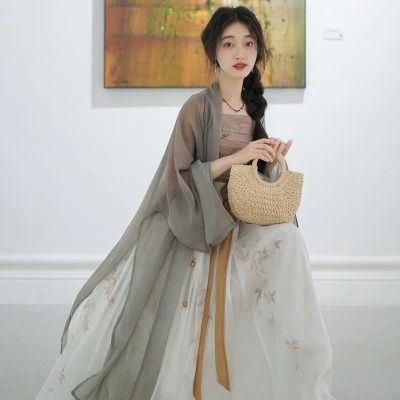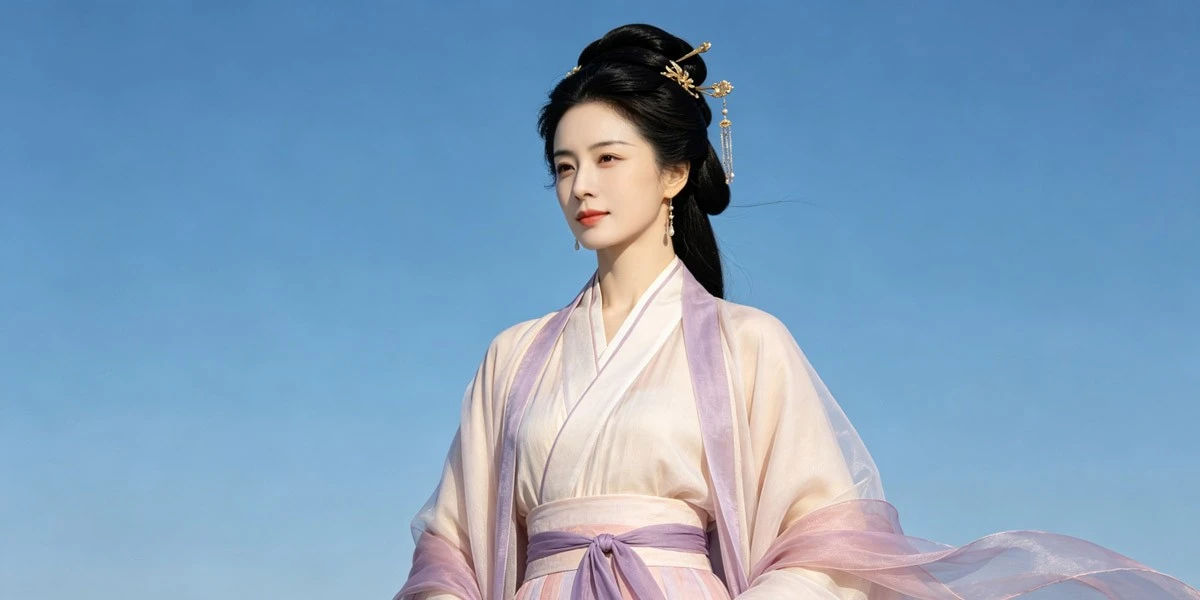

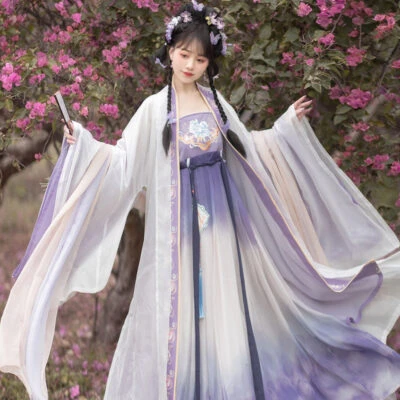
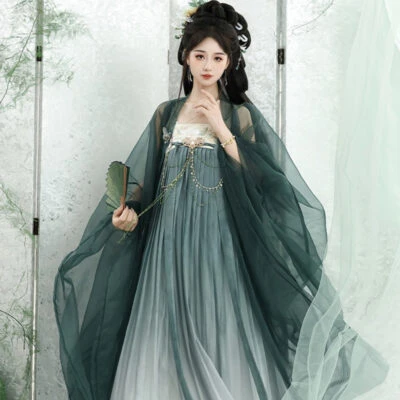


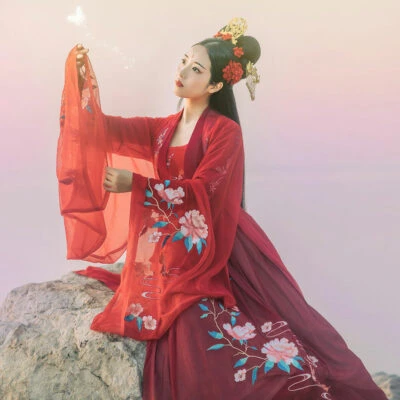
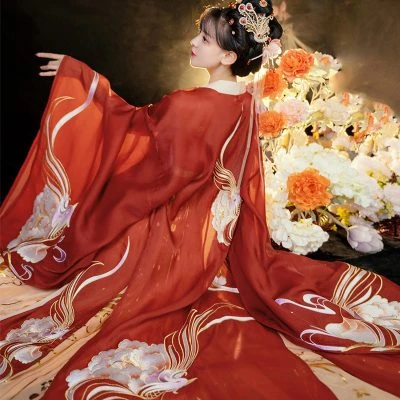

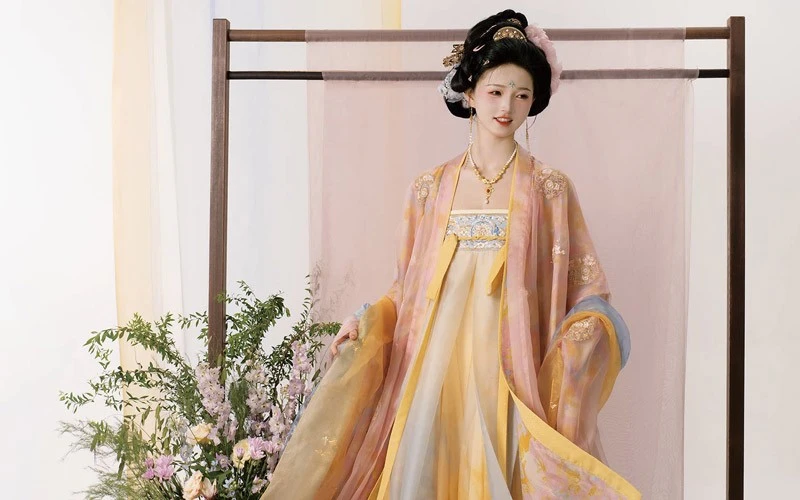
What Is a Daxiushan (大袖衫)?
A daxiushan is a wide-sleeved outer robe worn over a ruqun. The name is literal: Daxiu (大袖) – large sleeve; Shan (衫) – an unlined upper garment. It reached its most extreme proportions in the middle and late Tang dynasty, when sleeve widths ran past four chi, roughly 133 cm, and it stayed in formal use through the Song and Ming dynasties under different names.
Three names cause most of the confusion. In Tang ceremonial dress the same layer was recorded as dianchailiyi, the formal attire worn with ornamented hairpins. In the Song it was usually called daxiu or simply dayi, the great coat. By the Ming it had become dashan, and that is the name used in the Ming statutes. All of them describe the same idea: a loose, unlined over-garment whose sleeves, not its body, carry the status.
The reason a daxiushan hanfu piece is easy to find today is recent restoration work rather than continuous living tradition. Tang-style cutting has no surviving garment to copy, only paintings, murals and tomb figurines, so every Tang reconstruction on the market is an interpretation. In Luoyang, the Tang-style daxiushan making technique has been listed as a district-level intangible cultural heritage, and the workshop behind it rebuilt the dresses in the painting Court Ladies Preparing Newly Woven Silk from the painting itself. That is the reference standard most sellers now work from, whether they say so or not. Spelling varies as well: the same garment turns up under daxiu shan, wide sleeve hanfu and large sleeve hanfu, and the variant is a translation habit rather than a different item.
It Is One Layer, Not a Full Outfit
The single most common buying mistake is assuming the photograph is one garment. It almost never is. A Tang look is built in layers: a chest-high skirt, a short top tucked into it, the wide-sleeve robe over both, and a long scarf draped across the arms. Remove the robe and the rest still works as a ruqun. Remove the skirt and the robe has nothing to sit on.
So before ordering, decide which layer you are buying. A daxiushan robe is the outer layer only. If the listing calls it a daxiushan dress, check the piece count in the item details, because some sellers use the word loosely for a complete set while others mean the robe alone.
This matters for budget as much as for styling. The outer layer uses the most fabric and the most visible finishing, so a plain inner skirt usually costs less than the robe worn over it. If you are assembling a look from scratch, buy the robe first and the inner layers second; the robe sets the proportion, and every other piece has to answer to it.
It also matters for fit. A daxiushan outfit photographed on a model reads as one long line because the inner skirt is high-waisted and floor length. Put the same robe over a mid-calf skirt and the silhouette breaks at the knee. The robe did not change; the layer under it did.
Tang, Song and Ming: Three Different Garments
They share a name and a silhouette, but they are cut differently enough that you should know which one you are looking at. Sellers rarely label this clearly, and the differences decide whether the piece reads as Tang court fashion or Ming formal dress.
The Tang version is the one with no physical evidence. Nothing excavated survives from the Sui or Tang, so reconstruction depends on Zhou Fang’s painting Court Ladies Adorning Their Hair with Flowers and on the painted figurines recovered from middle and late Tang tombs. What those sources show is a straight-collar, front-opening robe in a thin, sometimes sheer fabric, worn loose over a high chest-high skirt, with the sleeve opening left raw and untrimmed. The widest recorded sleeves belong to this phase: late Tang writers describe widths beyond four chi, and the sleeve in the paintings falls well below the knee when the arm hangs.
The Song version is the first one we can actually measure, because Song tombs preserved the garments. Excavations at Huang Sheng’s tomb in Fuzhou, at the Zhou family tomb in De’an, and at the Huashan tomb in Gaochun have produced wide-sleeve silk robes with straight collars and center-front openings, cut long enough at the back to trail. The Song court records the combination precisely: empresses and consorts wore the large sleeve with a coloured collar, a long skirt, a xiapei sash and a jade pendant. That pendant is not decoration. It weights the sash so it hangs flat, which is why a Song dynasty daxiushan is almost always shown with one.
The Ming version changed name and proportion. It became dashan, and the statutes specify a straight collar, a center-front opening, a very wide armspan, a front hem that stops short and a back hem that trails. The phrase used to describe the effect is that it lifts when walking and spreads when bowing. Colour carried rank: the empress wore yellow, imperial consorts wore red. A plain satin dashan recovered from the tomb of Lady Wu, wife of the Prince of Ningjing, matches the statute text closely enough to be used as the reference piece, which is why a Ming dynasty daxiushan reproduction can claim to be copied from an object rather than from a painting.
In practice, almost everything sold as a daxiushan today is Tang style, because the Tang sleeve is the dramatic one. If you want Song or Ming, look for three tells: a front hem clearly shorter than the back, a straight collar with no overlap, and a listing that mentions a xiapei or a sash channel. A robe cut for a Tang look has an even hem and no provision for a sash.
Sleeve Width, Armspan and Cuff Opening Are Three Numbers
Listings mix these up constantly, and the mix-up is why people receive a robe that looks nothing like the photo. They are not interchangeable.
Armspan, sometimes written as sleeve-to-sleeve or total sleeve length, is the distance from one cuff edge to the other with the robe laid flat and the sleeves stretched out. This is the number that tells you whether the sleeves will clear your hands. Sleeve width, or sleeve depth, is how far the fabric hangs from the shoulder line down to the lower edge of the sleeve. This is the number the Tang sources are quoting when they say four chi, and it is what produces the draped, floor-sweeping look. Cuff opening is the circumference of the hole your hand comes out of, and it is the only one of the three that affects whether the sleeve stays put or slides down over your fingers.
A useful check before you order: stand with your arms out and measure fingertip to fingertip, then add 10 to 20 cm. That is the armspan at which the cuffs will hang just past your hands without dragging. If a listing gives an armspan longer than that, the extra fabric pools at the cuff, which is historically correct but impractical for anything involving stairs, food or a camera bag.
It also helps to know that width is not the same as fullness. A robe can have a very wide sleeve and still hang in a straight column if the fabric is stiff, or a moderately wide sleeve that billows if the fabric is light. Two garments with the same measurement can look completely different on the body, which is why fabric matters as much as the number.
Fabric Decides Whether It Falls or Floats
Tang sources describe the outer layer in silk gauze and leno, fabrics light enough to be seen through and stiff enough to hold a shape away from the arm. That combination is what gives the painted figures their particular look: the sleeve holds volume at the top and collapses into folds at the bottom, instead of hanging like a curtain.
Modern versions substitute freely, and each substitute changes the silhouette. Chiffon and georgette give you the float but not the structure, so the sleeve tends to cling rather than hold. Organza and stiffened tulle hold the shape but feel crisp and photograph with a slight sheen. Jacquard and brocade sit heavier, fall in a straighter line, and are the closest thing to the Ming formal look. Simulated silk gives the best compromise for photography, with enough weight to drape and enough sheen to catch light.
Sheerness is a separate decision. The historical Tang layer was often thin enough to require a chest wrap underneath, and a modern sheer robe will do the same. If you plan to wear it over a normal dress rather than a ruqun, a semi-sheer fabric reads as a layer; a fully sheer one reads as costume. The daxiushan pattern also behaves differently by fabric. Printed patterns sit on the surface and stay crisp on smooth cloth, while woven patterns only show when light hits the fabric at an angle, which is why the same motif looks flat in one photo and rich in another.
Care follows from the fabric. Gauze, chiffon and anything with a woven motif should be hand washed in cool water with a mild detergent, pressed rather than wrung, and dried flat in shade. Hanging a wet wide sleeve pulls the shoulder out of shape, and the weight of the water does more damage than the wash itself. If the piece has metallic thread or beading at the cuff, wash it alone.
What to Wear Underneath
The historical answer is a ruqun, and the chest-high version is the one that works, because the robe is cut to sit on a skirt that starts under the arms. A waist-height skirt leaves a gap of visible top between the robe and the skirt that the Tang sources never show.
The Tang combination is the robe, a short top, a high skirt and a pibo, the long scarf draped over the arms. The pibo is decorative and was worn across classes. The Song and Ming combination replaces it with a xiapei, a pair of narrow embroidered bands that hang front and back, joined at the bottom by a weighted pendant. These two accessories are not interchangeable. A pibo suits a Tang dynasty daxiushan; a xiapei belongs with a Song or Ming one and will look wrong on a Tang cut.
For modern wear, the easiest pairing is a plain slip dress or a long bias-cut skirt in a solid colour. The robe already carries the visual weight, so the layer under it should be quiet. A printed inner layer plus a printed robe produces noise, and the sleeve stops reading as the point of the garment.
One practical note: check how the robe closes. Tang reconstructions usually close with ties at the chest or hang open, Song and Ming versions close at the center front with a hidden fastening or a sash channel. A robe that hangs open needs a secure inner layer, because there is nothing holding it shut when you move.
Sizing: Measure Armspan, Not Shoulder
A daxiushan has no set-in shoulder seam. The sleeve runs from the collar in one piece, which means shoulder width is meaningless as a fit measurement even though most size charts still list it. Ignore it and use three others: armspan, garment length, and bust or chest circumference across the front opening.
Armspan decides where the cuffs sit. Garment length decides whether the hem clears the floor. Chest circumference matters less than you would expect, because a front-opening robe can be worn loose, but it still needs to be wider than your bust plus whatever you wear underneath, or the front edges will pull apart.
Height changes the proportion more than size does. On a shorter wearer, a historically correct armspan puts the cuff below the hand, which is accurate but means the sleeve will sweep the ground; you either accept it, wear the sleeve looped, or size down the armspan and lose some of the drama. On a taller wearer the same robe reads shorter in the body and the sleeve looks proportionate. If you are between sizes, size by armspan and adjust the length, not the other way round.
Made-to-measure is common for this garment because the sleeve is the whole point, and a stock size cannot fix an armspan that is 15 cm off. When ordering custom, give armspan, height, bust and the distance from your shoulder to the floor, and say explicitly whether you want the cuff to reach your knuckles or hang past your fingertips. Those two answers produce different garments.
Wearing It Outside a Photoshoot
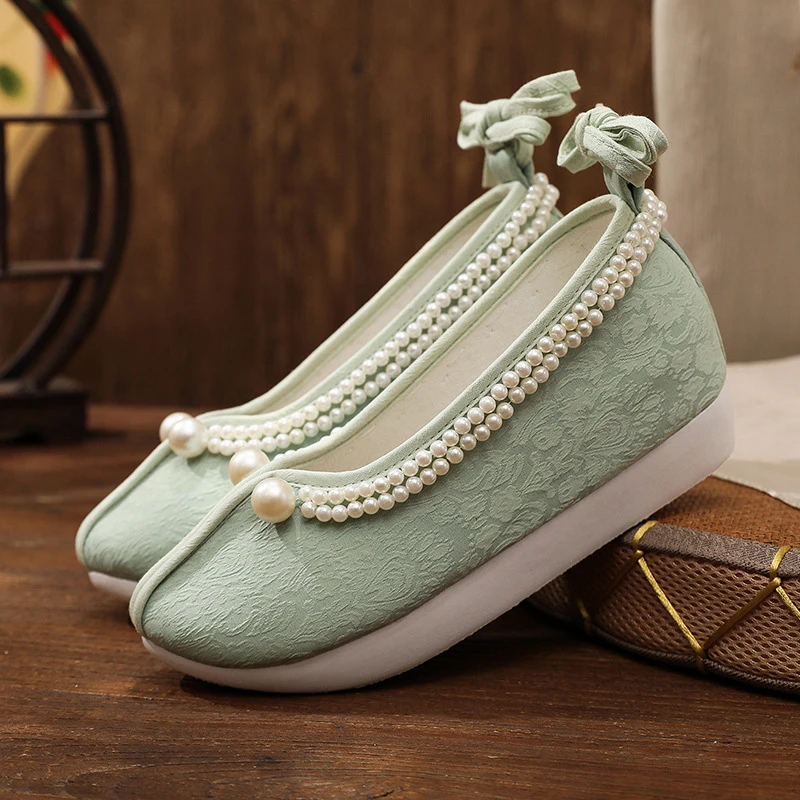
A wide sleeve is a statement piece, and the rule for wearing one in public is to let it be the only statement. Everything else should be quiet: one colour underneath, no competing print, hair up and simple, flat shoes. The moment a second dramatic element appears, the outfit reads as a costume rather than as clothes.
Where it works: weddings, cultural festivals, museum visits, portrait sessions, stage and dance. Where it does not: commuting, restaurants with low tables, anywhere you have to carry a bag on one shoulder for hours. The sleeve catches on door handles and dips into food, and no amount of care fixes that.
The historical solution is still the practical one. Wide sleeves were tied back with a ribbon or a loop at the wrist when the wearer needed her hands, and a thin cord does the same job today without damaging the fabric. If you plan to wear the robe for a full day, put a cord in your bag.
Photographically, the sleeve reads best in motion and in side light. Standing still with arms down, a wide sleeve collapses into a vertical line and loses the shape; walking, turning, or lifting one arm brings the volume back. That is also why the painting references matter: the figures are always mid-gesture, never posed square to the viewer.
Daxiushan FAQ
What is a daxiushan?
A wide-sleeved outer robe worn over a ruqun, historically associated with Tang court and aristocratic dress and later formalized in the Song and Ming as ceremonial wear for titled women. The name means large-sleeve shirt, and the defining feature is an untrimmed sleeve opening wide enough to hang past the hand.
Is a daxiushan the same as hanfu?
It is one garment type within hanfu, not a synonym for it. Hanfu covers the whole system of historical Chinese clothing; the daxiushan is the outer layer of one particular look, and it is worn over other pieces rather than on its own.
Should I buy Tang, Song or Ming style?
Buy Tang if you want the dramatic sleeve and are styling for photos or festivals. Buy Song or Ming if you want a garment that closes at the center front and can be worn with a formal sash. Tang is the most common reproduction and the easiest to match with existing hanfu pieces.
What is the difference between a daxiushan and a beizi?
Both are wide-sleeved outer layers, but the beizi is narrower through the sleeve and usually shorter in the body, and it developed as a everyday outer coat. The daxiushan is wider, longer and tied to formal and ceremonial dress. If the sleeve hangs past your hand when your arm is down, it is closer to a daxiushan.
Do I need a skirt to wear one?
For the historical look, yes. The robe is cut to sit on a chest-high skirt, and without one the proportions do not work. For modern wear, a long slip dress or a full-length skirt substitutes well, as long as it is long enough that the robe hem and the skirt hem do not compete.
How do I measure for the sleeve?
Measure fingertip to fingertip with your arms out, then add 10 to 20 cm for the drape. Ask the seller whether their listed number is armspan or sleeve width, because the two differ by a factor of two and a mislabeled listing is the most common reason a robe arrives wrong.
Is it see-through?
Often, yes, especially in the Tang-style versions, which were historically made in thin gauze. Check whether the listing describes the fabric as sheer, and plan an inner layer. A lined version exists but sits heavier and photographs with less movement.
Can I wear one to a wedding?
Yes, and it is one of the few occasions where the full look is appropriate. A red or deep-coloured robe with a formal sash reads as celebration; pale sheer versions read as a portrait shoot. Avoid white unless the couple has asked for it.
How do I wash and store it?
Hand wash in cool water with a mild detergent, press out the water without wringing, and dry flat in shade. Store folded rather than hung, with the sleeve supported, because the weight of a wide sleeve will stretch the shoulder over time.
Why does it cost more than a regular hanfu top?
Because the sleeve uses several times the fabric of a normal top and the cutting waste is high. A wide sleeve cannot be pieced from small panels without a visible seam, so the pattern layout alone raises the cost before any embroidery or finishing is added.