Article
Search results:
-
History of Traditional Chinese Attire - Hanfu Beizi
Beizi (褙子), a kind of traditional Chinese attire, began in the Sui Dynasty, both men and women can wear it. The style of Beizi is mainly straight collar and Duijin, with no stitching from the armpit on both sides. It is often worn outside other clothes. Popular in Song and Ming Dynasties. Origin and development of Beizi Beizi began in the Sui Dynasty. There are two ways of saying about the origin of the name of Beizi, one is Beizi means that when a person walks, his back should be straight to support his back and body; the other is the clothes that Beizi used to wear by servant, because the servant often stands behind the mistress, so gets the name. In the Song Dynasty, both the queen and the nobility, as well as the maidservants and ordinary people, all liked to wear Beizi. At the same time, it is also the formal dress of women in the Song Dynasty. Style Song Dynasty In the Song Dynasty, there were three kinds of collar styles: straight collar style was worn by women; slant cross collar style; round collar style was worn by men on formal occasions. The length of the… -
Song Dynasty Clothing - Traditional Chinese Hanfu
Song Dynasty clothing mainly refers to the Song Dynasty Hanfu clothes, including the popular clothing in the Northern Song Dynasty and the Southern Song Dynasty, which is a pearl in the development of clothing history. Brief of Song Dynasty clothing In the beginning, the function of clothing is to shield the body from the cold, but with the development of society, clothing has gradually been given other meanings, which has become a class manifestation of different levels. In feudal society, the dress system has always been an important system of monarch's administration. Different classes and occasions wear different clothes, which cannot violate the regulations. Moreover, clothing can reflect the characteristics of the times. The political, economic, and cultural prosperity of the prosperous Tang Dynasty, in such a social background, has formed a majestic, open, and magnificent clothing characteristics. While the Song Dynasty is different from the prosperous Tang Dynasty in the strength of the force, its emphasis on culture and light military, advocating the social trend of thought of Neo Confucianism, making the Song Dynasty clothing changed the magnificent atmosphere of the previous dynasty, became simple and elegant, conservative and introverted, but also formed its own distinctive characteristics. Characteristics… -

Interview | New Chinese Fashion - Modern Youth and Hanfu
Wear Hanfu as a Chinese fashion brand? Skateboarders, but a robe, skirt flying with the wind. ▼ Sometimes on the bus, subway or airport, you can also meet the classical girl in the Hanfu long suit. ▼ A few friends meet to wear Hanfu to go shopping and wear a mixed style Hanfu. ▼ Have you noticed that the Chinese fashion style is becoming more and more popular recently? All kinds of Chinese fashion styles and traditional element designs are sought after by young people, and the frequency of seeing Hanfu is also much higher? More and more fashionable men and women are in love with Hanfu, and they are wearing distinctive traditional clothes and walking on the streets. When young people's fashion personality collides with traditional cultural symbols, it's no longer a "spectacle" to wear Chinese fashion style clothes across the street. On the contrary, these young people dressed in Hanfu construct another landscape of the modern city. Today we also found 5 young people who love Hanfu. Let's feel their daily Hanfu life together. Hanfu & Chinese Fashion & Modern Youth ❶ Miss San sui 24 / actor Q: How much do you spend on Hanfu? A: I… -
Classic Chinese Hanfu: Shoulder Accessories - Yunjian
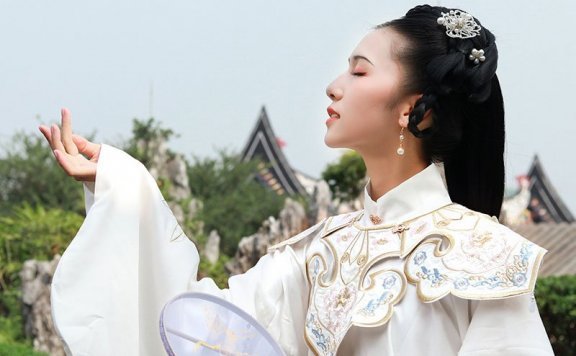
You may often see Yunjian in Hanfu, but you may never know it in detail. But in fact, it is a very important role in ancient chinese costume. The history of Yunjian Yunjian (云肩, Cloud-shoulder), is mostly made of silk and satin brocade. It is often decorated with four cloud patterns and made of colorful brocade. It looks like clouds reflecting the sun after the rain and rainbow scattering in the clear sky. Therefore, it is called Cloud shoulder. Yunjian is an ornament worn on the shoulder by ancient women, is one of the important characteristics of Chinese Hanfu clothing, with rich decorative patterns and profound cultural philosophy. Before the Qin and Han Dynasty, there was no relevant written record. From the perspective of clothing style, it was influenced by the concept of nomadic people in the north and belonged to foreign clothing styles. The image was first seen in Dunhuang frescoes of the Sui Dynasty, and Guanyin Bodhisattva, who has been sinicized, has a Yunjian. By the Qing Dynasty (1644-1911), it was gradually popularized in all walks of life, especially in marriage, which became an indispensable dress for young women. Later, Yunjian were often worn in customary activities… -
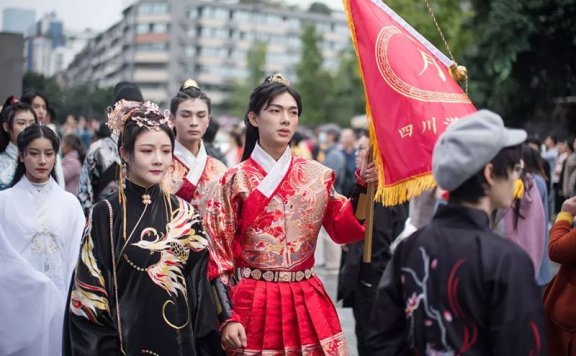
Hanfu Festival: Hanfu Parade Day on November 22
Background of Hanfu Parade Day At noon on November 22, 2003, Wang Letian, a power worker, dressed in Hanfu, which disappeared in daily life for 358 years, appeared on the street. He dressed in a Hanfu composed of a long Quju (曲裾) and a cocoon silk outer garment, strolls in the square, park and shopping mall in Zhengzhou, the capital of Henan Province. He said he did so in the hope of "promoting Hanfu" with his own meager strength and making people accept the traditional Chinese clothing again. Although this Han suit is simple and even a little out of shape, it was sewn by Wang Letian and his friends. These like-minded men even set up a team to search for documents, pick up sewing needles and make this Hanfu. Despite the ridicule and incomprehension of some people, Wang Letian calmly walked through the crowd and walked on the most prosperous street in Zhengzhou. He is more and more determined to promote Hanfu. He hopes to influence others with his limited power. Zhang Congxing, a reporter from Lianhe Zaobao in Singapore, came across the photos and wrote a report based on them. This article has also become the first article to… -
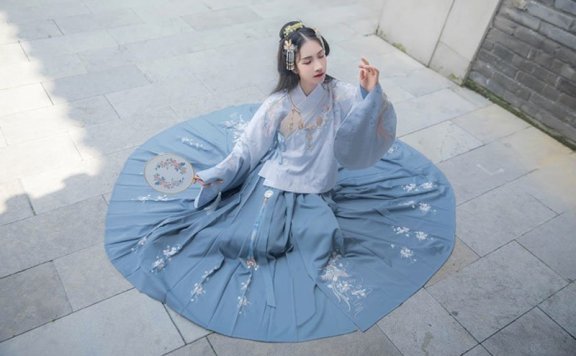
4 Secrets about Hanfu Ma Mian Qun
When it comes to the skirts of the Ming Dynasty, many people will remember the typical "Ma Mian Qun (马面裙, horse face skirt)", often gives a sense of elegance and wealth. It looks very dignified and gentle when matched with Han suit Ao (袄). Introduction of Ma Mian Qun & Lan Ma Mian Qun, also known as "Ma Mian Zhe Qun (horse face pleats skirt)", is a kind of traditional Chinese dress. There are four front and back skirt doors, overlapping each other, side pleating, middle skirt door overlapping part, commonly known as "Ma Mian (horse face, 马面)". The whole circle of patterns on the Ma Mian Qun's is called Lan, the bottom is called bottom Lan, and the top is called knee Lan. Double Lan was very popular in the middle of the Ming Dynasty. But later, with the growth of women's top in the Ming Dynasty, the knee Lan was gradually weakened because they were covered, while the bottoms Lan were widened and bold. Why is it called "Ma Mian"? The question of why Ma Mian Qun named has always been puzzling, what's the relationship between the animal's name and the skirt? In fact, "Ma Mian"… -
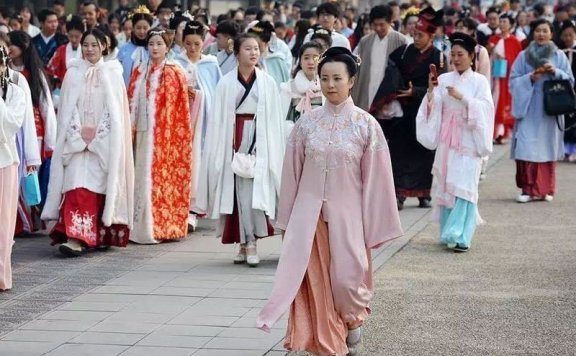
2019 - Latest Hanfu Report | Fashion Trends & Analysis
It might not be the first time you've heard of Hanfu (汉服). This kind of traditional Chinese costume has been discussed by media around the world frequently. More and more Hanfu events are being held, and more and more people are trying to wear traditional costumes. When browsing social media, you can often see beautiful pictures of Hanfu dresses. Even many people have incorporated them into their daily life. What types of groups are fancy in Hanfu? What are their original intentions of buying and wearing Hanfu? What attractiveness does Hanfu suit have? and more... This new report will introduce to you the current environment of Hanfu in several aspects. I. The Overall Situation of Hanfu Rapid Development of Hanfu Industry The revival of Hanfu culture began in 2003. An electric worker named Wang Letian walked with Hanfu on the street to promote it. This was the first person who wear Hanfu in the public. Currently, there are more than 1300 Hanfu cultural associations in the world in 2017, and there are more than 2000 in 2019, an increase of 46% can be seen in these two years. In China, there are more than 2 million consumers in the Hanfu… -
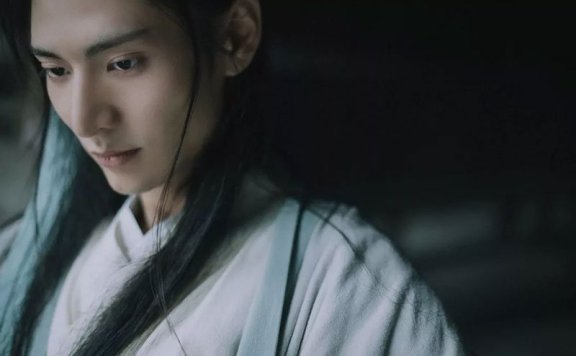
An Exhaustive Guide to Take Handsome Hanfu Pictures
A few days ago, we published an article about how to take beautiful hanfu pictures. Today we are going to show you how to take photos of handsome hanfu pictures. Stand Usually, when shooting, most of the postures stand more, start running in from a simple stand. You can try to relax, meditate and lean on objects. Squatting Squatting or sitting posture, easy to combine the environment, create emotions, as well as the overall sense of story. Running and Jumping Running and jumping is one of the best ways to make the picture look dynamic. Create character dynamics with lines. Use the dust and clothes raised by running. Using the dust and clothes raised by running can form the interaction between characters and objects and increase the tension of the picture. Lift up gently, just like a swordsman flying over the eaves. A Small Proportion of the Environment Popularly speaking, it is a long-term shooting, which combines artistic conception to show the interaction of characters. The position in the picture can be either the center or the corner, making the characters the finishing touches of the whole scene. When taking this kind of photograph, the picture needs to be concise… -

The Hanfu Etiquette You Should be Focusing on
Hanfu costume is not only the costume of the Han Dynasty, but the national costume of Han nationality. After more than 300 years of vicissitudes of life, it was annihilated in history and forgotten by future generations. Nowadays, many people still mistakenly believe that Hanfu clothes were eliminated naturally because of the inconvenience of their broad gowns and sleeves. It has been misread as an ancient costume, ridiculed as traversing, acting, making a show, and even recognized as kimono and hanbok costume. Characteristics of Hanfu Is it true that Hanfu clothes only have an appearance? Are there any details that can express Chinese traditional culture? The main feature of Hanfu is: Crossed-collar with the right pattern Restrain the waist by ropes Loose clothes with long-wide sleeves Han clothes give people a feeling of chic and free temperament. These characteristics are not only different from the costumes of other nationalities, but also the kimonos and Korean hanbok costumes produced by the influence of Chinese costumes in neighboring countries. Small details are hidden in the Shenyi The common Shenyi (深衣) is that the upper and lower clothes are linked together, with different colors of cloth as the edge, so that the body… -

A Brief Introduction to Hanfu's Fans Culture
In Chinese culture, accessories are a language of beauty. They are an extension of clothing expression. With accessories, Hanfu can be more appealing. Fans are one of the common accessories in Hanfu culture. This article will lead you to understand the history of Hanfu's fans. Fans have about three thousands of history in China. After thousands of years of evolution and improvement, they have developed into hundreds of fans' families. Fans were originally known as the "Five Ming Fans (五明扇, Wu míng shàn)" in history, was invented by the "Shun" (舜, Chief of the Ancient Tribal Alliance of China). In the Yin and Zhou Dynasties, appeared a kind of "Di Fan" (翟扇, Dí shàn) made of the colorful pheasant tail feathers, so there is a saying of "Feather Fan". At that time, the fan was not used to fan the wind, but to serve as the emperor to ward off the wind and avoid the sand. It can be classified into two categories: First, Flat Fans (平扇), can not be folded. Brief introduction: during the Warring States, Qin, and Han Dynasties, flat fans became the mainstream of fans at that time, used by both emperors and civilians. In the Western Han… -
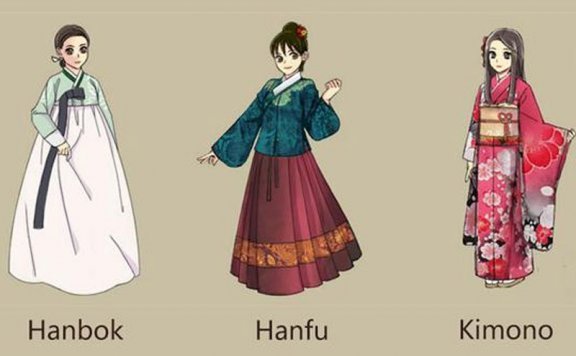
The Difference between Hanfu Kimono and Hanbok
Many friends who have just contacted Hanfu will find that Kimono and Hanbok (Korean clothes) are similar to Hanfu in many ways. This article takes you to know the differences between Hanfu, Kimono, and Hanbok. Hanfu vs Kimono During the Nara period in Japan, the period of China's prosperous Tang Dynasty, Japan sent a large number of sent envoys to China to study culture, art, and law systems, including the clothing system. In the early days, the kimono was a replica of the Tang suit. At that time, they also imitated the Tang system and issued a "clothing order". So far, Japan still refers to the kimono as "Wu suit", which means clothes from Wudi (now Jiangsu and Zhejiang) in China. Although the kimono came from the development of Hanfu, it has developed its own national characteristics after a long period of history. Waistband: Hanfu: Hanfu usually has a narrow waistband; Kimono: there is no tie on the kimono placket, and the waist is wide with a fabric. Neckline: Hanfu: Hanfu neckline clothing is close to the back of the head; Kimono: In the kimono, the neckline of an ordinary woman's neck wrapped her neck tightly, and the geisha… -
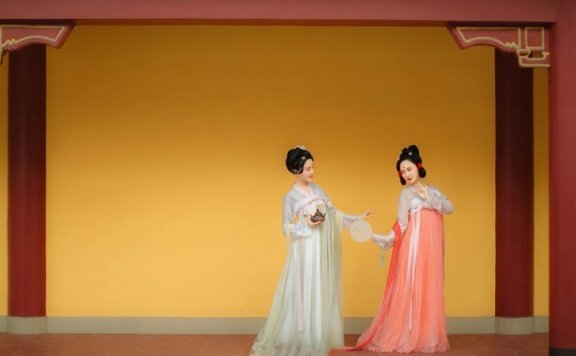
Best Hanfu Clothing 2018
Hanfu is a traditional Chinese costume and one of China’s 5,000-year cultural symbols. In the last century, Hanfu was once forgotten by Chinese people. However, since the 21st century, through the Hanfu movement, Chinese Hanfu has reappeared in people's vision, and combined with modern design elements, making Hanfu rejuvenate. Top 10 Chinese Hanfu Dress 2018 With the revival of Chinese Hanfu costume, more and more people wear Hanfu and walk on the streets. Maybe one day you will find out, Oh! the beautiful clothes that the women wore were Hanfu clothes. Now through this article, let us take a look at the most popular Hanfu in 2018. 1. Kirin Costume Kirin, a traditional Chinese beast, has a mild temperament. In the legend, Kirin can live for thousands of years. The ancient people believed that when the Kirin appeared, there must be auspiciousness. Therefore, it is often used to describe people with outstanding talent and noble moral character. Kirin Hanfu costume is the best clothes for excellent people. I have a childhood friend who is going to study abroad soon, so I always wanted to send her a special gift. One night I saw the Kirin movie on TV, and the… -

Guide to Choosing Ming Dynasty Aoqun Top
As one of the most popular styles of hanfu, Ming Dynasty Aoqun has a rich variety of styles and styles, and the Jiaoling Aoqun is one of the most common styles. This article is based on the artifacts of Jiaoling Aoqun, so that you can quickly understand the correct Ming Dynasty Aoqun top shape for your next hanfu purchase as well as hanfu making. Image quoted from hanfu making hobbyist @Sue簌簌. 1 Overall 1.1 Youren (右衽, the left lapel covers the right lapel). 1.2 A single layer is a Shan (衫) and a double layer is a Ao (袄). 1.3 Cutting method: with center seam and no shoulder seam. 2 Collar 3 Sleeves 3.1 Aoqun top can have a variety of sleeve shapes. 3.2 Pipa sleeves are wide, not narrow. 3.3 The benchmark through-arm length of Pipa sleeves is nearly two meters. 3.4 The sleeve root should not be too narrow. 3.5 The sleeve is divided into a section or two sections connected. 3.6 Sleeve pleats often accompany the existence of the sleeve edge. 4 Garment body 4.1 The underarms should be curved. 4.2 It is right with or without shoulder pleats. 4.3 The waist should… -
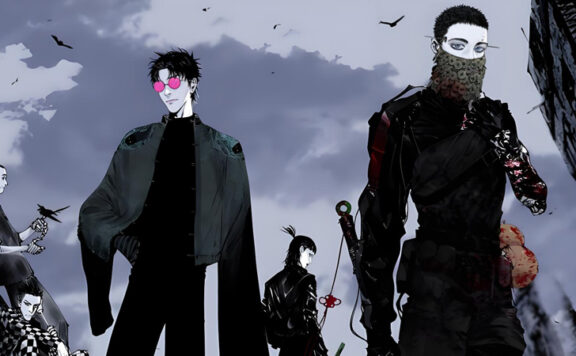
The Crow: Weaving Chinese Folklore into Modern Horror
What happens when a routine food delivery becomes a one-way ticket to a world of Chinese horror? For 18-year-old courier Zhang Zha (张炸), a simple mistake—mixing up floor numbers—leads to a brutal murder and a terrifying rebirth in The Crow (楚乌). This new animated series, adapted from Mo Fei's (墨飞) award-winning Manhua (漫画), arrives on Youku to redefine the genre. It blends the mundane with the macabre, pulling viewers into a modern Jianghu (江湖) where restless spirits threaten the living and a secret organization fights in the shadows. Forget cultivation clichés; this story grounds its supernatural terror in the grit of everyday life, asking what happens when death isn't the end, but the beginning of a much darker obligation. The Lore of "Shang" The genius of The Crow lies in its core concept: "Ren Si Hua Shang" (人死化殇). When individuals pass away with intense, unresolved obsessions, they do not simply fade away. Instead, they transform into Shang (殇)—malevolent entities fueled by lingering regret. These spirits can re-enter the human world through a mysterious, forbidden gateway, bringing chaos and danger to the realm of the living. This isn't a random haunting; it's a cosmic rule with dire consequences. Those who become… -
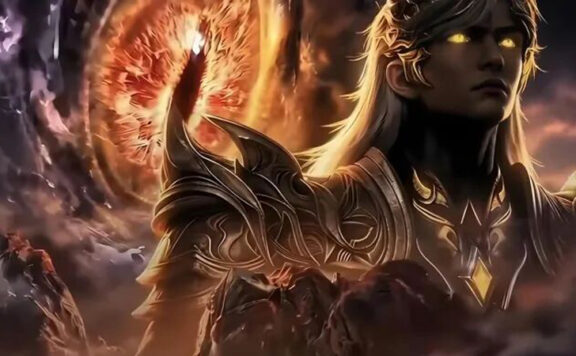
Perfect World: Anlan & Yutuo Hunt for the Key to Emperorship
The episode of the animated series Perfect World (完美世界) has ignited the fandom, not just with a fight scene, but with the arrival of two beings who redefine the meaning of "overwhelming power." Anlan (安澜) and Yutuo (俞陀), the immortal kings from the alien realm, have crossed the celestial chasm, and their goal is terrifyingly simple: find a single treasure, or destroy everything in their path. This isn't just another battle; it's a desperate, cross-generational hunt for the key to godhood. The episode opens with a scene of sheer dominance. The border fortress, a bastion of defense for the Nine Heavens, is bathed in a menacing golden light. The powerful experts stationed there, including the resolute Meng Tianzheng (孟天正) and the young prodigy Shi Hao (石昊), can only watch as the projections of Anlan and Yutuo manifest. These aren't mere illusions; they are the condensed will of two Immortal Kings, a pressure so intense it feels like the very laws of the world are bending to their whim. The message is clear: the era of skirmishes is over. The alien realm is making its ultimate move, and they are here for one thing only—the "Key to Emperorship." Why Two Immortal… -
What Did an Ancient Chinese ID Look Like?
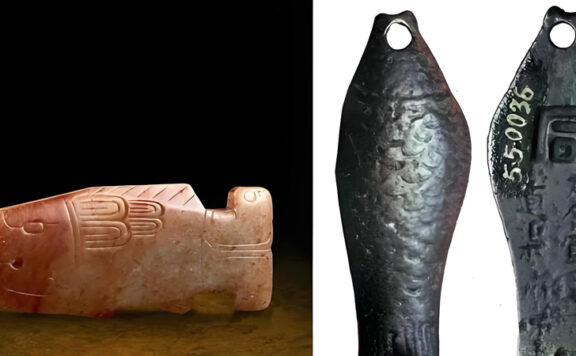
Imagine an object that everyone possesses, made from the same material, and engraved with the details that make you, you. In our modern world, the answer springs to mind instantly: it's an ID card. This little piece of plastic holds our birth date, our birthplace, and essentially summarizes all our social connections. In a way, it declares that we are who our society requires us to be. Within our familiar circles, we rarely need to prove our identity. But the moment we step into a completely new environment, our first task is to convince strangers that we are indeed ourselves, and not someone else. The ID card is the physical key to that proof. Today, it's a thin, simple card, yet it acts as a passport, safeguarding our journey wherever we go. But in the distant past, long before plastic and photographs, what object did a person use to answer the fundamental question: "Who are you?" 1. Sui and Tang Dynasties - Fish Tally China’s earliest known official ID emerged during the Sui and Tang Dynasties. It was Emperor Taizong (太宗) of the Tang who, during his Zhenguan (贞观) era, distributed a unique item to his officials called a "fish… -
The Rise of Sun Zhenni’s Majestic New Image
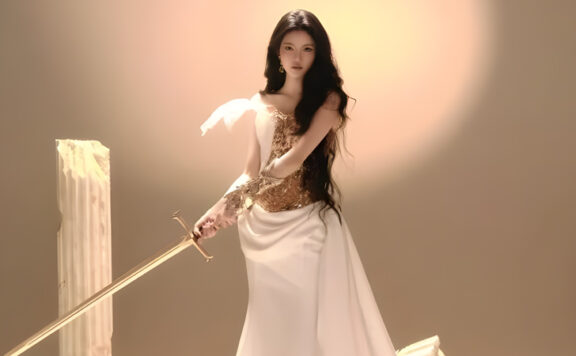
Is Sun Zhenni (孙珍妮) Hollywood's Next Big Fantasy Heroine? Her new look, a striking combination of gilded bodice and flowing white satin, has ignited the internet. It feels less like a photoshoot and more like a teaser trailer for an epic saga. We are witnessing the arrival of a "Dark Queen," a persona that is both icy and majestic, powerful and elegant. This isn't just a fashion moment; it's a statement that completely redefines her public image, leaving fans and onlookers utterly captivated by every single frame. Gilded Armor and Silken Strength The centerpiece of this transformation is a meticulously designed strapless gown. The upper half features a metallic gold fabric that catches the light, creating a shine that is bold yet never gaudy. Its sharp cut perfectly highlights the lines of her shoulders and neck. A single, large white satin bow drapes down one side, softening the golden intensity and adding a touch of dramatic flair. It is a masterful blend of strength and grace. Below, the dress flows into a high-quality white satin skirt. The fabric drapes perfectly, with smooth folds extending to the floor. This creates a rich, layered look that is both grand and understated. The… -
The 2,000-Year Story of Niu Ma
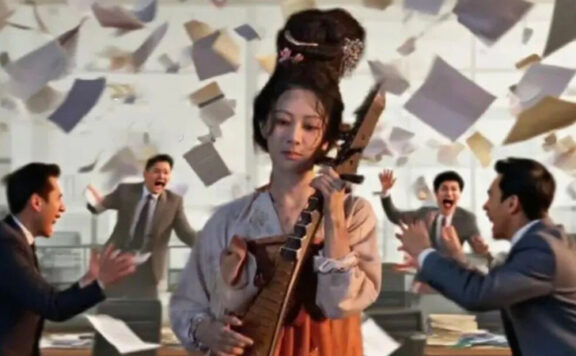
Have you ever called yourself a "Niu Ma" after a long day of work? This modern internet slang perfectly captures the exhaustion of the daily grind. But here's the kicker: government officials were using the exact same term to describe themselves over 2,000 years ago. That's right—feeling like a beast of burden at work is a tradition as old as Chinese civilization itself. When a Historian Called Himself a Beast The most famous example comes from the grand historian Sima Qian (司马迁). In his legendary letter Reply to Ren An (报任安书), he opens with the line, "The Grand Historian, a Niu Ma Zou (牛马走), Sima Qian, bows twice." By using "Niu Ma Zou"—which literally means "a running ox and horse"—he was calling himself a lowly servant, someone driven like livestock. It was a formal term of self-deprecation, but for Sima Qian, it carried profound weight. He endured castration to complete his historical masterpiece, making his use of "Niu Ma" less a polite gesture and more a bitter reality. He was a man of immense talent, yet in the eyes of the emperor, he was merely a tool, a creature to be used and discarded. The ox symbolized loyalty and hard… -

5 Chinese Health Habits Going Viral Globally
What started as a playful hashtag has quietly turned into a global movement. Earlier this year, a Chinese-American blogger named SherryXiiruii jokingly suggested everyone "become Chinese" by adopting simple daily habits—drinking hot water, eating hot pot, and embracing cozy comforts. To everyone’s surprise, millions of international users didn’t just laugh; they joined in. Now, social media feeds are flooded with posts about brewing Go Ji (枸杞) berries, practicing Ba Duan Jin (八段锦), and rediscovering the joy of long underwear. But beneath the humor lies something real. These viral trends aren’t just quirky fads—they are windows into a lifestyle rooted in balance, mindfulness, and centuries of observation. Here’s what the world is discovering, and why these practices might be worth keeping around. 1. Mahjong Therapy It is one of the first challenges new “Chinese” recruits take on: learning to play mahjong. To outsiders, the clacking tiles and complex rules can seem intimidating. Yet once the game clicks, it often becomes an obsession. International fans post videos of their makeshift tables and tile-scrambling techniques, marveling at the "advanced technology" of automatic tables (a common sight in Asian homes). But beyond the fun, research suggests mahjong offers genuine cognitive benefits. The game demands… -

3 Gentle Morning Rules for a Healthier Life
Waking up is a daily ritual, yet how you perform it can set the tone for your entire day and, according to ancient wisdom, your long-term health. Many of us rush through these first moments, making mistakes that jolt the body and drain energy. By avoiding three common, hasty actions, you can cultivate steadiness, protect your vitality, and build a foundation for a longer, more comfortable life. 1. The Bolt Upright Blunder The blare of an alarm clock often triggers an instinctive reaction: sitting up abruptly. For many, especially those in their golden years, this sudden shift from horizontal to vertical is a shock to the system. After a night of rest, your blood flows more slowly and your blood pressure sits at a lower baseline. Leaping up too fast can cause a head rush, dizzy spells, or even a dangerous fall. The ancient remedy is elegantly simple and can be summed up in one word: gradual. It advises a three-step awakening. First, upon waking, lie still for about thirty seconds and give your body a good, slow stretch. Next, push yourself up to a seated position slowly, allowing another half minute for your circulation to adjust. Only then should…