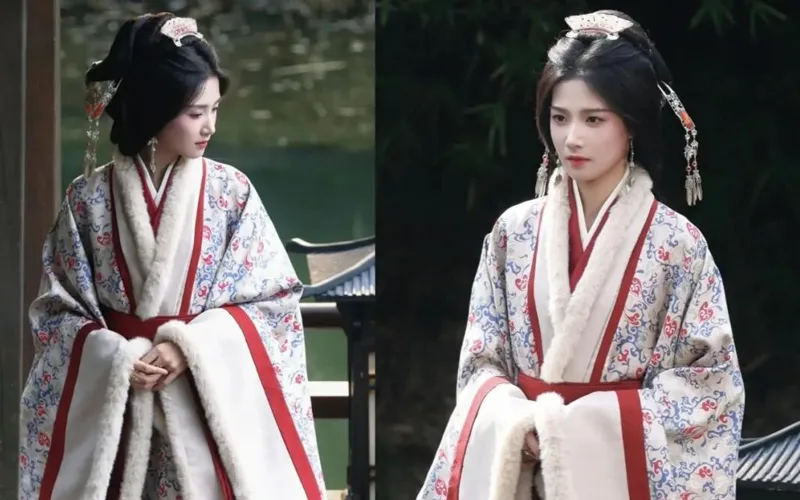
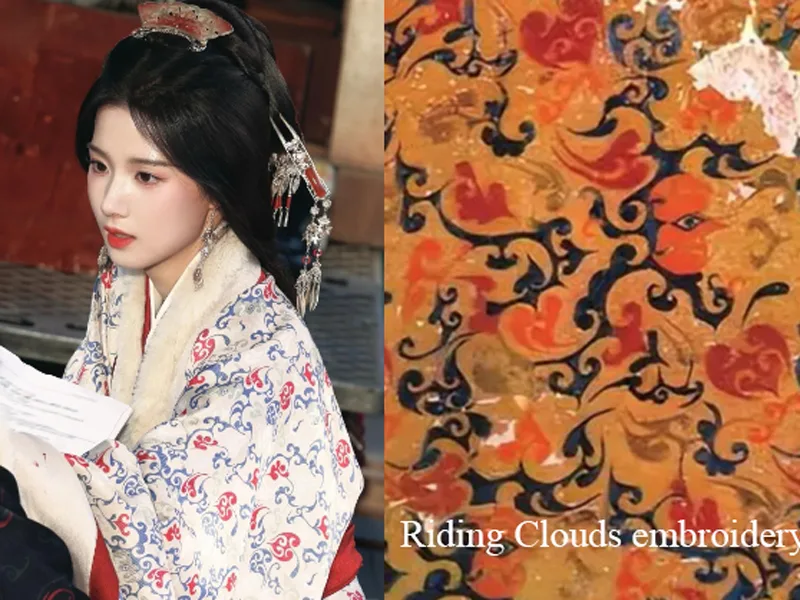
A recent set photo from Ci Tang (刺棠) shows Lu Yuxiao (卢昱晓) in a white wide-sleeved robe covered with curling red, blue, and gray motifs. Some viewers called the pattern “very now,” comparing it to prints used by luxury labels. The question is fair: did the costume team borrow a contemporary design, or did ancient China already have this look? Lu Yuxiao first drew wide attention as Shangguan Qian (上官浅) in My Journey to You (云之羽), so her costumes now invite close reading. The answer is more interesting than a simple yes or no. The motif resembles Riding Clouds embroidery, a Han-dynasty textile tradition. Once you follow its lines, the “modern” print becomes a clue to much older taste.
Han Roots
Riding Clouds embroidery is not a decorative nickname invented by a drama. It is a named type of Han embroidery. Its main stitch was chain stitch, worked loop by loop to create fine, linked lines. The design centers on rolling cloud forms, with outlines of phoenix birds and coiling chi dragons tucked among them. The effect is movement: cloud scrolls seem to drift across the cloth rather than sit flat on it. Before the Han, related scroll patterns appeared in Chu (楚) style work from Hubei (湖北). Those early examples did not yet form the fixed Riding Clouds type, but they prepared the visual grammar. Their lines curl and turn with a freedom that differs from heavier Central Plains patterns.
The early Western Han was its high point. Several pieces from the Mawang Dui (马王堆) Han Tombs carry this embroidery. Mature chain stitch, worked in vermilion, brown, and olive-green silk, produced continuous cloud bands with clear lines and rich color. After centuries underground, the patterns still read. The name itself appears in a burial inventory from the same tomb, so it is not a modern label. The robe in the photo shares that rolling rhythm, even if its colors and production method are different. The resemblance is not exact copying; it is a family likeness in line and mood.
After the Western Han, the specific phoenix-and-cloud combination stopped being used as an independent embroidery name. The cloud motif did not vanish. It became more regular in composition and appeared on more objects. During the Wei, Jin, and Southern and Northern Dynasties, flat stitch began to share the stage with chain stitch. Silk threads were laid side by side on the surface, and cloud shapes grew lighter, ribbon-like, less heavy than Han examples. This shift matched changing dress styles. The old linked texture did not disappear overnight, but it no longer dominated the visual field.
Tang, Song, and Yuan makers kept revising the motif. Some clouds were full, some thin, yet the pattern remained a common dress decoration. The specific Han form faded, and flat stitch became the mainstream technique. By Ming and Qing times, cloud systems were fully sorted: ruyi clouds, four-joint clouds, drifting clouds. They appeared on clothing, buildings, and objects. Embroidery grew smoother and more even, losing the grainy texture of Han chain stitch. The white robe’s print sits at the end of that long revision, not at its beginning.
Screen Choices
Why did Riding Clouds embroidery appear in the Western Han? One reason is Chu taste. Many founding figures of the Han court came from Chu territory, so Chu visual habits entered elite dress. Curling clouds and phoenix birds moved from a regional style into courtly fashion. A second reason is craft. Han embroiderers could control chain-stitch spacing and direction with great precision, and the stitch naturally built the layered density that cloud scrolls need. A third reason is belief. Cloud breath and auspicious birds carried lucky meaning, and wearing them was a visible wish for good fortune. The pattern worked as fashion and as a quiet blessing.
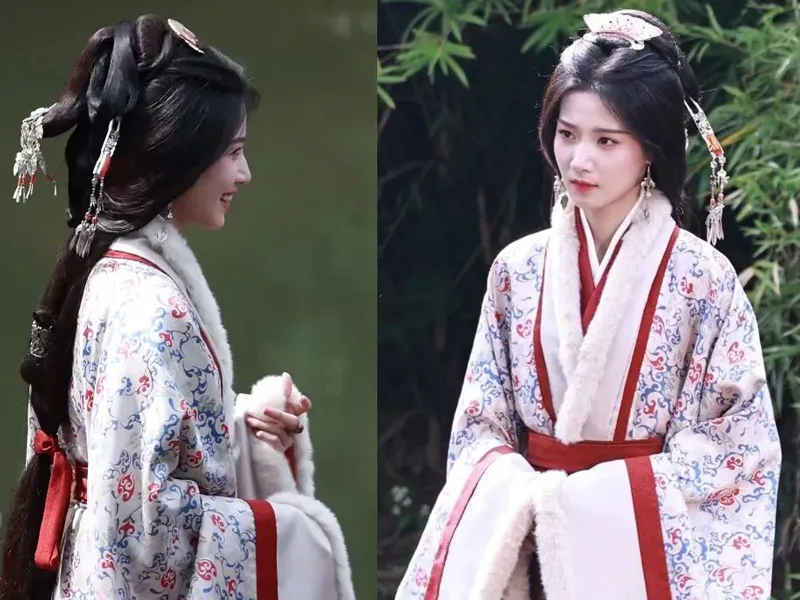
The Ci Tang costume team did not copy a tomb object. It made a screen-friendly adjustment. Red, blue, and gray suit the white robe better than ancient silk colors might under current lighting. The pattern is produced by digital printing, not chain stitch. That choice explains why the surface looks sleek and “modern” to some eyes. A fully hand-stitched chain-stitch garment would take enormous labor and money, and few productions can carry that cost for one costume. The result is a translation, not a fake.
This small debate shows how costume dramas can teach without a lecture. A viewer notices a print, asks a question, and lands on a Han embroidery name, a tomb inventory, and a stitch history. The white robe is not a textbook page. It is a visual prompt. Once the prompt is followed, the “modern” curl turns out to be an old line, bent to fit a camera. That is a reasonable compromise between accuracy and storytelling.