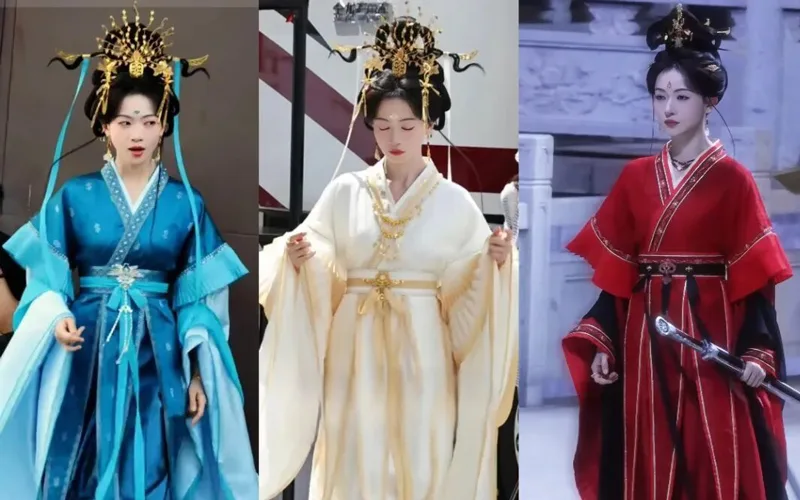
Recent leaked shots from Feng Bu Qi (凤不栖) show Wu Jinyan (吴谨言) in several period costumes with clusters of pointed cloth strips hanging below the belt. At first glance, they can look fussy, even a little alien to viewers raised on clean cross-collar robes and plain skirts. The question is fair: why attach so many sharp tails to a waistline? The answer is less about random decoration than about a very old garment structure, filtered through television design. Once you see the logic, the strange detail starts to make visual sense—though it still deserves a second look. The effect is deliberately unstable: elegant from one angle, almost armor-like from another. That tension is exactly what makes the costume worth discussing rather than simply dismissing.
Historical Echoes
The strips echo a garment element called drooping shao (髾). The word has two lives: it can mean the natural tip of long hair, and it can mean a swallow-tail cloth pendant sewn at the waist or hem, narrowed to a point at the end. The drama uses the second meaning. Instead of floating freely from a skirt, the pointed pieces are fixed near the waist seal and fall along the skirt. That placement matters. It turns the body’s vertical line into a series of sharp accents, so the eye keeps sliding downward. It also separates the upper body from the lower body without adding a heavy belt or bulky sash. In motion, the strips break the skirt’s solid block into flickering fragments, which is useful on camera and unusual in ordinary period dress.
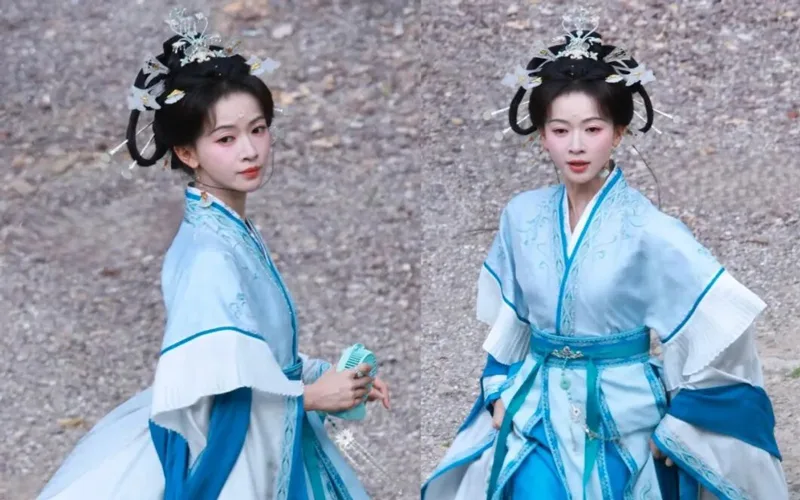
Its roots reach back to Shenyi (深衣) tailoring from Pre-Qin times into the Western Han. In that deep robe, the lapel was extended and wrapped around the back, and the hem naturally formed a swallow-tail point. This point was not an extra applique; it belonged to the cut. It helped cover the lower body, respected ritual codes, and kept fabric from wrapping around the legs. Fragments from Mawang Dui Han Tomb (马王堆汉墓) show such extended hems, and Sima Xiangru (司马相如) mentions shao in Zixu Fu (子虚赋). The detail, in other words, has a structural past. It began as a solution to how cloth should wrap, move, and cover, not as a decorative flourish added for spectacle.
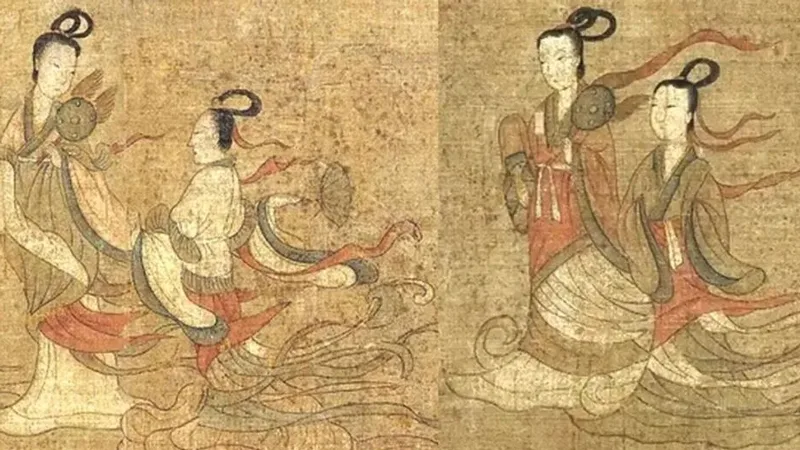
Later, Shiming (释名) described Guiyi (袿衣): its pointed hem was wide at the top and narrow below, like a gui (圭), the ritual jade tablet held by early lords. Eastern Han versions often had only two or three such points. By the Wei, Jin, Southern and Northern Dynasties, Sima Biao (司马彪) used shao for these pendants, and separate layered pieces appeared. They hung from a waist skirt and spread in tiers, leading to Zaju chuishao Fu (杂裾垂髾服). Gu Kaizhi’s (顾恺之) Nymph of the Luo River (洛神赋) and Northern Wei figurines show the layered effect. Sui and Tang taste moved toward rounder, fuller silhouettes, and the pointed pendant faded from mainstream dress. Its later return in costume drama is therefore selective, not a full historical revival.
Camera-First Design
So why load her costumes with so many? First, the silhouette becomes instantly readable. The show’s overall look draws on Wei-Jin references, and shao carries a clearer period signal than an ordinary cross-collar robe. In a crowded costume-drama market, that difference matters. A viewer may not know the term, but the sharp tails tell the eye that this world is not generic ancient China. They also give the character a recognizable outline, especially in wide shots where faces are small and costumes do much of the storytelling. Recognition is not the same as accuracy, but it helps a show create a visual identity before a single line of dialogue lands. A repeated shape across episodes also helps viewers track the character through crowded palace scenes. That repeatable cue is practical for serial television.
Second, the pieces are built for motion. Light pointed strips lift in wind and swing with each step, so the costume keeps changing shape. Slow-motion scenes and mood-heavy sequences benefit: flying tails create texture, and layered points read more richly than one flat skirt. The risk is overstatement. If every frame is crowded with strips, the costume can overpower the face. Used with restraint, though, the movement turns walking into a small visual event. That is probably why the design feels so noticeable in leaked images—it is doing exactly what camera costumes are meant to do: giving movement a visible edge and giving stillness a little danger. The costume becomes a timing device, not just a surface. Editors can cut to it, and viewers can feel the pause.
The team has not copied a museum piece exactly. It keeps the basic shao form but adjusts length, number, and material for the lens. That is a sensible compromise: television needs clear shapes, safe movement, and repeatable looks across scenes. The result may look odd because modern eyes expect smooth, minimal lines; historical dress often did not. As a design choice, it works when the character’s status and the scene’s rhythm support it. It is not proof of strict authenticity, nor is it pure fantasy. It is a readable costume decision—one that asks viewers to look twice, then decide whether the sharp tails serve the story or steal the scene. In that sense, the controversy is part of the costume’s job: it makes people ask what they are seeing.