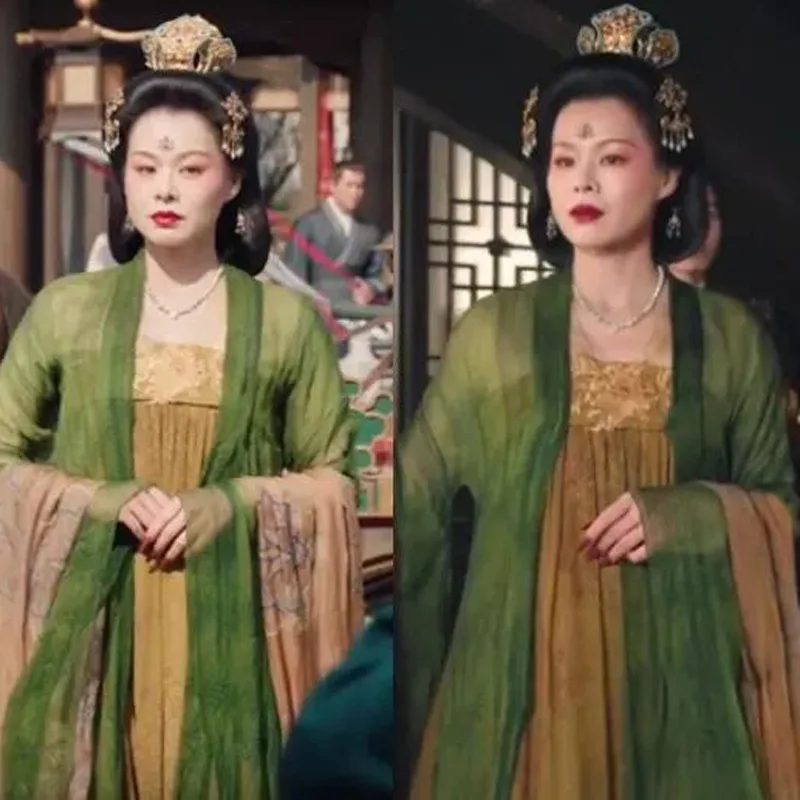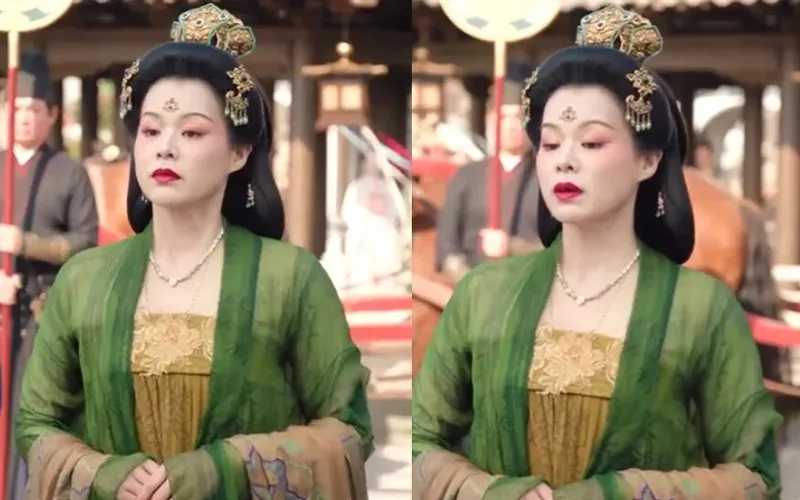
At the Peony Banquet, Myolie Wu does not enter as a guest who needs attention. She plays Mu Ningshuang (暮凝霜), the Grand Princess in Tigers Sniff the Rose (尚公主), and her first look does the talking. A lotus crown sits high on her head. Loose hair falls behind her shoulders. A dark green sheer robe opens over a ginger-yellow dress. The scene belongs to a Tang court setting, yet the costume never feels like a museum display. It feels like a quiet warning. People around her may bow, but the outfit explains why they do. This is power dressed with patience, not noise.
Lotus Crown
The crown is not a random pretty accessory. It borrows from Daoism, where a lotus-shaped ritual headpiece signaled rank and purity. In Tang times, royal women sometimes became female Daoist priests, and noblewomen adapted the shape for gatherings and ceremonies. The drama uses that history without turning it into a lecture. Here, the lotus outline is softer, set on gold and studded with stones. It reads as court jewelry first and religious reference second. That balance matters. The crown gives Mu Ningshuang distance from the room, even while she stands in the middle of it.
Why does the crown work so well on camera? It lifts the head and lengthens the silhouette. It also creates a visual pause above her face. Viewers look up, then meet her eyes. The gold base adds weight, but the open lotus petals keep the shape from looking heavy. The stones catch light in small flashes, not big sparks. This is a restrained choice. It says the character has nothing to prove. Her rank is already known. The crown simply confirms what the banquet should already understand.
There is also a practical story in the design. A Grand Princess who has taken religious vows needs a symbol that can move between temple and court. The lotus does that. It can suggest devotion, but it can also suggest control. On Mu Ningshuang, the crown never looks fragile. It looks chosen. That small difference keeps the character from becoming a costume mannequin. She wears the history; the history does not wear her.
Back Hair
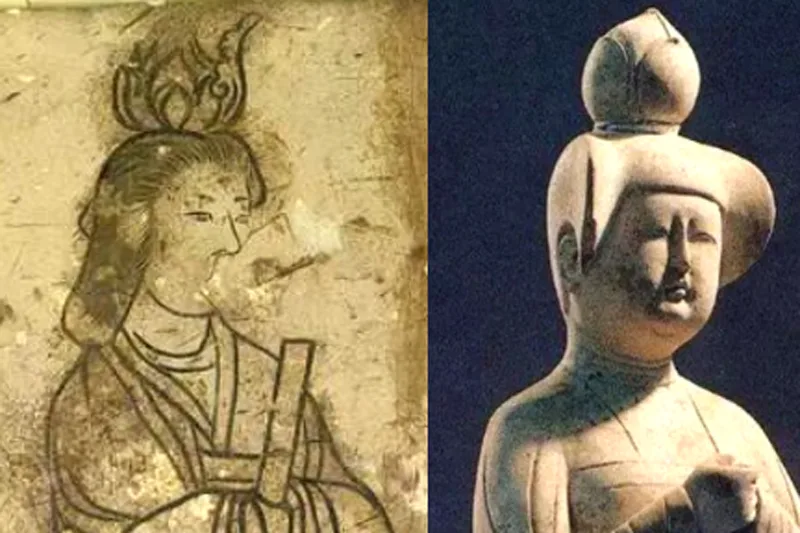
Early Tang women often wore full high buns. By the Kaiyuan (开元) and Tianbao (天宝) years, noblewomen began gathering the back hair and letting it hang behind them. Modern viewers call this “Tianbao hair.” It looks loose, but it is not messy. The shape widens the face and gives the wearer a mature, composed presence. Murals in Dunhuang and Tang Huiling (唐惠陵) show similar arrangements. In Tigers Sniff the Rose, the style gives Mu Ningshuang age and authority without adding a single harsh line.
The hair also solves a casting problem quietly. Myolie Wu shares scenes with younger women. A tight, trendy style would flatten that difference. The backward flow of hair creates a generational gap that feels natural. It frames her face instead of hiding it. The crown sits above, the hair falls below, and her expression stays in the center. No extra veil is needed. No giant sleeves are needed to announce her. The silhouette already does the work.
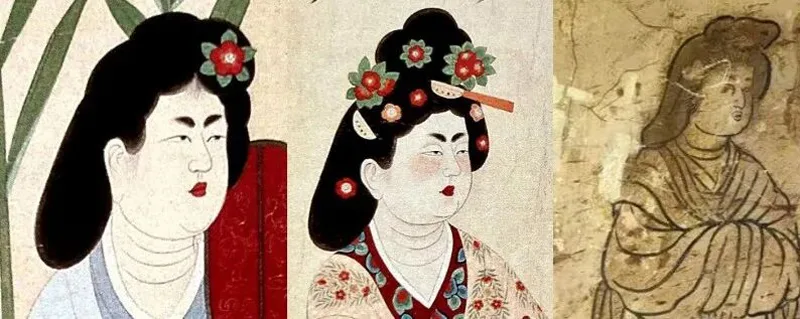
What makes this hair read as noble rather than casual? Control. The strands are gathered with intention. The back section is smooth near the crown and relaxed lower down. That contrast keeps the look from turning stiff. It also matches the character’s temperament. Mu Ningshuang is calm, but not soft. She watches before she speaks. The hair carries the same message: movement is allowed, but only within limits she sets.
Face Signals
Her makeup is strong, but it is not loud. The brows are slender and slightly lifted at the ends. That angle creates a frown without forcing one. Warm red-pink color sits around the eyes, echoing Tang red makeup while staying controlled. The lips are full and clear red. The skin looks bright, not painted over. Every choice pulls attention to the eyes and mouth. The face becomes a map of rank: calm, watchful, and ready to answer a challenge.
A small red Huadian sits on her forehead. It is easy to miss, and that is the point. The mark does not shout. It gathers the gaze between the brows and adds one sharp note to an otherwise balanced face. In a crowded banquet scene, this tiny detail helps viewers find her. It also keeps the makeup from looking like a modern beauty filter. The finish is rich, but the edges stay clean.
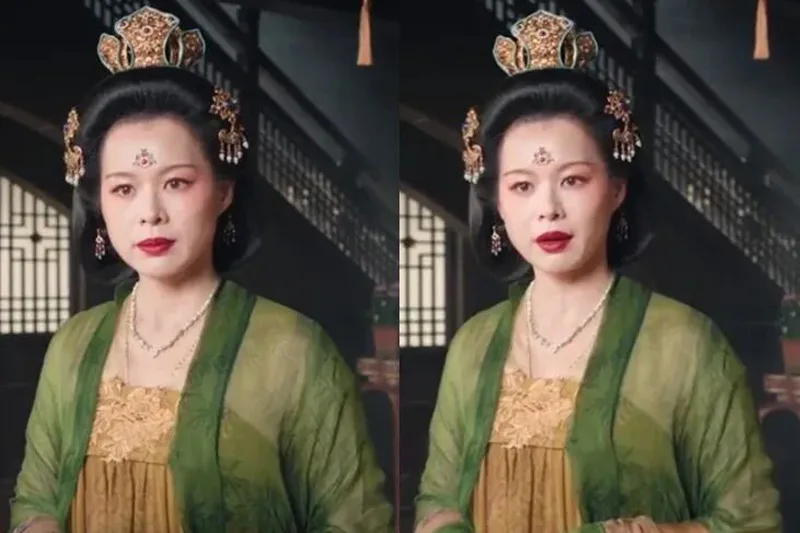
The restraint matters. A Grand Princess can wear heavy color, yet too much would turn her into a painted warning. This makeup lets her stay still. The red around the eyes suggests warmth, but the brows suggest distance. The lips suggest ceremony, but the forehead mark suggests precision. Together, they create a face that can smile and still make the room nervous. That is a harder effect to build than anger.
Green Layers
The outer robe is deep green and sheer. It is light enough to fold as she walks, so the costume never looks like a board. The green is dark, not fresh or sweet. That shade creates distance. Under it, a ginger-yellow dress gives a controlled clash. Yellow and green could fight, but here they separate into layers. The cut is loose. There is no tight waist to make the look modern. The broad sleeves and open shape follow Tang court style while keeping the body relaxed.
This outfit also solves a scene problem. Attendants and younger women often wear darker or simpler clothes. The green robe lets Mu Ningshuang stand out without standing in the center. She can be at the edge of a frame and still hold it. The crown adds height. The loose hair adds width. The wide sleeves add movement. Together, they make her posture look straighter and her presence calmer. The costume is doing camera work before the camera does.
The design logic goes further than beauty. Mu Ningshuang has weight in both court and inner palace. She is mature, patient, and hard to read. The lotus crown suggests distance from ordinary concerns. The loose hair and rich makeup place her in her age and class. The dark green robe hints at depth she does not show. None of these choices are loud alone. Worn together, they explain why younger characters keep their guard up around her. The look is not just a costume. It is a character summary.