A handscroll nearly seven meters long, crowded with figures, carts, bridges and water, was once remade in thread. The 1959 Bian embroidery version of Along the River During the Qingming Festival hangs at the Tsinghua University Art Museum, and its inscription records an improbable schedule: 22 women workers at the Kaifeng Bian Embroidery Factory, 35 days. The picture area measures 30.5 centimeters high and 680 centimeters wide, and every shopfront, boat, rope and ripple in Zhang Zeduan’s original has been translated into the thickness, direction and color of silk.
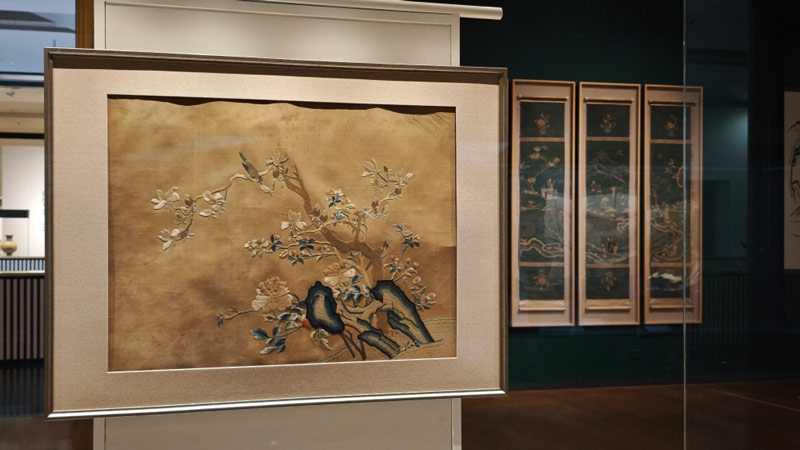
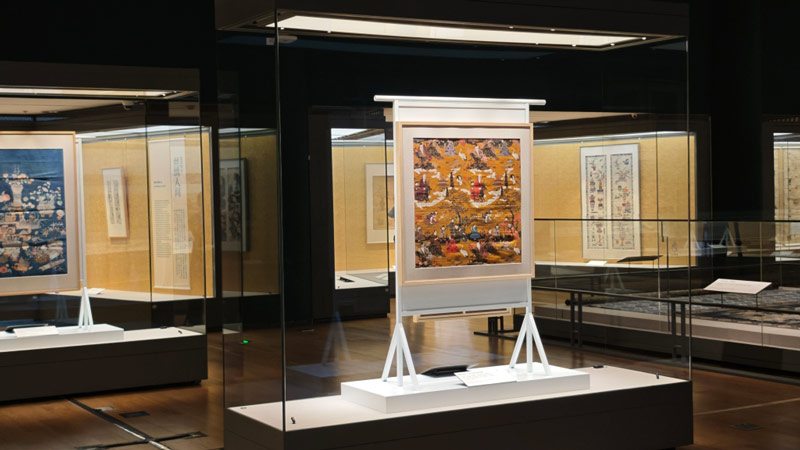
The work sits inside Woven and Embroidered Paintings from the Museum Collection, an exhibition drawn from the museum’s own holdings that runs until April 11, 2027. More than 60 pieces are shown, arranged in five sections covering birds and flowers, human relations, antiquarian objects, everyday life and sacred figures.
What the Five Sections Hold
Curator Gao Wenjing describes the show as holding two kinds of realm: the maker’s realm, built from material and technique, and the human realm, where patterns carry feeling, ethics and aspiration.
In the first section, a Qing pair of screens in blue silk-ground embroidery sets peonies, an egret, autumn chrysanthemums, magpies and calligraphy into a single picture. The second holds a Ming Kesi silk tapestry of the five relationships, in which a phoenix, a crane, a mandarin duck, a wagtail and a pair of swallows stand for ruler and minister, father and son, husband and wife, elder and younger brother, and friends. The third shows how Kesi and counted-thread gauze work handle scholar’s objects, bronzes and flowers. The fourth is where the Bian embroidery hangs, among small figures that reward close looking rather than an abstract idea of a golden age. The fifth gathers longevity and blessing subjects, among them immortals celebrating, the star Kui, and Magu offering peaches. Also on view are a Qianlong-period woven brocade Buddha image, the Immeasurable Longevity Buddha, and a late Ming to early Qing four-panel screen of Gu embroidery figures.
Turning a Painting Into a Construction Drawing
Bian embroidery takes its name from Bianliang, the old name for Kaifeng in Henan. In 1959, marking the tenth anniversary of the People’s Republic, the province set out to produce a work with a strong local signature, and Along the River was chosen: it depicts Dongjing Bianliang in the Northern Song, the city that became Kaifeng. For the city, the painting works as a portrait of itself across a thousand years.
Wu Tianfang, a provincial inheritor of the Wu family Xuanhe mounting and restoration technique, recalled that once the project began, the painters and technicians involved traveled to Beijing to study Zhang Zeduan’s original at the Palace Museum and record its details. Among the early materials later rediscovered are printed copies of the painting marked densely with color notes, detail notes and positions that needed handling.
Cheng Manping (程曼萍), a national inheritor of Bian embroidery, walked the room through the sequence. A line drawing is traced from the original, with translucent paper laid over the image and the outlines of figures, buildings, boats and trees picked out one by one against the light. White satin is then stretched on the frame, the drawing placed beneath it, and the lines drawn again onto the silk surface. Only at that point does a painting become a working drawing for the embroiderer.
Even then the problem is one of language. Ink can be washed thin or laid on thick; embroidery has only thread. Water appears as a calm sheet in one place and a whirlpool in another; a willow branch should read soft, an old tree rough and strong. Clothing folds, faces, straw hats, the ropes on a boat and the crowd on a bridge each call for a different stitch. “You can’t add stitches carelessly, and you can’t take them away carelessly,” Cheng said.
Scale compounds it. Figures in the original are tiny, and at 30-odd centimeters high a face in the embroidered scroll comes to less than a grain of rice, yet the action and expression have to survive. Silk thread is split finer and finer to manage it. A single filament can be divided repeatedly depending on the subject; for a translucent fish tail, Cheng said, the thread can be parted until it nearly merges with the water. Studying the 1959 piece, the curator found extremely fine thread worked through many of the water patterns, with the stitches barely visible at normal viewing distance.
What Came Before the Thirty-Five Days
Thirty-five days reads like a speed record. The materials discussed at the session make the number more concrete. Wu Tianfang said work began in May 1959 and ran through version selection, observation in Beijing, design drawings, tracing, color matching, embroidery and mounting, with the finished piece sent to Beijing on September 27. The 35 days cover only the concentrated stitching stage; a long stretch of preparation came first.
Conditions were nothing like today’s. The workshop relied mainly on natural light, and to hold the pace many embroiderers moved their bedding in, working out stitches by day and continuing under lamps at night. Some traditional stitches could not handle a picture this complex, so the makers tried, unpicked and reworked as they went.
How many people actually took part drew fresh attention at the session. The inscription on the piece names 22 women, and the museum and earlier research have used that figure. Wu Tianfang, working from a surviving group photograph, counted 25 people in the frame; subtracting two male staff, he suggested there may have been 23 embroiderers. Twenty of them have been identified so far.
Decades in the Storeroom
After 1959, Along the River became one of Bian embroidery’s most recognizable subjects. Cheng Manping entered the Kaifeng factory in 1972 and was first set to embroider flower pots, tables and stools before moving onto the scroll. The full work was later divided and enlarged into sections such as the Rainbow Bridge and the city gate, and embroiderers across the decades kept adjusting colors and stitches so that faces, clothing folds, straw hats and grain sacks gained more depth. Hand copying, in other words, never froze after one attempt; each re-stitching is another reading of the original.
The 1959 scroll was sent to Beijing as a gift, entered the collection of the Central Academy of Arts and Crafts, and eventually reached the Tsinghua University Art Museum with the school’s holdings. For decades it stayed out of public view. Tang Wei, a professor at the Tsinghua Academy of Arts and Design, recalled that the academy received a batch of state-allocated craft works mainly as teaching material, and that limited display space kept much of it in storage, available for occasional classroom viewing but rarely to visitors. Only when the exhibition brought the piece out did Tang Wei, standing in the gallery, recognize it as the very scroll made in Kaifeng and sent to Beijing. Word traveled back to Kaifeng, and the people working on Bian embroidery research reconnected with a work that had been out of sight for decades.
One question closed the session. Machines embroider, high-resolution scanning exists, and artificial intelligence can produce an embroidery-style image in seconds, so why spend months over a painting by hand? Cheng’s answer came back to the thread. A machine uses thread of essentially fixed thickness, while a hand embroiderer can change the thickness, direction and color of silk for one patch of water, one face, one willow branch. How fine a filament is split, and where a stitch lands, remain a judgment made by the person holding the needle.