The sound comes before the cloth does: a wooden loom ticking and knocking, then the rasp of the beater pulling a weft into place. Inside the Xiuniang Intangible Heritage Culture Park (绣娘非遗文化园) in Gaoyinpu village, a dozen or so weavers work the treadles in the same room, turning seven-color cotton and plain cotton yarn into striped and diamond-patterned fabric. The village has spun and woven for more than 700 years, and the craft is listed as a Tangshan municipal intangible heritage item.
What is unusual here is not the survival of the technique but the way it has been organized. Handicraft traditions often persist as a family practice or a demonstration for visitors. This one runs as a business with a village at its center.
A Village Workshop That Grew to 300 Mu
In 2017 the village set up the Xiuniang Handicraft Workshop, held by the village collective with shares across the residents, and it has since grown into a park of more than 300 mu, about 20 hectares. The scale is the point: it is large enough to hold production, training and visitors at once.
“Our village has woven and spun since the Qing dynasty, when the craft was at its height and every household had a loom,” said Zhang Aidong, a member of the Gaoyinpu village Party branch committee. “When we founded the workshop in 2017 it helped more than 120 women in the village earn, with monthly income of around 2,000 yuan. There are home-based workshops too: the finished cloth comes in and we price it by quality.”
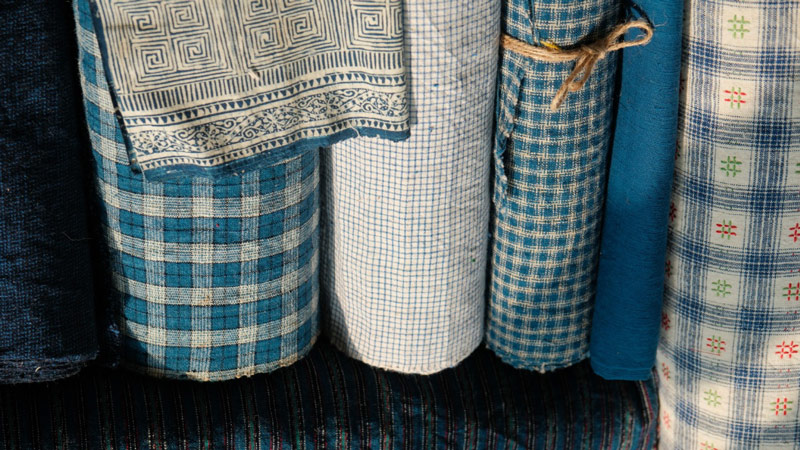
The work itself has not been simplified. Weavers read the warp by feel, press the treadle and pass the shuttle by hand, producing a firm, even surface in stripe, diamond and meander patterns. Finished cloth becomes tea mats, table runners, cushions, aprons and storage bags. Getting from raw cotton to those goods takes 72 separate operations, among them ginning, fluffing, spinning, sizing and dyeing, and weaving.
Seventy-Two Steps and Five Unifications
Production follows what the park calls the five unifications: one design, one supply of materials, one standard, one production process, one buy-back price. Liu Xiufeng, the park’s technical manager, said most of the weavers come from the village itself and can work either at home or on site. Seven-color cotton and pure cotton yarn feed a line of more than 100 kinds of cloth products, among them bedding, women’s bags and accessories, and custom orders are taken as well.
Zhang Xiuzhi, 78, is one of the older hands. “I’m 78 and I was weaving at home from about the age of 15,” she said. “When Gaoyinpu set up the workshop I signed up straight away. We keep each other company, we talk, and we work out how to weave better.”
Sales reach across the Beijing-Tianjin-Hebei region and beyond it, to the United States and Australia, and the park’s annual turnover runs at 5 million yuan. Alongside the looms, the park has built more than 30 study-tour programs, among them cotton fluffing, rolling cotton sticks, cloth painting, tie-dyeing and batik, and redesigned a small loom for teaching that works on the same principle as the full-size one. Song Yuhua, a guide at the park, said nearly 1,000 students on overseas study tours have come through this year, most of them American.
The Same Craft Elsewhere in China
Qian’an is one node in a wider network of coarse-cloth traditions that have taken similar routes to sustainability. Zaoyang in Hubei, whose craft was added to the national intangible heritage list in 2021, traces its history to the Neolithic period; pottery spindle whorls have been unearthed at the Taolongbei site there, and its core sequence runs to 17 operations. Boxing in Shandong, a provincial-level item, represents the hand cotton-weaving tradition of the Yellow River basin and has grown into a complete industrial chain and one of the country’s main production bases. Zanhuang’s Yuancun cloth in Hebei joined the provincial list in 2013 and keeps the full 72 operations from cotton picking to loom, with products shown at Milan Fashion Week. Yongji’s Huichang cloth in Shanxi entered the national list in 2021 as an extension of traditional cotton weaving, carries more than 400 years of family transmission, and also works through 72 operations. Hong’an large cloth in Hubei is hand-woven in 72 steps, and Tao Wencheng, a municipal inheritor, has led fellow villagers into production that has appeared at China Fashion Week. In Shanghai, Qingpu handwoven cloth has its own teaching institute, and its offshoots include qipao, cloth shoes and dolls.
Read together, these cases suggest the same conclusion. A loom at the edge of a village can become a classroom for students from another continent; a workshop run by a collective can keep 120 women in paid work. The 72 operations are slow by design, and the value of the slow part is that it cannot be moved offshore or compressed into a shorter sequence.