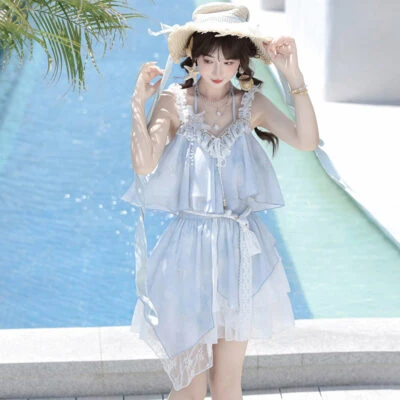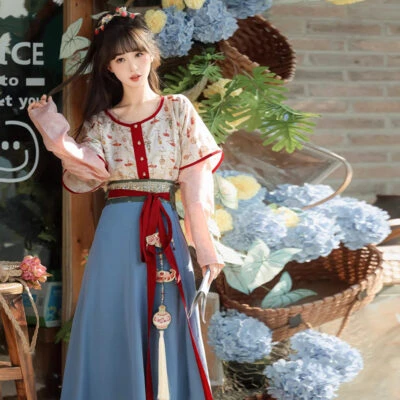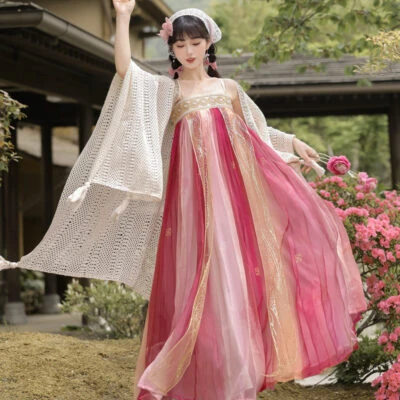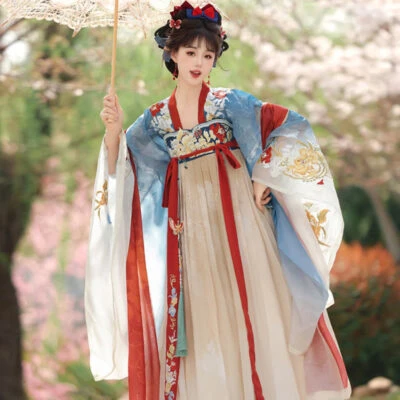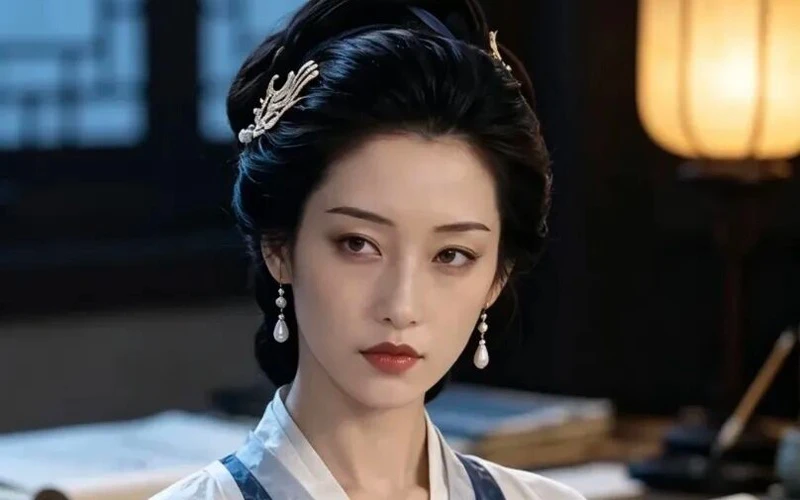
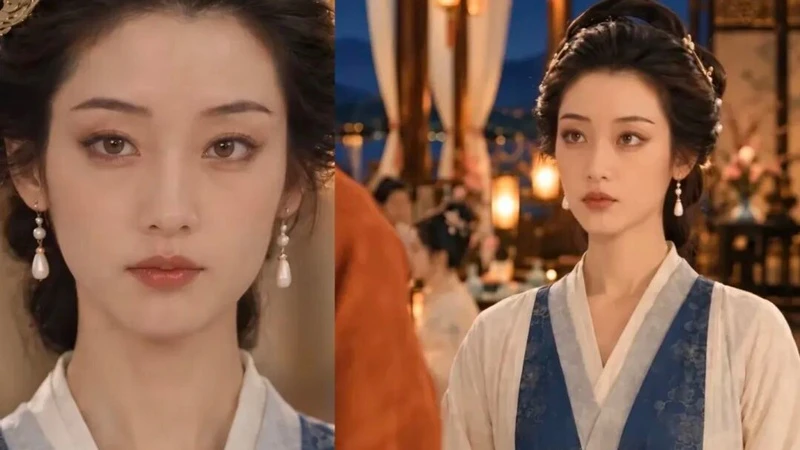
When the AI drama Chi Xie Ru Song (持械入宋) introduced its version of Li Qingzhao (李清照), viewers reacted as if a portrait had stepped out of a museum and corrected years of casting. Her face looked spare, her clothing quiet, her gaze firm. The surprise was not that a machine could draw a historical woman, but that this invented image felt closer to her than many flesh-and-blood performances. Set near the Song dynasty’s fracture, when the north fell and the court moved south, she needed both polish and resolve. This version gave her both. Online comments focused on one thing: recognition. The image did not flatter her; it studied her. It also reopened an old question: what should Li Qingzhao look like on screen?
A Sharp Scholar
The design team looked at fine-line paintings by Zhao Guojing (赵国经) and Wang Meifang (王美芳). Their women are not sugary beauties; they are calm, narrow-eyed, and slightly distant. The AI portrait borrowed that restraint. Instead of adding glamour, it removed noise. Eyebrows sit low and clear. Lips stay quiet. The result suggests a scholar who can drink alone, write a bitter poem, and still refuse to soften her judgment. That kind of face does not beg for sympathy. It waits for the viewer to catch up.
Her period makes this restraint meaningful. In the Northern Song, women’s fashion leaned toward muted elegance. Moral philosophy was gaining ground, and public taste rewarded clothes that looked plain but cut well. A memoir, Dongjing Menghua Lu (东京梦华录), remembers Bianliang (汴梁) as a city of shining hairpins and drifting silk. Another book, Wulin Jiushi (武林旧事), describes Southern Song crowds in bright dress. Those records promise color, yet they also show a society obsessed with finish, posture, and small details. Luxury existed, but it was edited.
That context explains the appeal. Li Qingzhao lived through a broken border, a lost collection, and a marriage cut short. A soft face alone cannot carry that story. The AI image keeps her features delicate but adds a closed, steady mouth. It is a small choice with real force: she looks like someone who has learned to survive polite company and impolite history. She also looks like a writer, not a mascot. That difference matters more than any gold pin.
Dress As Argument
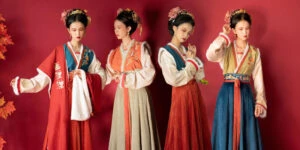
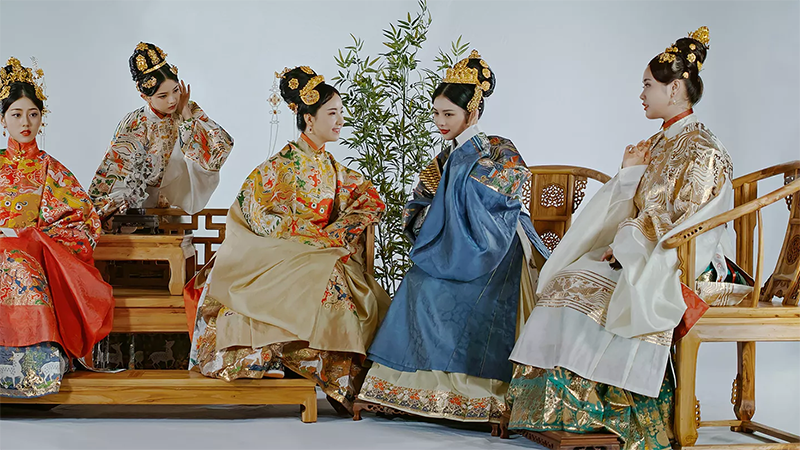
Her clothes do much of the arguing. The outfit follows the jacket-and-skirt set common in the Song era. The top can cross at the collar, open at the front, or overlap lightly; the skirt can be pleated or paneled. Such pieces are flexible. Change the fabric and color, and the same shape becomes morning wear, travel wear, or a private evening dress. A long scarf adds movement without fuss. A narrow belt and a plain inner layer keep the line clean. Nothing here is random. Each layer can be read at a glance, yet none of it shouts.
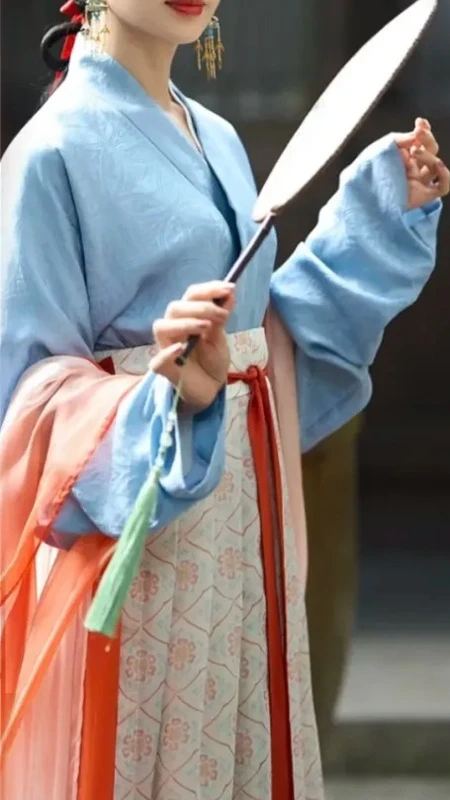
Blue and green keep appearing in Li Qingzhao portraits, and this version uses them with care. The colors cool the skin and sharpen the mood. They also match a Song preference for restrained contrast: not dull, not loud. Her hair follows the same logic. Tang high buns would overpower her; Song-style knots sit closer to the head. Pearls and tiny pins do the rest. Even the 1980s television habit of building elaborate loops now looks too busy beside this quieter shape. Simplicity here is not laziness. It is control.
The drama pushes the palette paler and colder than usual. That choice gives her a blade-like clarity. She can stand in a room full of officials and lose nothing. Yet the soft fabric keeps her from looking like a man in costume. The balance matters. Li Qingzhao was not a warrior, and she was not an ornament. She was a writer whose pen could cut, and the clothes let us see that without shouting. When the wind lifts the scarf, the image finally breathes.
More Than One Face
Her own lines resist a single portrait. In one poem she is a girl running shyly from a visitor, hairpin slipping, pausing at the door to sniff green plums. In another she drinks by a fence at dusk, sleeves full of scent, thin as a yellow flower in west wind. Playful and exhausted, curious and withdrawn: both belong to her. A good screen image must leave room for that swing. It must allow her to blush, then harden, without turning into two separate people.
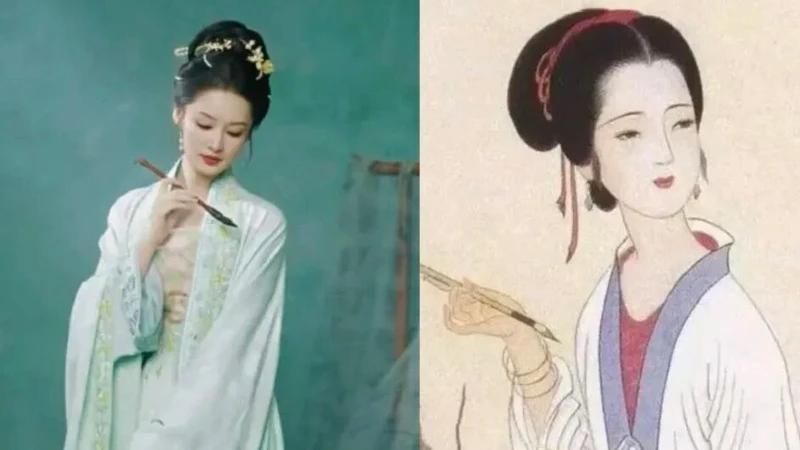
What holds the pieces together is stubbornness. The era pressed on her: war, displacement, widowhood, gossip, legal trouble. She kept writing anyway. That is why simple styling works better than grand costume. Too much decoration turns her into a museum doll. Too little makes her a modern woman in old clothes. The AI version succeeds because it looks lived-in. The face is quiet, but the spine is straight. Her elegance is not fragile; it is the result of pressure.
Viewers keep returning to her because she never becomes a fixed icon. Each generation redraws her according to its own idea of intelligence, grief, and independence. The new portrait is not the final answer. It is a useful provocation. It asks casting directors to stop chasing pretty symmetry and start looking for inner weather. Some viewers want a fragile poet; others want a stubborn survivor. The strongest choice may combine both. So the question remains open: who should play Li Qingzhao next, and what should her face tell us before she speaks? The best answer may still be a surprise.