Flax and rose are what you notice first in a Liangzhou mooncake, then the steam. The cake is heavy, flat-faced and banded with color, and in Wuwei it has been made the same way for centuries. “Heaven above, send it down big, mooncakes as big as a cartwheel,” runs a children’s rhyme still chanted in Liangzhou district as the Mid-Autumn Festival comes round.
Against a season of elaborately marketed factory mooncakes, the plain, dense Gansu version has found a following of its own. Its appeal is not sweetness but heat and grain: sourdough, wood fire, and color drawn entirely from plants.
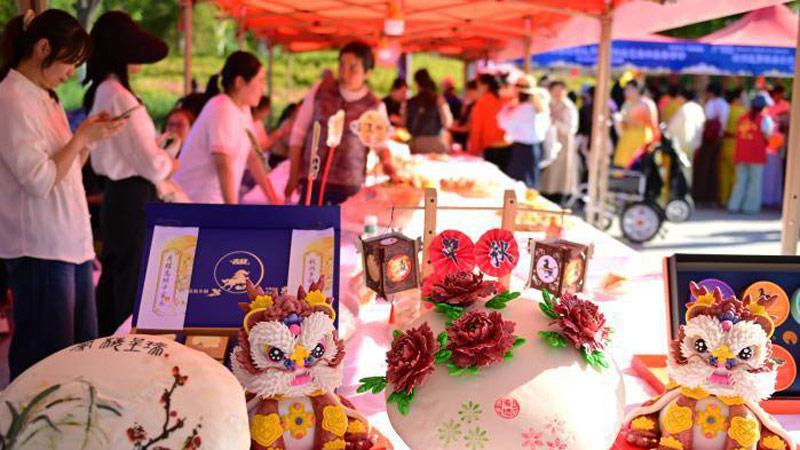
150 Cakes From 47 Townships
On September 22, at the Hexi Metropolis scenic area in Liangzhou district, visitors stopped in front of cartwheel-shaped cakes laid out for Gansu’s 2026 provincial Mid-Autumn main event, a civilization market titled Moonlight on the Silk Road, New Style Warms Ten Thousand Homes. “This mooncake is so beautiful I hate to eat it,” one visitor said.
The recipe is a municipal intangible heritage item in Wuwei. Sourdough starter and hand steaming do the work, with no artificial colorants; turmeric, flax, red yeast and fenugreek supply the color, turmeric across the top and flax along the bottom, and the layers are stacked one on another. Zhao Jianping of the Liangzhou district New Era Civilization Practice Center listed the meanings folded into that construction: five blessings, seven stars, completeness.
Cakes sent by every township and street in the district were shown together. “There are more than 150 in all, from 47 townships and streets, some 70 to 80 centimeters across and the heaviest over 10 jin,” said Wang Hongshan, director of the Liangzhou district cultural center. They will also enter a skills competition with 10 prizes. The display was one part of the fourth Liangzhou Big Mooncake Making Skills Exhibition and Tasting event.
Xinhua reporters at the scene drew the contrast with the delicate mooncakes of the south. A Liangzhou cake runs up to 80 centimeters across and about 15 centimeters thick, weighs more than 10 jin, and is shaped like a wheel; a family will work through one for days. Zhao Rong, an official from Zhangyi township, walked through the seven stages: mixing and fermenting the dough, rolling the skins, brushing oil and spreading the filling, stacking the layers, sealing and shaping the top, stamping patterns, and a long turn in the steamer. Dough is rolled into several discs of decreasing size, brushed with oil, dusted with turmeric, red yeast, flax and fenugreek, and piled up before it goes in. Cut open, the cake shows five bands of black, brown, green, red and yellow, one color and one aroma to a layer. Xu Jingyun, a clerk in Gaoba township, described the shapes pressed onto the surface, among them a monkey gazing at the moon and lotus petals, worked from dough and standing for reunion as much as for the maker’s hand.
Eight Steps and a Fire Set by Feel
Two days later, on the fourteenth day of the eighth lunar month, smoke and the smell of baking rose over Yujiawan village in Xiashuang township, where the annual steaming of thousand-layer cakes went ahead as it does every year.
“Every Mid-Autumn we make big mooncakes by hand. These are the old recipes handed down by the elders: flax, turmeric, red yeast, fenugreek, layered one on another. The color comes out beautiful and the texture is soft,” said Li Shuqin, kneading and pressing the dough, rolling the skin, brushing oil and building up the layers as she spoke. In the village the work is part of the festival itself: after the full moon is honored, the family sits down to share the cake, and relatives are given one to take away.
Local makers follow what they call the eight-step method: ferment, roll, spread, rest, load, steam, lift, decorate. Fermentation is the first gate. A little dry yeast is opened in water, worked into flour, covered and left until the dough is honeycombed, then kneaded again with 40 degree water and a little more flour, with water and flour added repeatedly until the mass reaches the right size. The more rounds of fermentation and kneading, the fuller the aroma. Rolling turns the dough into portions: the largest becomes the base, the second the outer skin, the rest equal middle layers. Spreading means a layer of oil, then a layer of color: red yeast for red, fenugreek for green, turmeric for yellow, flax seed for brown. The layers go five, seven or nine deep, the outside lightly tinted with turmeric and oil so the steamed cake shows a golden grain-ear shade. Then the dough rests about half an hour. Loading takes two people, who lower the discs in and weight the top so no steam escapes. Steaming starts on a high flame and drops to a gentler one once the heat rises through; 40 to 50 minutes finishes it. Lifting and decorating follow immediately, a carved stamp dipped in red yeast juice dotting 24 flowers across the top, like the 24 solar terms, or a sky of stars.
Shi Hongqin has steamed these cakes for decades and judges temperature by hand, holding a cook time of more than two hours. “Steaming mooncakes is all about the fire. Some of the young people in the village don’t know how to run it, so they ask me to come and watch,” she said. Wood fire offers no fixed settings, and the work cannot be hurried or skimped, which is why, she argues, machine production has not replaced it. While the cakes cook she walks younger villagers through the ingredients, the layering, the stamping and the shaping.
The Same Recipe at a Museum Counter
In Lanzhou, steamers come off the heat through the day, turning out Yongdeng thousand-layer cakes built on local flax oil and rose jam. In a Qilihe district alley, Grandma’s Home Earth Mooncake weighs 1.5 kilograms and orders are booked through the National Day holiday.
The old recipe has also moved indoors. For three years running the Gansu Provincial Museum has worked with local companies on cultural-creative mooncakes, stamping the Bronze Galloping Horse and a spiral-pattern painted pottery jar onto the surface and folding Lanzhou lily, goji berries and bitter-water rose into the filling.
Beyond the mooncakes, the market gathered a wider slice of Hexi food and craft. Stalls ran through millet soup with fried dough twists, cold noodle sheets, the three-part Wuwei platter known as Sanche, pounded potato mash, sugar-oil cakes, oven buns and Liangzhou spicy hotpot, alongside a display of the district’s cold-arid “four golds”: vegetables, sheep, cattle and melon. Liangzhou lanterns, built from bamboo, silk, paper and candle through tying, mounting, cutting and carving, stood near a heritage area holding Minqin embroidery, felt and bone ointment; hand-made Gulang carpets, embroidery and dried noodles; Tianzhu Tu pan embroidery, thangka, clay figures and yak-wool weaving; and Liangzhou pile embroidery, masks, knotting, straw painting, Western Xia clay movable type and paper-cutting. In the calligraphy section, pieces reading Great Virtue Carries Blessings and Bloom With the Full Moon were given away. “Each Liangzhou ci poem carries home and country, parting and reunion,” said Wang Xiangyu, deputy secretary-general of the Wuwei Calligraphers Association. “Visitors can order a piece in their own words and put their longing into ink.”