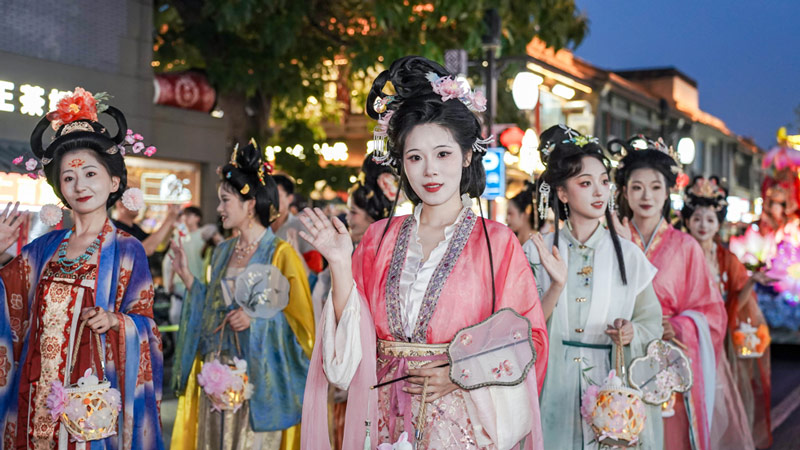
In 2022 Luoyang had 18 Hanfu experience shops. The city now counts more than 1,600, a 75-fold rise in three years, and the trade supports over 30,000 jobs as shop managers, makeup artists, photographers and livestream hosts. The Old Town district alone has drawn more than 15 million Hanfu visits and close to 2.6 billion yuan in related spending, roughly 80 percent of it from visitors who came from outside the city.
Those figures make Luoyang an unusual case in China’s costume economy. Few cities have pushed a rental counter all the way into an industrial chain, with manufacturing, styling, photography and hospitality feeding one another inside a few square kilometers.
A Full Chain Built in Three Years
Around Luoyi Ancient City and the Cross Street blocks, Hanfu shops stand shoulder to shoulder in a cluster with few equals in the country. Upstream, local garment workshops and accessory studios supply fabric, hairpins, dangling ornaments and Huadian (花钿) face decorations, which holds costs down and shortens the gap between a new look and a store window. In the middle sit the styling counters themselves, where makeup artists trained in Tang aesthetics build a look around a visitor’s features. Downstream, the trade has pulled in travel photography, night-time photo spots, Chinese-style restaurants and heritage merchandise.
Luoyi Ancient City is the pivot. The 4A-level scenic area holds the Wenfeng Pagoda, first raised in the Northern Song, the Henan Prefecture Confucian Temple, Tuoling Palace, the Siyanjing well and a stretch of Jin-Yuan city wall. It was named among the first national tourism and leisure districts in 2022 and has long led rankings of the country’s most popular Hanfu photo locations. More than 200 themed scenes have been built inside, and the site stages shows including The Heavenly Maiden Scatters Flowers. The combinations are deliberate: Hanfu with photography, Hanfu with heritage crafts, Hanfu with homestays, Hanfu with short-drama shoots.
History supplies the backdrop. In the first year of the Daye era, 605 CE, Emperor Yang of the Sui built his Eastern Capital here on a walled area of about 47 square kilometers, and under Wu Zetian the city was raised to the rank of Divine Capital. The ground under modern Luoyang is the same ground. At the Sui-Tang Luoyang City National Archaeological Park, the southern gate Yingtianmen was built with a two-tier tower and a three-tier que, the highest grade found among surviving gate ruins. Further in stand the Mingtang and Tiantang halls and Jiuzhou Pond, the largest imperial garden in the palace city, whose water was diverted by the designer Yuwen Kai. “Wearing Hanfu in Luoyang has an atmosphere of its own,” one visitor in Tang-style dress said. “It comes with a built-in filter that takes you back to the Tang.”
Where 1,600 Shops Sit in a 22.8 Billion Yuan Market
iMedia Consulting puts China’s Hanfu market at 19.11 billion yuan in 2025 and projects 22.8 billion yuan in 2026, growth of about 19.3 percent. The enthusiast base is estimated at 12.836 million for 2025, rising to 14.312 million in 2026, an average annual increase of 38.88 percent.
Nationwide, online retail sales of clothing rose 11.6 percent year on year in the first quarter of 2026, 11.7 percentage points faster than a year earlier, and turnover in women’s Hanfu grew 455 percent over the same stretch.
Qichacha records 7,449 active Hanfu-related companies in China as of May 2026, more than 60 percent of them founded within the past three years; businesses aged one to three years form the largest single group at 42.53 percent. Supply has arrived faster than demand has consolidated. Entry barriers are low, the field is crowded with small firms and sole traders, and the products increasingly look alike.
The manufacturing benchmark sits in Caoxian, Shandong. Online Hanfu sales there reached 4.775 billion yuan in the first half of 2026, up 9.2 percent and more than half the national total, with a cluster that completes every stage of production within five kilometers. Caoxian has 2,822 Hanfu-related companies and close to 100,000 workers. Its goods reach 32 countries and regions and earn more than 10 million US dollars a year in exports, and local exporters are now building their own labels rather than filling orders for others. Luoyang competes on a different side of the ledger. Its advantage lies at the experience end, where thirteen dynasties of history meet immersive spending, and where shop density and styling services absorb the crowds.
Policy is adding weight. Six departments led by the Ministry of Industry and Information Technology have issued opinions on promoting high-quality development of historic classic industries, the first national policy document aimed at the sector. By 2028 the plan targets 50 leading companies with revenue above 10 billion yuan each, 100 Chinese consumer brands and several clusters worth hundreds of billions of yuan. By 2030 it aims to build world-class companies and brands and move the sector up the global value chain. Industry associations estimate the Chinese-style apparel market at 300 billion yuan, much of the demand coming from commuting, leisure and social settings. Historic classic industries as a whole take in about 8 trillion yuan a year across 25,000 above-scale firms and nearly 3.5 million workers. The structure behind those totals is fragmented, made up mostly of small companies and workshops parked in low-value processing.
Holiday Supply, and the Questions Underneath
Over the Mid-Autumn and National Day holidays the city released 33 culture-tourism events across four sections and five premium routes, and extended night opening at the Sui-Tang sites. Holiday demand is the easy part.
Growth in the national market has slowed from 80 percent in 2021 to under 15 percent in 2025, and analysts point to narrow spending scenarios and low repeat visits. In Luoyang, shop density has brought homogeneous competition and uneven service quality. Regulators have responded by requiring travel photographers to register, train, carry a number and hold a licence, display prices openly and work under a shoot-first, pay-later rule with compensation when a customer is not satisfied. For a city that has written Hanfu into its identity, the next stretch is harder than the last: turning a one-off costume change into a repeat purchase, and building brand and cultural value on top of shop counts.