
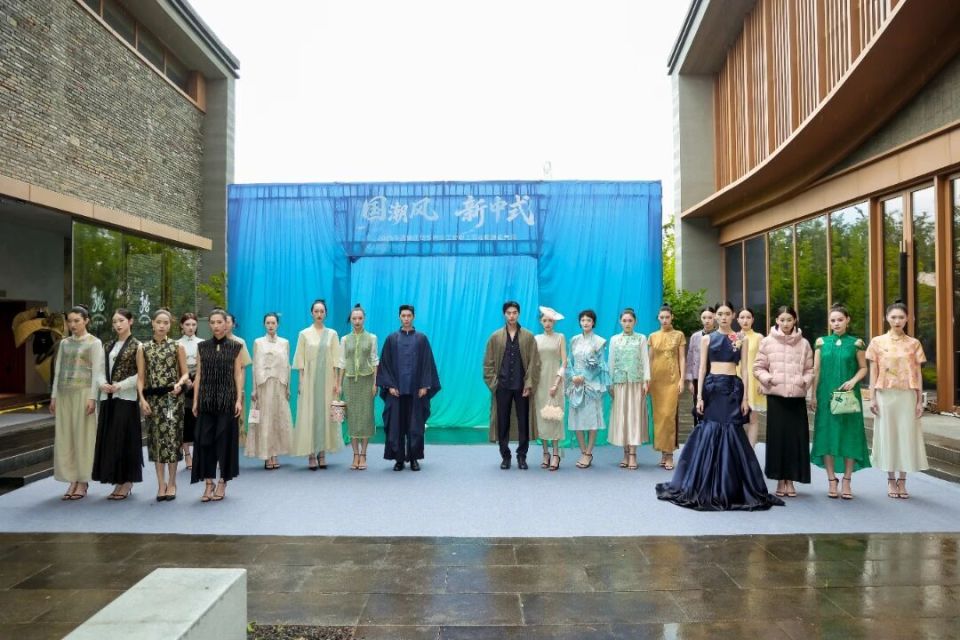
On June 13, the "Guochao Style · New Chinese" 2026 Qingpu District Textile Industry Workers' Labor and Skills Competition wrapped up at Songze Yingxiang (崧泽映巷), showcasing how intangible heritage textiles and contemporary design can produce garments that are both culturally rooted and daily-wearable.
Competition Overview
Co-hosted by the Shanghai Textile Trade Union and Qingpu District Federation of Trade Unions, the event brought frontline textile artisans and original design practitioners onto the same stage. The competition's creative mandate was explicit: dig into Song brocade, qipao, and hanfu aesthetics — then break free from rigid retro templates, integrating modern tailoring and everyday-wear requirements into original garments.
The process was rigorous. Design proposals first survived a strict preliminary selection before advancing to the final round. Artisans then spent days selecting fabrics, precision-stitching seams, and pairing guofeng accessories — transforming paper concepts into tangible new-Chinese-style finished garments. The final runway show featured pieces that carried traditional weaving textures yet suited modern daily-wear scenarios, drawing sustained applause from the audience.
Zhu Ying, chairwoman of Jingbo Qinhan Cultural Communication (Shanghai), presented three pieces inspired by Jiangnan ink-wash landscapes and Huizhou architecture. "I combine qipao's traditional intangible heritage techniques with modern daily-wear needs," she explained, "sketching Jiangnan's misty-water alongside Huizhou architecture's austere solemnity — so traditional guofeng clothing sheds its stiff retro image and adapts to how people actually dress today."
Three Lines Define a Garment
Tang Ligang, technical director at Shanghai Yuyue Fashion, took a diametrically opposite approach. "Chinese-style design originates from Confucian, Daoist, and Buddhist philosophy," he said. "My two competition pieces follow 'Confucian exterior, Daoist structure, Buddhist spirit' — I discard excessive decoration and use just three lines to define the entire garment's silhouette, letting minimalism restore Chinese negative-space aesthetics."
The competition venue simultaneously hosted a "Jinxiu Jiangnan · Duanwu Elegant Gathering" market — intangible heritage textile goods, original guofeng clothing, and Chinese-style hair ornaments and accessories were on display. The setup pushed artisan achievements out of the competitive arena and into public life, letting heritage textile craft reach everyday consumers directly.
Twelve winning pieces across first, second, and third prizes were selected by professional judges. The competition served simultaneously as a skill-training platform, a heritage transmission channel for Jiangnan textile weaving techniques, and a strategic pivot helping Qingpu's local textile industry ride the guochao consumer wave toward transformation.
