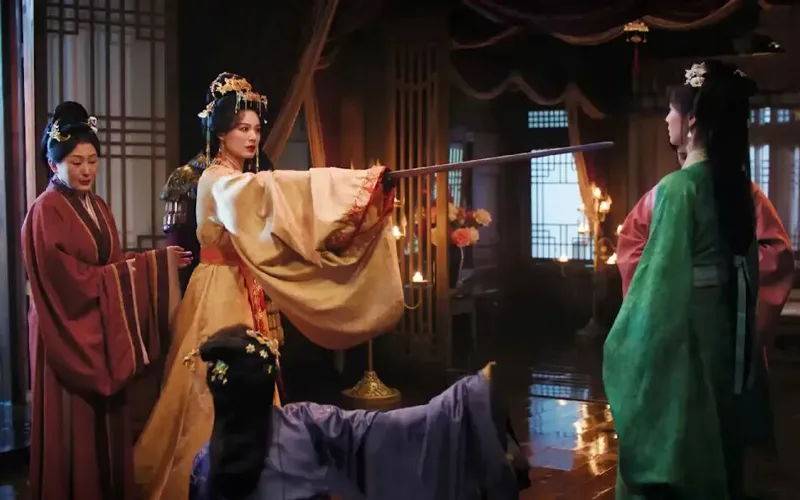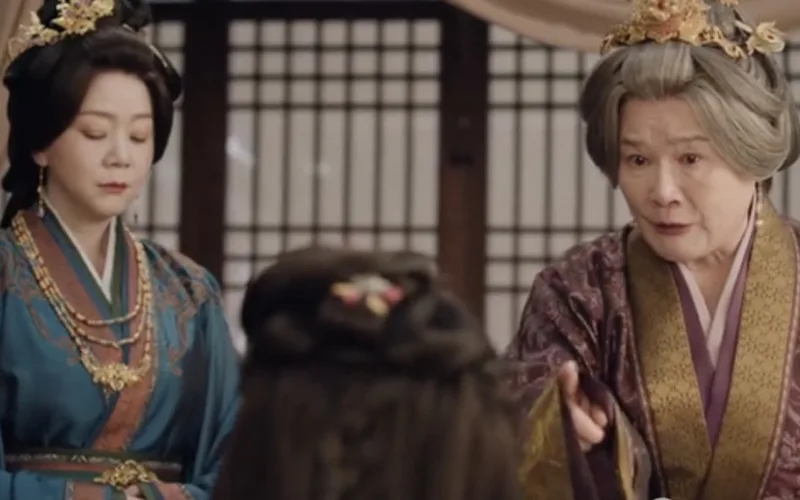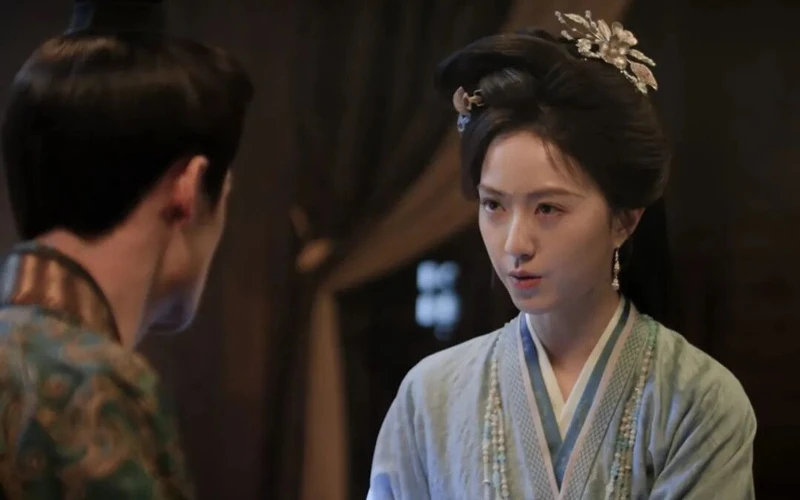
The final episode of Where the Mask Ends (嫁金钗) leaves a few rough edges, yet its supporting players stand on their own. One question lingers after the dust settles: why could Yi Jiang (易姜) read Wei Rao’s (魏娆) three deadly turns so sharply, but not see that Fu Wang (福王) lacked a true emperor’s face? That gap feels less like a plot hole and more like a clue about fear, ambition, and the limits of any prediction. A fortune teller can be gifted and still be trapped by the room she stands in.
A Careful Worker
Yi Jiang’s first reading of Wei Rao was not vague. She named a wealthy fate, then three death traps. The details landed: lime water as a child, a ghost marriage, a warning that sisters must never meet. Those were private matters, not street gossip. Li Zhaoyi (丽昭仪) panicked at once. Fu Wang and Wang Xing’e (王娙娥) treated Yi Jiang with unusual care. Fu Wang needed a bride with strong family backing, yet he bruised the Xie Taifu (谢太傅) family’s pride for her. Wang Xing’e spoke to her as an equal, not as a son’s disposable concubine. Such treatment suggested real skill, not theater.

So why the blind spot? Yi Jiang likely did see a possible throne for Fu Wang, but with a condition: years of patience first. After the crown prince was demoted, Fu Wang decided Liu Shuo (刘朔) had simply picked up the prize. He stewed, imagined a different ending if he had moved earlier, and began hearing Yi Jiang’s warnings as half-true. Three years later he struck. The scheme was clumsy enough for bystanders to spot. Even Lu Zhuo’s (陆濯) trap around the crown prince’s rebellion should have taught him caution. Yi Jiang had called that hexagram a trapped dragon and advised against action. He remembered the glory he wanted, not the risk she named.
There is also a practical reason her prophecy stayed incomplete. Yi Jiang worked for Fu Wang. She could not openly dismantle her employer’s dream, and too much correction would make her tiresome or dangerous. If she had wanted another patron, Fu Wang would never let her leave alive. Her first duty was survival. A fortune teller in that room was still a worker with a pulse to protect. So she likely hinted at hardship, not erased it. Fu Wang’s impatience did the rest. He treated a conditional forecast as a guarantee, then blamed the world when reality bit back.

History Echoes
This may sound like television exaggeration, but Western Han had a female physiognomist named Xu Fu (徐负). Her record included three famous readings. First, among Wei Bao’s (魏豹) wives and concubines, she picked Bo Ji (薄姬) as the mother of a future emperor. Wei Bao briefly believed heaven had chosen him. Bo Ji later became a concubine of Liu Bang (刘邦), and her son Liu Heng (刘恒) became Emperor Wen. A face reading had rewritten a family’s political imagination, and the court could not ignore it.
Second, Xu Fu looked at young Zhou Yafu (周亚夫) and said he would starve. The son of founding minister Zhou Bo (周勃) found this absurd. Later he gained favor, earned merit during the Seven States Rebellion, and served as chancellor. Still, prison and a hunger strike ended him. He refused to confess, and starvation did what rank could not prevent. The prediction was ugly, specific, and correct. His earlier success made the ending harder to accept, not easier.

Third, she told Deng Tong (邓通) he would starve. Emperor Wen, Deng Tong’s patron, gave him minting rights, gold, and a title, as if wealth could cancel fate. Deng Tong then offended Liu Qi (刘启), the future emperor. Once Liu Qi took power, the reckoning came: Deng Tong was reduced to commoner status and died hungry in the street. These stories do not prove every fortune teller is reliable. They do explain why a character like Yi Jiang could hold court attention and why frightened people listen, even when the warning is partial.
Fate, however, is full of moving parts. Face reading claims to see an end point, while ordinary eyes see only the present. When a prediction clashes with today’s evidence, disbelief is natural. The useful lesson is not to worship mystery. It is to notice weak spots, change bad habits, cool a hot temper, speak with care, and build better odds. You may reject fortune telling. You can still see your own blind spot and step around the risk before it steps on you.