
Eight hundred years after they were laid to rest, the finest surviving garments of the Southern Song dynasty (1127–1279) have come together for the first time. On June 12, 2026, the "Crown of Song Clothing" (宋服之冠) exhibition opened at the Huangyan Museum in Taizhou, Zhejiang Province, bringing 97 sets of rare Song dynasty artifacts into a single gallery. The centerpiece: the first-ever joint display of male and female aristocratic wardrobes from the tombs of Zhao Boyun and Huang Sheng — two archaeological discoveries that together define our understanding of Southern Song dress.
A Decade of Discovery: The Zhao Boyun Tomb
In 2016, archaeologists in Huangyan District unearthed a tomb that would become a landmark in Chinese textile archaeology. The occupant was Zhao Boyun, a seventh-generation descendant of Song dynasty founder Emperor Taizu (Zhao Kuangyin). His tomb was the only intact, unlooted Southern Song imperial clan burial ever found in Zhejiang Province.
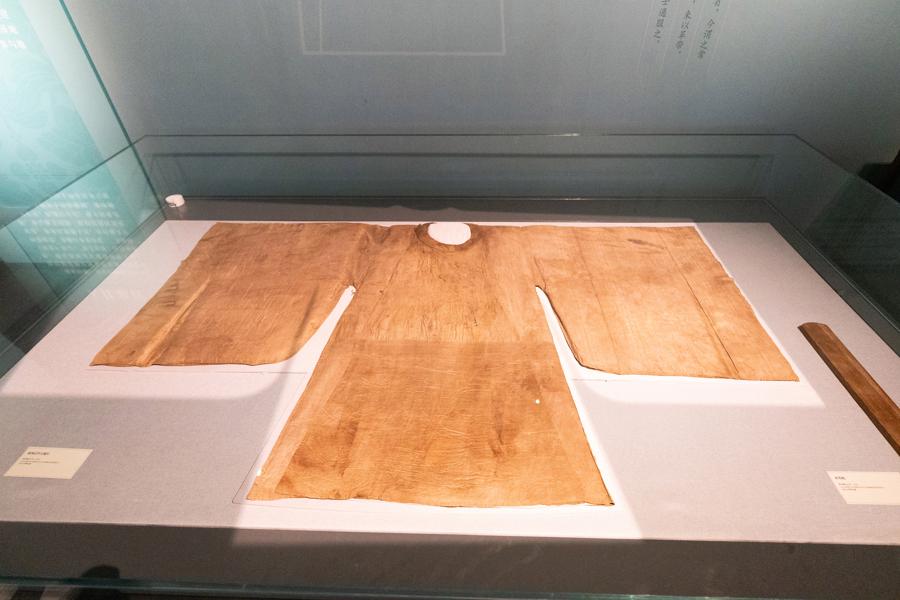
Inside, researchers recovered a complete wardrobe of silk garments — formal court attire, everyday robes, trousers, shoes, hats, belts, and accessories — all preserved with astonishing fidelity. The collection earned the title "Crown of Song Clothing" for its comprehensiveness: it is the most representative assemblage of Southern Song men's clothing ever excavated in China. Several pieces from the tomb were previously displayed at the G20 Hangzhou Summit, cementing their status as cultural icons.
The exhibition marks the tenth anniversary of the tomb's excavation, and several items are being shown publicly for the first time: a lined jacket with pine, bamboo, and plum blossom motifs (松竹梅纹夹衣), agarwood fragrance chips, a combined cicada-pattern incense disc, a wooden ceremonial tablet (笏板), and prayer beads.
The Huang Sheng Tomb
Discovered in 1975 at a Fuzhou middle school construction site, the tomb of Huang Sheng tells a different story. She was a 17-year-old daughter of an elite scholar-official family — her father Huang Pu was a zhuangyuan (top-ranked imperial examination candidate) who rose to become prefect of Quanzhou and director of maritime trade. Her grave yielded 436 burial objects, of which 354 were silk textiles — including 201 complete garments.
Huang Sheng's wardrobe is the largest and best-preserved collection of Southern Song women's clothing ever found. It includes nine wide-sleeved ceremonial robes (广袖袍), seventeen single skirts, two pleated skirts, numerous narrow-sleeved beizi (褙子) jackets, bodices, trousers, and two ceremonial xiapei stoles — a privilege reserved for titled noblewomen. The fabrics are predominantly lightweight luo gauze (罗), with extensive use of gold-printing (印金), gold-foil (贴金), and gold-mud (泥金) decoration. One of the most striking pieces is a brownish-yellow gauze wide-sleeved robe with embroidered borders, measuring 120 cm in length with sleeves 69 cm wide.
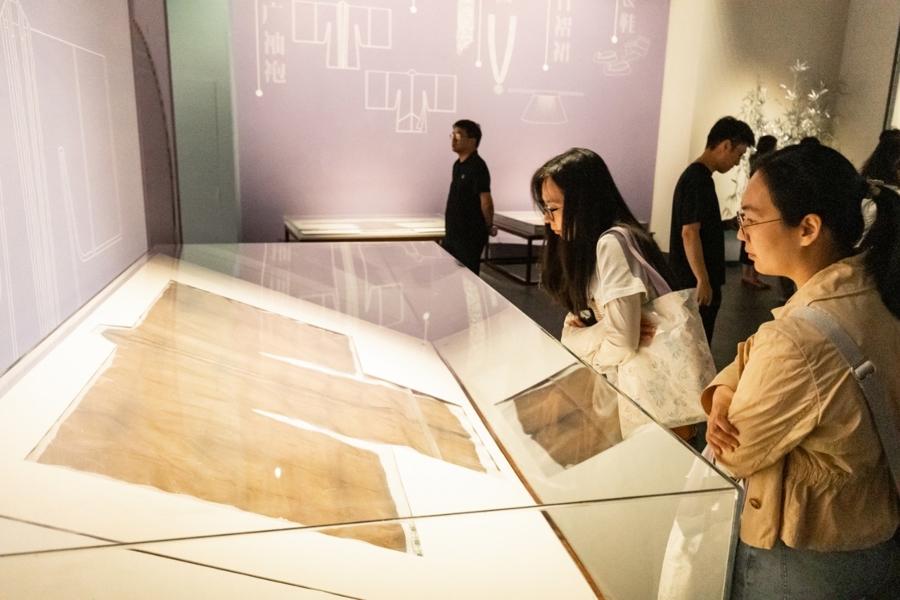
Jointly organized by the Huangyan Museum, Fujian Museum, and the China National Silk Museum, the exhibition is divided into four thematic sections that move from formal ritual attire to everyday dress. Rather than the conventional wall-mounted displays, the curators have opted for freestanding glass cases that allow visitors to examine the garments from all angles — observing fabric texture, stitch precision, and subtle pattern details at close range.
Among the 97 exhibited artifacts, 12 are classified as National First-Class Cultural Relics. The display strategy is deliberate: "Past exhibitions typically showed men's or women's clothing in isolation," explained Zheng Jiali, deputy director of the China National Silk Museum. "By bringing Zhejiang and Fujian museum resources together, visitors can now read Song dynasty clothing culture systematically, three-dimensionally, and comprehensively."
What Southern Song Clothing Tells Us About Hanfu
The exhibition offers an unparalleled reference for understanding authentic Song-dynasty hanfu — the historical foundation for one of the most popular hanfu styles worn today.
Men's Wardrobe: Rank and Restraint
Zhao Boyun's clothing reflects the full spectrum of a Southern Song male aristocrat's life: formal court robes for official occasions, round-collared gowns (圆领袍) for semi-formal settings, and simpler cross-collared garments for daily wear. The garments display the restrained elegance characteristic of Song aesthetics — clean lines, muted colors, and ornamentation achieved through weave structure rather than surface decoration. The fabrics include plain-weave silk (绢), twill (绫), and patterned gauze, with motifs drawn from nature: bamboo, plum blossoms, pine branches, and scrolling floral patterns.
Women's Layering: The Art of Subtle Luxury
Huang Sheng's wardrobe reveals a sophisticated layering system that was both practical and hierarchical. A fully dressed Southern Song noblewoman would wear, from innermost to outermost:
- Undergarments: A bodice (抹胸) or wrap (裹肚), worn directly against the skin
- Inner layer: A narrow-sleeved shirt (衫) reaching the waist
- Middle layer: A narrow-sleeved beizi jacket, the defining garment of Song women's fashion
- Outer layer (formal): A wide-sleeved ceremonial robe (广袖袍) for grand occasions
- Lower body: An underskirt (单裙) or pleated skirt (褶裥裙), with split-crotch or closed-crotch trousers underneath
The beizi deserves special attention. Characterized by a straight collar (直领), parallel front opening (对襟), narrow sleeves, and high side slits that leave the front and back panels unsewn at the sides, the beizi was worn by women of all social classes. What distinguished rank was fabric and craftsmanship: Huang Sheng's beizi are silk gauze with gold-printed floral borders, while common women wore cotton or hemp versions reaching only to the waist.
Color was another marker of Song aesthetics. Unlike the bold reds, greens, and golds of Tang dynasty fashion, Huang Sheng's garments favor pale greens, muted blues, tea-browns, and soft ochres — colors described in period poetry as "light as mist, weightless as smoke." Luxury was expressed not through color but through technique: gold printing covered eighty percent of her surviving textiles.
The "Crown of Song Clothing" Exhibition
Pale green, muted blue, tea-brown, soft ochre — the palette of a Southern Song noblewoman's wardrobe was a study in restraint. The garments from both tombs confirm what historical texts describe: the Song dynasty marked a decisive shift from Tang exuberance toward an aesthetic of understated refinement, driven by Neo-Confucian philosophy that emphasized moral cultivation over sensory indulgence.
The exhibition runs through September 6, 2026. For hanfu enthusiasts, costume researchers, and anyone interested in the material culture of China's most aesthetically influential dynasty, this is an unmissable event — the first time the complete male and female clothing systems of the Southern Song can be studied side by side.
For the modern hanfu community, the "Crown of Song Clothing" exhibition provides something invaluable: direct, verifiable reference points for Song-style hanfu. Many contemporary Song-dynasty hanfu designs draw inspiration from precisely these two tombs. The beizi-and-skirt combination, the soft color palette, the layered styling — all are now staples of hanfu fashion, especially popular for summer wear and everyday hanfu due to the lightweight fabrics and breathable construction.
The exhibition also corrects common misconceptions. Song women's clothing was not universally drab or severe — Huang Sheng's gold-printed gauze robes and embroidered borders demonstrate that aristocratic women found ways to express luxury within the period's aesthetic constraints. And men's Song hanfu, often overlooked in favor of Ming or Tang styles, emerges from Zhao Boyun's wardrobe as a sophisticated system of dress with clear distinctions between formal, semi-formal, and casual attire.
As the Huangyan District culture and tourism bureau plans to expand its "Follow Cultural Relics on a Journey" tourism initiative, the exhibition is likely to become a pilgrimage site for hanfu enthusiasts. It represents a rare convergence: archaeological authenticity, curatorial ambition, and a living fashion movement that looks to the past for inspiration.
