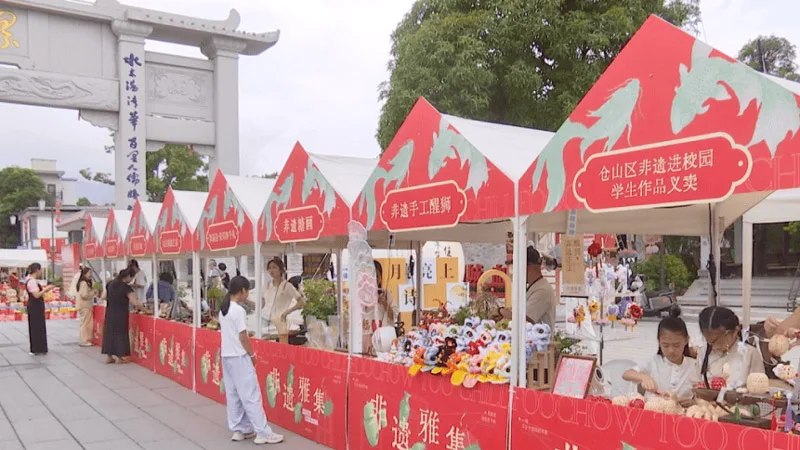
Crowds filled the square in front of Zhenhai Tower in Pingshan, Fuzhou, early on October 5 and stayed busy through the afternoon. Under the red walls and flying eaves, the Gulou district laid out its 2026 National Day heritage market, “National Day of Grace, Intangible Heritage Gathering”, with more than twenty local craft and performance traditions on show. Families and tourists drifted between stalls, watching makers at work, catching a demonstration and stopping to taste what the vendors had brought.
What the organisers wanted was a market, not a display case. Each stall carried a single craft, and almost all of them invited a hand or a question. The result was a light, walkable circuit where visitors could see a thing being made, buy it, eat it or try it, with no glass between the public and the people who keep these skills going.
Nothing Sits Behind Glass
At the craft tables, the small trades lined up shoulder to shoulder: dough figurines pinched into shape, finished fan paintings, Pankou for qipao, and the horn combs Fuzhou has cut for generations. The inheritors worked as they talked, fingers moving while they told stories of old Fuzhou street life, and the crowds pressed in to watch.
Traditional medicine held its own ground. At the Chinese-medicine stalls, visitors slowed to hear practitioners explain the Xu family fire-needle therapy, the preparing of herbs to prescription, the Bazhen medicinal cuisine and the Zou family external treatments, tracing the region’s own approach to keeping well. Nearby, children recited Fuzhou sayings, bayin music and dialect nursery rhymes in a dialect corner that stayed warm all afternoon, while a goldfish tank turned a stretch of pavement into a stop for the youngest visitors.
Boxing, Herbs and a Local Tongue
At three in the afternoon the pace changed. Footwork and open palms arrived with a martial-arts showcase that ran through Southern Shaolin Luohan boxing, Ziranmen, Xiangdian boxing and Golden Lion boxing in turn. Wang Huanan (王华南), a provincial inheritor of Xiangdian boxing, led his school’s students through bare-hand routines, sparring and staff work, and a slower marrow-nourishing daoyin exercise closed the set with a softer edge.
“On the National Day holiday we want to show the best of traditional martial arts, as a gift to the country, and to let more visitors understand what heritage means,” Wang said. The routines drew applause from a ring of onlookers who had drifted over from the food stalls.
A Programme Built for Passers-by
Visitors were a mixed group. Some were local families out for the day; others had come from further away and found the fair by chance. A visitor from Shanghai, Ms Wang, had climbed up to see Zhenhai Tower and stayed for the stalls and the boxing. “I came for the city view and ran into this,” she said. “I watched makers at work and heard real Fuzhou speech. It was a lovely surprise.” A visitor from Hubei, Ms Xiao, took her child from stall to stall and said the detour had given the trip more weight.
The market was run by the Gulou district culture, sports and tourism bureau, organised by the district’s cultural centre and heritage protection centre and co-organised by the district museum. Set as one of the district’s main public events for the holiday, it kept to a light format the whole way through, the better to close the distance between heritage and the people who happen to walk past it.