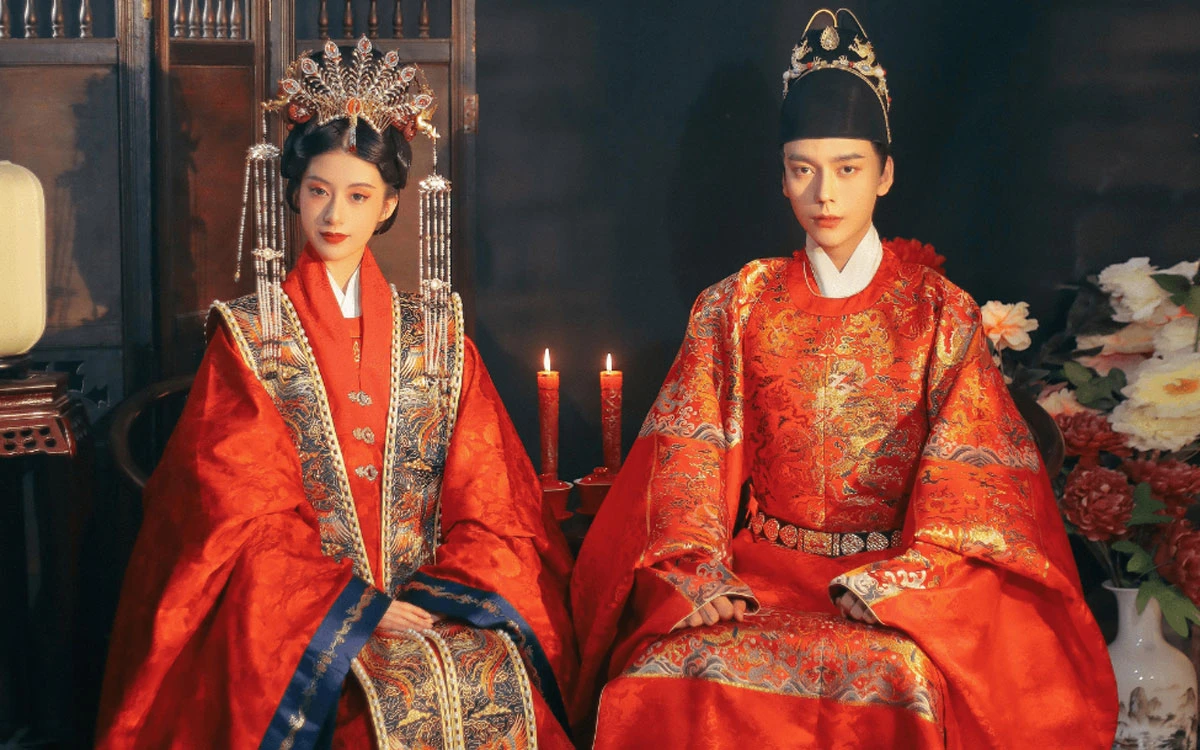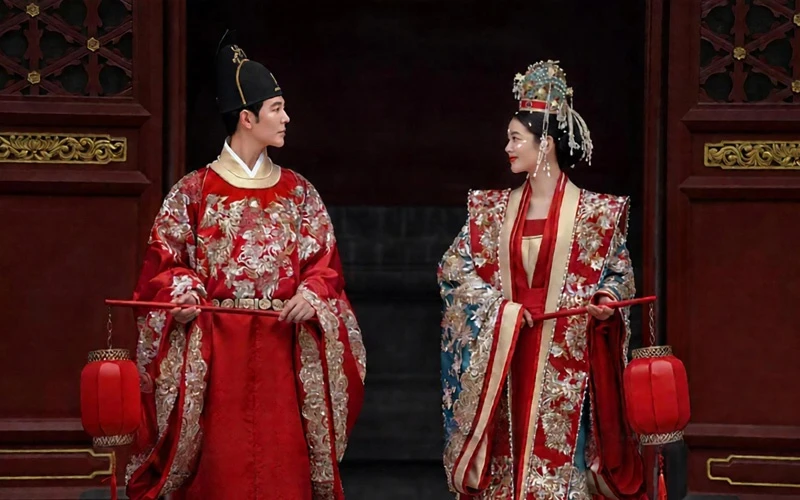
The answer depends on the era—and on the wedding. Earlier generations saved cloth coupons for a new everyday garment; later couples wore suits; white gowns became standard; Xiuhe (秀禾) dresses returned for the home send-off. Today the wedding industry commonly sells three-, four-, or five-outfit packages, adding a greeting dress and a morning robe to the core send-off, ceremony, and toasting looks. Yet this expanding wardrobe is not the only model.
A Ming-style Hanfu wedding proposes a quieter logic: one ceremonial set, adjusted through layers and pairings, can move from makeup-room photographs to the home send-off, guest greeting, main ceremony, and banquet. The familiar Fengguan Xiapei (凤冠霞帔) is not a single robe but a crown and the Dasha Xiapei (大衫霞帔), supported by an inner shirt, crossed-collar layer, round-collar robe, skirt, trousers, and horse-face skirt. By adding or removing outer pieces, changing headwear, and re-pairing tops and skirts, a couple can create five distinct bridal looks without buying five dresses.
This article explains the modern lineup and shows how one set of Dashan Xiapei can do more work—and save more—than a rack of gowns.

How Many Wedding Looks for Modern Chinese Weddings?
First, let’s consider a question: how many sets of formal attire are needed for a wedding?
People of different eras would give different answers. In earlier times, wedding gowns were not a necessity. Couples would save their cloth coupons to make a new, everyday garment. Paired with a big red flower and a red hair ribbon, this served as their wedding outfit. In the 1980s and 1990s, the groom wore a suit, and the bride a matching suit dress — that was their wedding attire. After the turn of the millennium, white wedding gowns became the standard for the ceremony. More than a decade ago, the Xiuhe dress, a reinterpretation of the Qing-style stand-collar and front-opening jacket-and-skirt set, grew popular as the bride’s outfit for the home send-off segment.
As we can see, the core wedding attire for Chinese weddings traditionally consists of an outgoing dress (for the home send-off) and a ceremony dress. Later, driven by customer demand and local customs, the wedding industry added a greeting dress and a toasting dress. In recent years, the morning robe, worn by the bride while getting her makeup done before the send-off, has also become popular.
The modern Chinese wedding attire lineup breaks down like this:
- Basic package: outgoing dress, ceremony dress, toasting dress (3 pieces)
- Mid-tier package: outgoing dress, greeting dress, ceremony dress, toasting dress (4 pieces)
- Premium 5-piece package: morning robe (bride only), outgoing dress, greeting dress, ceremony dress, toasting dress
For an all-Western wedding following the premium 5-piece setup, the purpose and features of each piece are as follows:
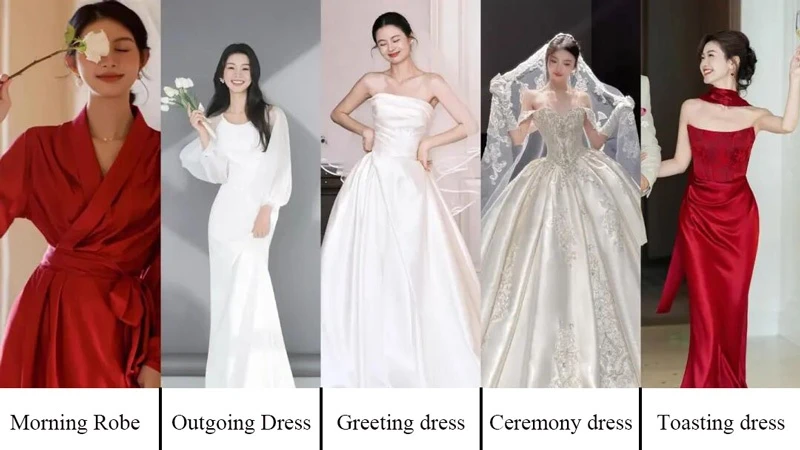
Morning robe: A loungewear-style robe for the bride to wear while having makeup applied, mainly for photoshoots. It is lightweight. A growing trend in the market blurs its distinction from toasting dresses. Not essential.
Outgoing dress (home send-off dress): A light formal dress worn during the groom’s pickup and the bride’s departure from home. It balances formal aesthetics and practicality. Many couples opt for a Xiuhe dress or Hanfu instead of a Western short wedding dress for this segment to highlight traditional Chinese festive vibes. Essential.
Greeting dress: A formal dress worn at the venue before the ceremony to welcome guests. It is more formal and less easy to move in than the outgoing dress. In some regions, relatives and elders greet guests on the couple’s behalf, so this piece is optional. Not essential.
Ceremony dress: A grand statement gown, the centerpiece of the wedding. Practicality takes a back seat to a dramatic, dignified silhouette, which is why wedding gowns often feature long trains and full skirts. Essential.
Toasting dress: A light formal dress worn after the ceremony while the couple toasts guests. It is the most mobile of the four guest-facing wedding outfits. To fit Chinese wedding traditions of good fortune, even Western-style toasting gowns are usually red.
Order of formality (least → most formal):
Morning robe < Toasting dress < Outgoing dress < Greeting dress < Ceremony dress
How Many Pieces Make a Fengguan Xiapei?
Modern weddings ask couples to buy too many outfits. Photo studios fill racks with gowns because one ceremony, one tea service, and one dinner seem to demand separate clothes. A Ming style Hanfu wedding offers a quieter answer: one ceremonial set, adjusted by layers and pairings, can cover the day. A rack of five dresses can cost more and tire the bride; one set with layers can be packed, pressed, and changed without losing the formal frame. The couple can spend on fit and fabric instead of storage. Where a Western plan may need five changes, this plan changes the shape of one outfit.
Layered Logic
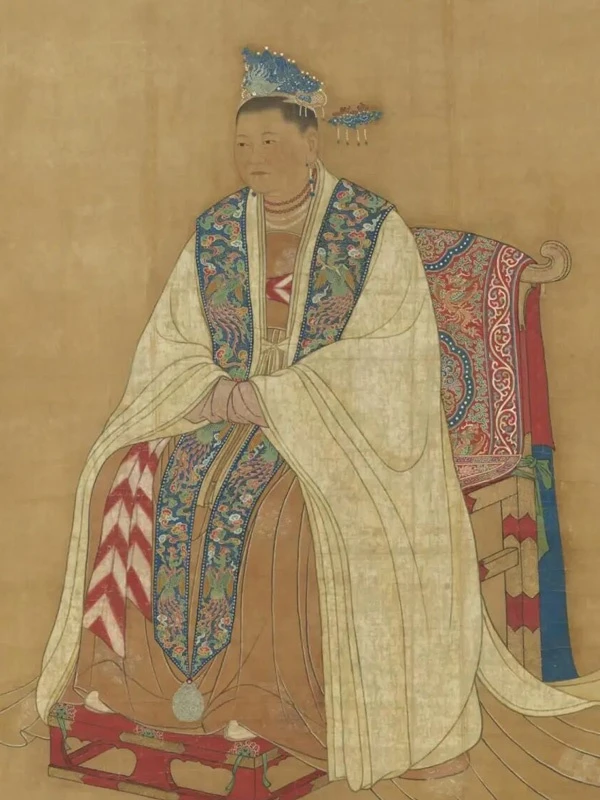
Two industrial revolutions raised output and loosened old dress codes. A single garment no longer marked rank. Ordinary people could wear former elite clothing at life’s big moments. Western bridal style often echoes an old noblewoman. The Hanfu wedding set echoes a Mingfu (命妇), a titled lady at court, and the better-known Gaoming Furen (诰命夫人). The aim is not fake nobility. It is a flexible formality that lets a couple use one visual language across several events. A planner can label each layer by event, so helpers do not guess.
The familiar Fengguan Xiapei is not one robe. It is a crown plus the Dasha Xiapei, a broad outer robe with a long scarf-like panel. Its roots sit in late Tang and Five Dynasties capes and shawls. By the Song period, court rules absorbed the look. Ming women, including commoners, wanted it for formal wear. A straight collar frames the face; a round collar smooths the shoulders; a crossed collar closes the inner layers. The long panel can be pinned narrow for photos or spread wide for a formal walk, so the same garment reads differently.
Ming rules were strict. The queen’s crown was called a phoenix crown; a titled lady’s crown was a di crown, with different shape and rank. Modern equality lets both be called phoenix crowns. That small shift matters: today’s bride can borrow the visual weight of court dress without claiming an old rank. The crown can appear for the ceremony, then come off for quieter moments.
Four Pieces
A useful sketch comes from Ming Palace Crown, Dress, and Ceremonial Guard Chart (明宫冠服仪仗图). Inner to outer, the court look runs: edge-trimmed skirt, crossed-collar coat, four-panel crossed-collar coat, round-collar Juyi (鞠衣) robe, then straight-collar Dasha Xiapei. Bottoms include trousers, a petticoat, and a horse-face skirt. The collars change, but the body stays calm and readable. This is why one set can look full at a ceremony and lighter at a banquet.
Titled ladies outside the palace had a slightly shorter list: no round-collar Juyi. They wanted that missing layer. In the Hongwu (洪武) twenty-fourth year, rules allowed a colored round-collar shirt for daily wear. Women tucked it under the ceremonial set, filling the gap and edging closer to an imperial consort’s silhouette. The result was still a graded dress code, but it gave outer court ladies more visual weight. A red Juyi with a blue coat keeps the palette bright but not flat.
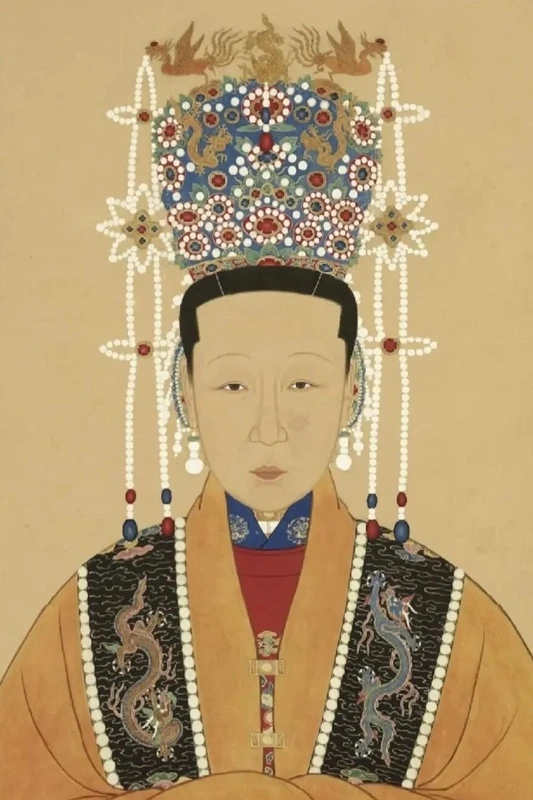
Empress Xiaochun (孝纯) offers a portrait close to the written rules. Her inner layer becomes a stand-collar shirt and coat; the blue four-panel coat, red Juyi, and Dasha Xiapei remain. For a modern wedding, keep four main pieces: inner shirt or coat, crossed-collar layer, round-collar long robe, and straight-collar outer set. Add trousers, petticoat, and horse-face skirt. Then swap layers for the ceremony, tea table, and dinner: crown on, outer robe off, lighter top with the same skirt. For a reception, the round-collar robe can stand alone with the horse-face skirt; for tea, the crossed-collar coat can take the crown’s place. One set does more work, and the couple buys less.
Five Wedding Looks with One Dashan-Xiapei
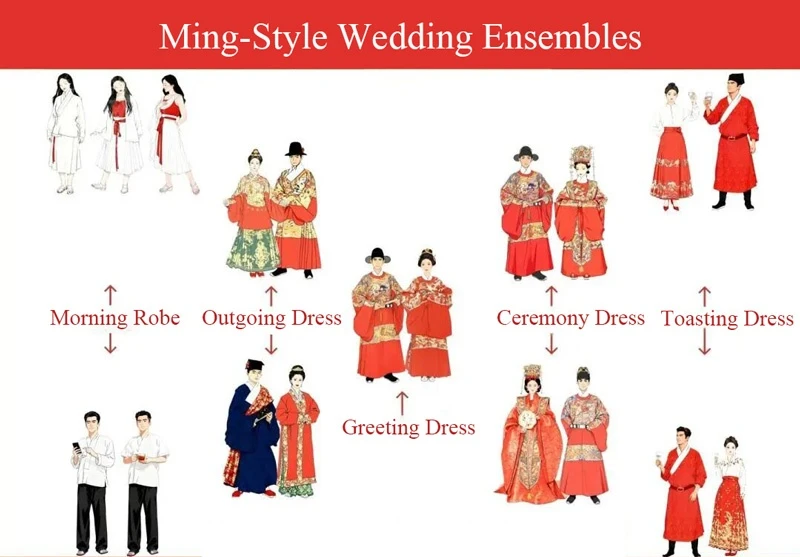
As mentioned in the previous section, a modern wedding commonly includes five costume segments: the morning robe, the send-off outfit, the greeting outfit, the ceremony robe, and the toasting outfit. A complete set of Ming-style phoenix coronet and Xiapei consists of four upper garments: the inner shirt jacket, the cross-collar shirt jacket, the round-collar long robe, and the outermost straight-collar Dashan paired with Xiapei. Their matching lower garments are trousers, a lining skirt, and a Mamian Qun (马面裙) respectively.
Based on this full set of Dashan and Xiapei, we can adjust the layering to create different bridal looks, paired with coordinated groom ensembles. The five wedding attires are listed below.
Morning Robe (Optional)
- Bride: Lining trousers → camisole Zuyao (主腰)→ lining skirt → shirt jacket
- Groom: Lining trousers → shirt jacket
The morning robe serves as loungewear for bridal makeup and casual photos before the groom departs for the send-off. Lightweight and relaxed, it corresponds to the traditional Chinese undergarment set, the innermost layer of shirt jacket paired with skirt and trousers.
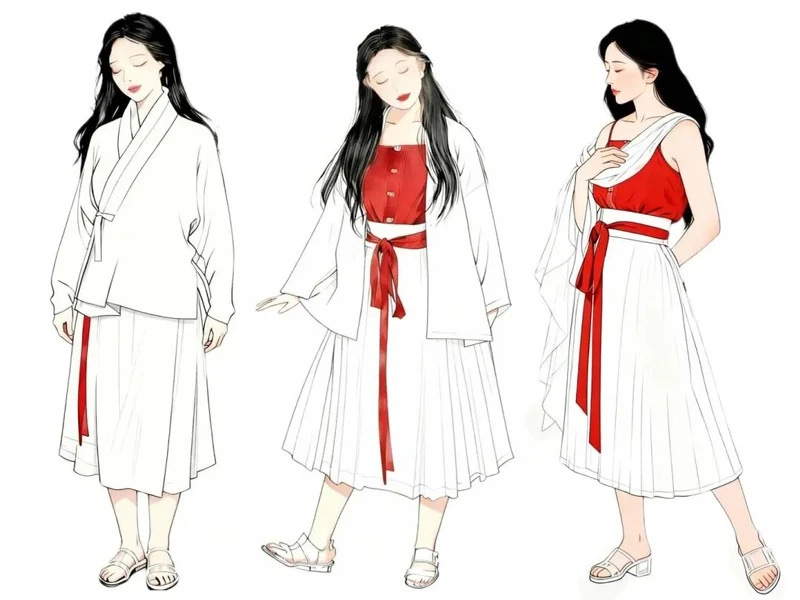
There is no strict rule for the collar style of the bride’s shirt jacket. Traditional Huaxia basic styles such as cross-collar and straight-collar, as well as Ming innovations including round-collar and standing-collar front-opening styles, are all acceptable. The inner camisole Zuyao follows Ming aesthetic preferences and offers versatile styling. It can be worn closed as a cross-collar piece or left open; a white open jacket revealing a red Zuyao fastened with golden frog buttons creates a striking, elegant effect.
The groom’s undergarment is recommended to be cross-collar and worn closed. For male intimate wear, traditional Fuba (抱腹) is an option for those interested. This shirt jacket is not meant to be worn alone externally. White is a versatile colour and can replace a modern suit shirt in daily use, while black lining trousers work well as a base layer for outer robes.
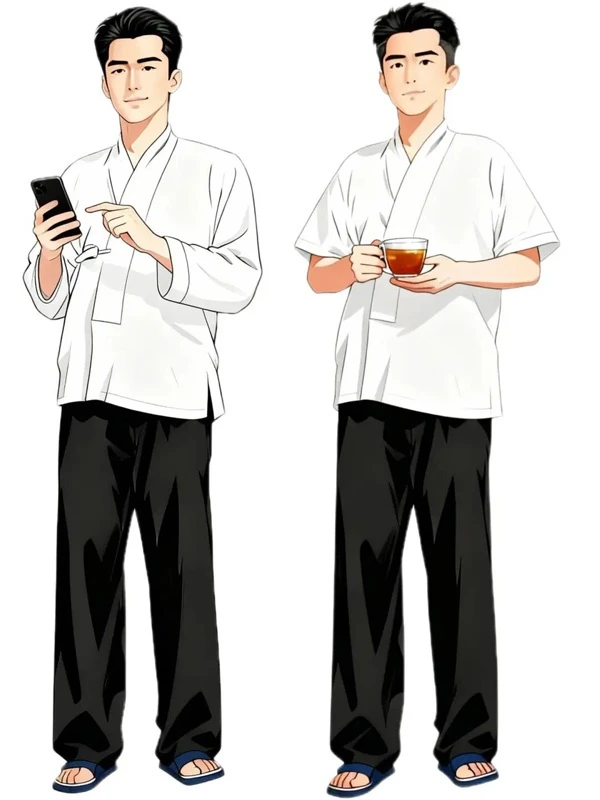
This Hanfu morning robe captures laid-back, homely vibes. Still, it requires the couple to wake up extra early for shooting, so this look is optional.
Send-off Outfit
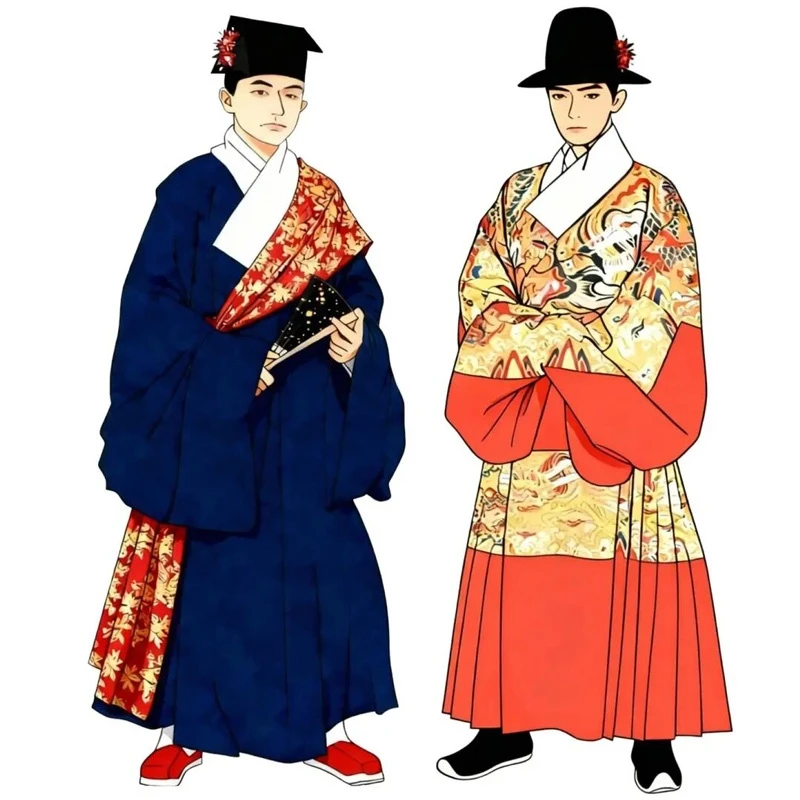
- Bride: Lining trousers → camisole Zuyao → lining skirt → shirt jacket → Mamian Qun → cross-collar shirt jacket
- Groom: Lining trousers → shirt jacket → cross-collar lining robe → cross-collar Daopao (道袍) or Zhepao (褶袍)
The send-off outfit is a semi-formal ensemble worn when the bride leaves her home. It balances ceremonial formality and ease of movement.
For the bride, a narrow-sleeve long jacket or pipa-sleeve short jacket in cross-collar cut is preferred. Red jackets fit the festive mood. The gold-woven Mamian Qun can also be red, or follow Ming conventions with an official green skirt. Purple, blue and other hues are also valid choices according to personal taste.
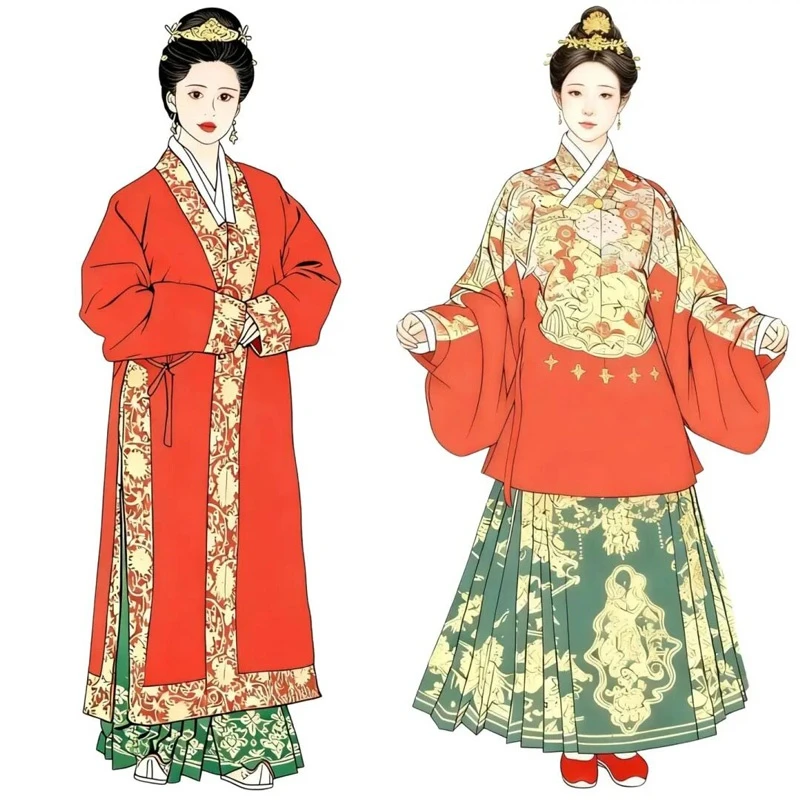
A classic Ming hairstyle and a partial set of Ming hair ornaments are recommended. Footwear options include Qiaotou Lü (翘头履) and Dengyun Lü (登云履).
The groom wears either Daopao or Zhepao. Floral hair accessories complement the headwear: Piaopiao Jin (飘飘巾) pairs with Daopao and Lü, while Damao (大帽) goes with Zhepao and official boots. A red robe does not need an additional red sash, whereas non-red robes are matched with one.
Greeting Outfit
- Bride: Lining trousers → camisole Zuyao → lining skirt → shirt jacket → Mamian Qun → cross-collar shirt jacket → women’s round-collar robe
- Groom: Lining trousers → shirt jacket → cross-collar lining robe → cross-collar Daopao or Zhepao → men’s round-collar robe
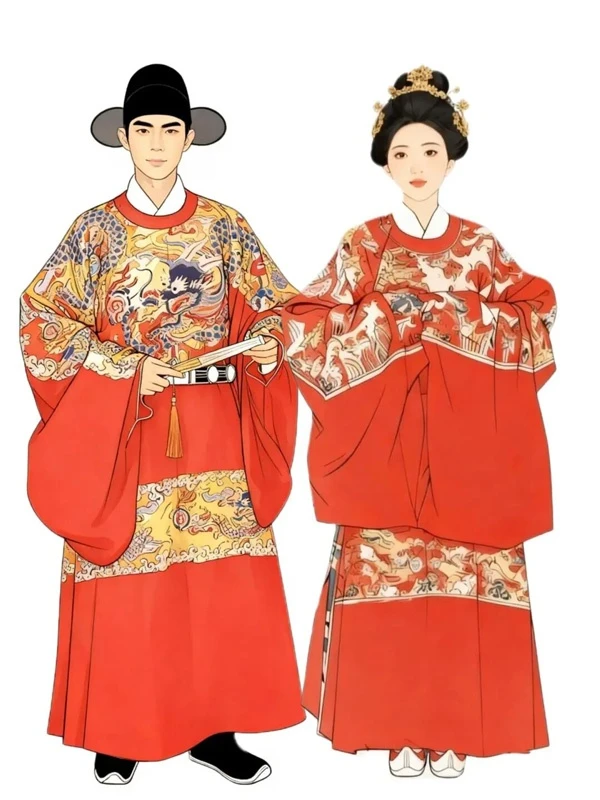
This formal set is worn at the venue before the main ceremony to greet guests. Its formality sits between the send-off outfit and the ceremony robe. This look is unnecessary if elders handle guest greeting on behalf of the couple.
The bride wears a full set of Ming hair ornaments with a traditional bridal hairstyle, while the groom wears a Wusha (乌纱) hat. Both the male and female round-collar robes feature the same cloud-shoulder, full-sleeve and knee-hem pattern layout with subtle structural differences. The men’s version has outer side panels, and the women’s version has side slits and pleats. Leather belts are worn by both. The groom wears boots, and the bride wears Lü.
In Ming dynasty regulations, these round-collar robes were standard formal wear for officials and noble ladies, falling to the ankle and covering the skirt completely. Many modern Hanfu makers shorten the female robe deliberately to distinguish it from the male cut, exposing the decorated Mamian Qun underneath. Enthusiasts pursuing historical authenticity may size up by one or two sizes so the robe fully covers the skirt; others may follow regular sizing.
Ceremony Robe
- Bride:
① Simplified ceremony look: Lining trousers → camisole Zuyao → lining skirt → shirt jacket → Mamian Qun → cross-collar shirt jacket → women’s round-collar robe → Xiapei
② Standard ceremony look: Lining trousers → camisole Zuyao → lining skirt → shirt jacket → Mamian Qun → cross-collar shirt jacket → women’s round-collar robe → straight-collar Dashan → Xiapei
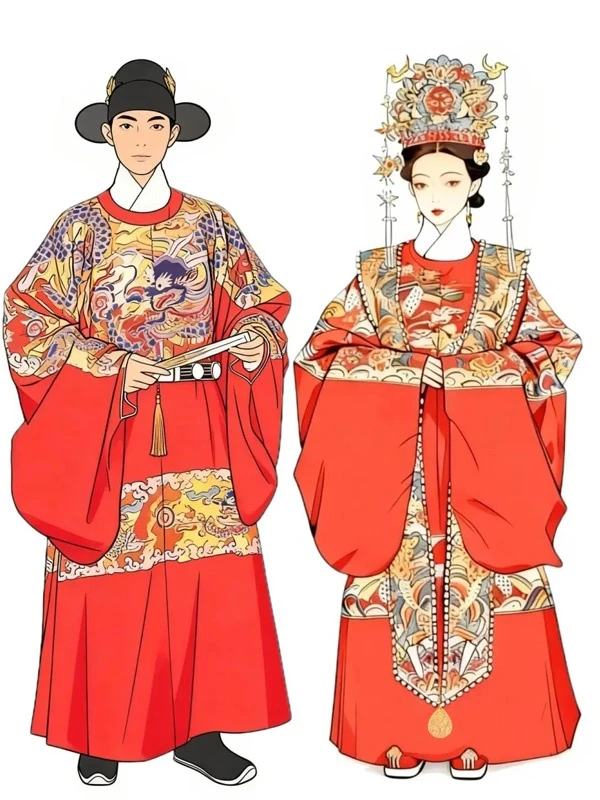
- Groom: The groom’s base layers stay the same as the greeting outfit, with headwear upgraded to a flower-adorned Wusha hat or Yishan Guan (翼善冠). Though Yishan Guan was originally exclusive to imperial members in the Ming period, it is accessible for ordinary couples’ wedding ceremonies today.
The ceremony robe is the grandest formal attire for the core wedding ritual, designed for solemn and imposing silhouettes. The standard version adds a trailing straight-collar Dashan and phoenix coronet and Xiapei over the round-collar robe. The simplified version skips the Dashan and pairs Xiapei directly with the round-collar robe.
The phoenix coronet here refers broadly to Ming-style Yanju (燕居) phoenix coronets and di guan. Matching etiquette levels are traditionally observed: flower-adorned Wusha hat pairs with di guan for official-class couples, and Yishan Guan pairs with Yanju phoenix coronet for imperial-style aesthetics. In practice, styling follows the couple’s preference.
Toasting Outfit
- Bride: Lining trousers → camisole Zuyao → lining skirt → shirt jacket → Mamian Qun
- Groom: Lining trousers → shirt jacket → cross-collar lining robe
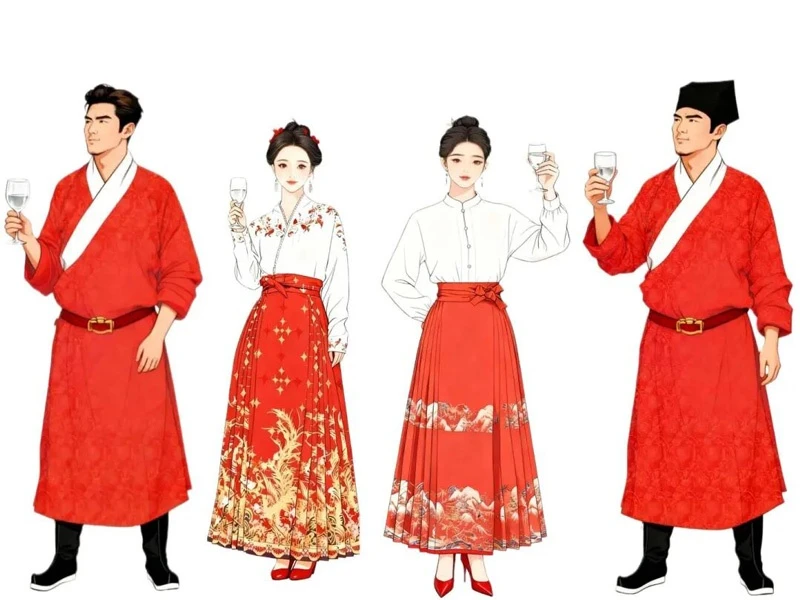
The toasting outfit is a light semi-formal look, less ceremonial and more mobile than the send-off attire. The groom wears a lining robe over the shirt jacket, while the bride adopts the classic “skirt covering the hem of top” combination of shirt jacket and Mamian Qun. This was a practical everyday outfit in the Ming dynasty and works well for wedding toasts or engagement occasions. The groom may choose to wear a soft head covering or go bareheaded.
Two popular modern silhouettes for this pairing are widely available: the so-called “airplane sleeve” top and standing-collar front-opening short shirt. The “airplane sleeve” is a colloquial name for a straight-collar front-opening short top with wide sleeve roots and narrow cuffs. Though commonly labelled as Song-style, this cut belongs to the shared foundational costume structure of Huaxia, consistent across Song, Yuan and Ming dynasties, so it fits naturally within a Ming Hanfu wedding ensemble.
Standing-collar styles with a row of frog buttons resemble modern suit shirts and blend discreetly into daily wear.
This combination is highly practical. A white top with a red Mamian Qun is recommended for the bride. The red skirt can be reused for festivals and casual events, and the white shirt can serve as a substitute for formal blouses. For the groom, a red dark-patterned Ming Quekua (缺胯) robe is a versatile investment suitable for celebrations after the wedding.
The following illustration shows the full set of outfit changes for a Ming-style Hanfu wedding.
Conclusion
In the end, there is no single correct number of wedding outfits—only the number that fits the era, the customs, and the couple’s priorities. Modern packages offer convenience, but a Ming-style fengguan xiapei set shows that thoughtful layering can cover five bridal looks with one ceremonial wardrobe. It saves money, reduces changes, and still preserves the formal beauty of the day.