A familiar story says trousers entered China through King Wuling of Zhao (赵武灵王). It is tidy, dramatic, and wrong. A grave in Henan tells a quieter tale. Trousers have a long, practical history in China; open-crotch designs answered climate and layered dress, not ethnic identity. The evidence invites a fresh question: who really invented trousers, and why does the wrong answer keep returning?
Buried Evidence
The usual claim credits King Wuling with importing trousers during his riding-and-archery reforms. No ancient chronicle says he brought trousers to the Central Plains. Modern writers stitched that idea onto the famous “Hu-style Garments and Mounted Archery” (胡服骑射) policy, turning a military change into a clothing origin myth. The tale sounds neat because it links trousers with cavalry and speed. Neat stories often travel faster than evidence, especially when a single reformer makes a messy history easy to remember.
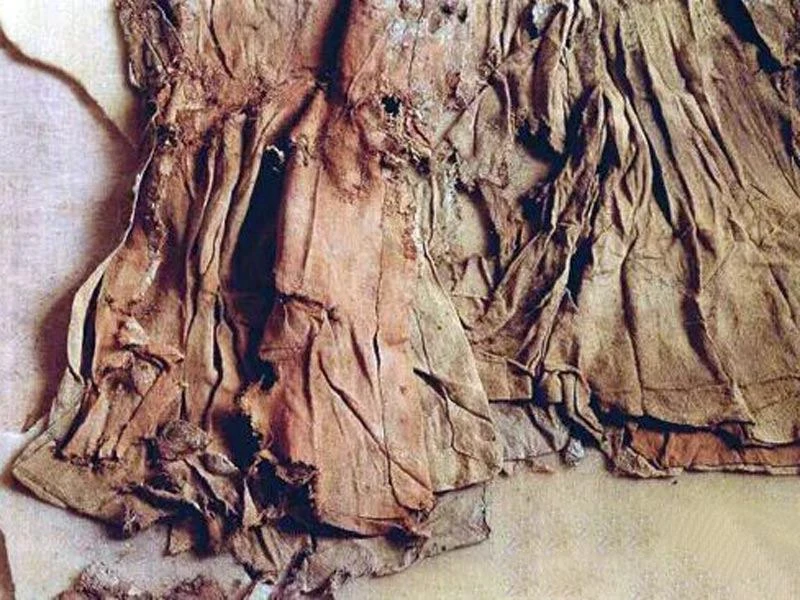
A grave in San Men Xia (三门峡), Henan (河南), offers a sharper clue. The Guo State (虢国) cemetery yielded remnants of Western Zhou (西周) hemp trousers. The tomb belonged to Guo Zhong (虢仲), who died roughly 450–500 years before King Wuling. That date makes an “imported by Zhao” story impossible. The fabric is fragmentary, but the implication is plain: tailored leg coverings existed in the Central Plains long before the cavalry reform.
Why does the old myth survive? It gives trousers one hero and a clean timeline. Archaeology offers scattered innovations and local solutions. A garment does not need a royal sponsor to become useful. Once the Guo State evidence enters the conversation, the question changes: not who imported trousers, but how communities covered, warmed, and freed the legs.
Two Trouser Families
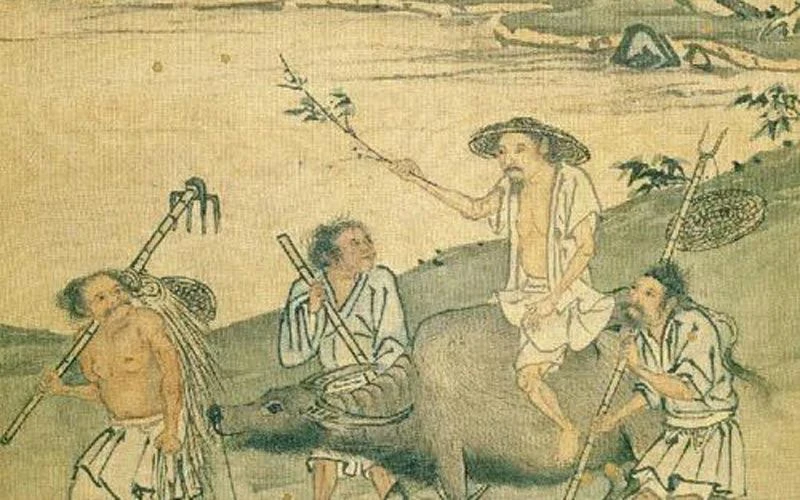
Ancient Chinese trousers fall into two broad families. The first is Kun (裈), a crotched undergarment. One form was short and close, like a modern brief; the Han called it “calf-nose” Kun. Another was roomier, with two clear legs and a knee-length cut, closer to beach shorts. A later Han variant, “poor trousers,” was longer and wider, yet still belonged to the Kun system. Kun sat close to the body, so farmers, servants, and soldiers might expose it for movement, but most people wore it beneath other layers.
Short Kun reaches back to the late Neolithic. Sima Xiangru (司马相如) once wore calf-nose Kun while washing vessels in the market. Ruan Xian (阮咸) hung a large cloth calf-nose Kun from a pole in his courtyard. The style lasted more than five thousand years and still appears in parts of Asia. Roomier Kun with legs also served hot regions well, giving wearers a little more formality without the weight of outer trousers.
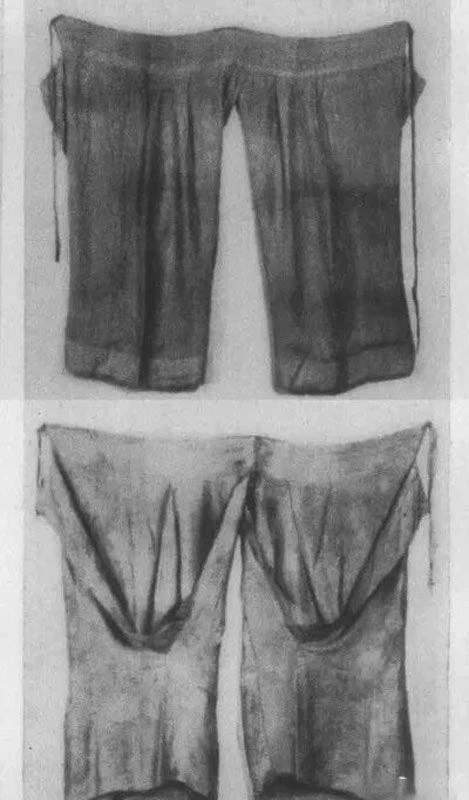
The second family is Ku (袴), outer trousers. Early Ku often had no crotch seam and was worn over crotched Kun. Modern readers picture babies’ split pants, so the design seems strange. In practice, ancient open-crotch Ku was rarely worn alone. Warmth was its main job, so makers used thick cloth, padding, or fur. Flat cutting did not hug the body; thick fabric made crotch construction awkward and could pinch. Leaving the crotch open was a shortcut. One style had a waist and two legs but no seam; wide overlap and inner layers prevented exposure. Another had separate legs tied to Kun cords or an outer belt; people called it a shin garment or knee pants, and after the Qing dynasty, over-trousers. Thin embroidered Ku later became decorative.
Climate, Not Clan
Open-crotch Ku makes most sense as climate equipment. It appears more often in northern China, where warmth mattered. Hezhen (赫哲族) fishermen used fish-skin over-trousers; Nenets (涅涅茨人) reindeer herders still wear fur over-trousers in cold seasons. Calling split trousers a Han “patent” misses the point. The design follows temperature, work, and layering, not a fixed tribal signature.
Decoration tells another story. In the Noin-Ula (诺音乌拉) tomb M6, a Xiongnu (匈奴) noble grave, archaeologists found a brocade knee Ku with attached socks. Han-style warp brocade formed the face, and felt flowers decorated openings. Later Mongol (蒙古族) wrestling dress uses plain, loose trousers as a base and adds vivid over-trousers. Ku could warm the leg, signal status, or frame the body in cloth.
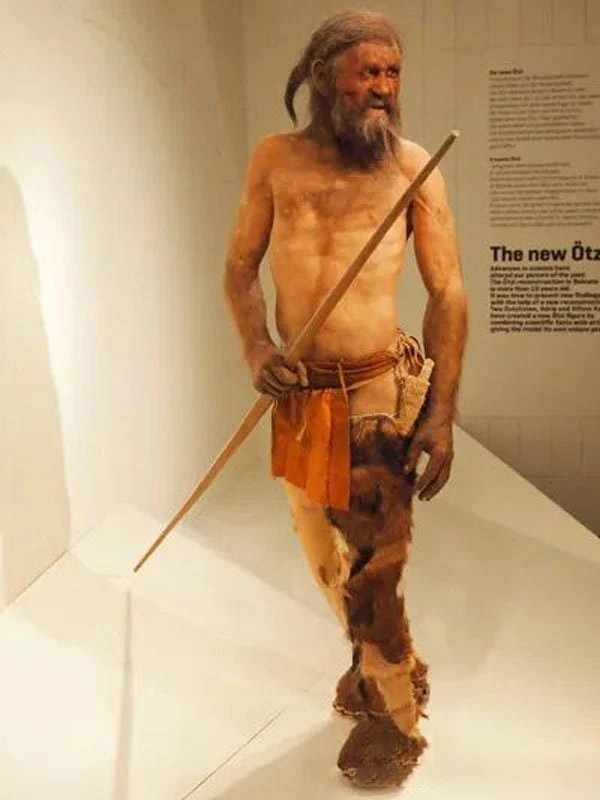
In 1991, hikers found Otzi (奥兹) in the Alps (阿尔卑斯山). The frozen man, about 5,300 years old, wore separate leg tubes with no crotch. His clothing survived in fragments, and researchers reconstructed the cut. Otzi’s trousers resemble a solution seen across Eurasia. Perhaps no single ethnic group invented this design and passed it onward. People facing similar needs—cold, mobility, simple cutting—arrived at similar answers. The split trouser is less a secret signature than a shared human response.