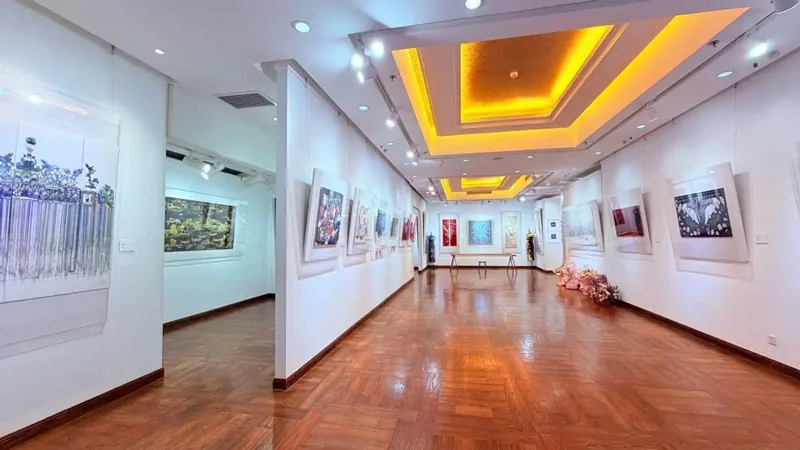
An exhibition tracing four decades of needlework by Zhou Xueqing has opened at the Aojia Art Museum, also known as the Beijing Yingjie Hardstone Art Museum. “Wuzheng Wuzhen: Zhou Xueqing Embroidery Art Exhibition” gathers more than forty years of her work and invention, and runs in Beijing until October 20, 2026. More than fifty craft experts, scholars and guests attended the opening.
Its title turns on two ideas. The first, drawn from the Diamond Sutra, points to a maker who keeps to one path without argument; the second, “no needle”, describes a level of skill where the tool disappears from view. The visitor sees clouds rise and fall, or grass and trees take on feeling, and never quite tracks the stitch that put them there.
A Needle the Eye Cannot Follow
The pieces are arranged to show how that skill took shape. The exhibition follows Zhou from her beginnings in a Suzhou embroidery household, through her fusion of Suzhou and Yue embroidery, to the snowflake simulated embroidery she developed herself. Its curator has built the display on two parallel lines of narrative, one tracking the craft and the other the era it belongs to.
At the opening, speakers placed her work in a broader frame. Yang Xiaobo, a deputy secretary-general of the Chinese Peasants and Workers Democratic Party central committee, Cai Daying, party secretary and chairman of the China Arts and Crafts Society, and Wang Anzheng, producer of the documentary “Chinese Embroiderer”, each credited Zhou with advancing both technique and the training of new hands.
Three Rooms, Two Traditions
Zhou came from a Suzhou embroidery family and began learning at five. She is now a professor at Zhongshan Polytechnic, a senior arts-and-crafts master, a municipal-level inheritor of Yue embroidery in its snowflake simulated form, and a Guangdong provincial arts-and-crafts master, and she has lectured at the Royal School of Needlework in Britain. On the strength of Suzhou and Yue stitching she invented the snowflake stitch, collected more than thirty national honours and trained over three thousand people. In 2024 her studio was named a Guangdong provincial female-worker innovation studio.
Its first section, “Wumen Lineage”, shows her Suzhou roots in scroll works including “Hundred Sons”, “Tuning the Lute and Sipping Tea” and “Court Ladies Preparing Newly Woven Silk”. The second, “Lingnan Renewal”, turns to the south, where she created the snowflake simulated embroidery, and includes “Flower Crown Bearing Dew” beside the Yue embroidery works “Golden Branch and Jade Feathers”, “Taiping Youxiang” and “Double Happiness”. The third, “New Patterns”, gathers her cross-boundary work: “Breaking the Cocoon”, “Untitled” and “Seasons on the Ridge”.
The Symposium Draws a Line
A symposium held in Beijing alongside the show reached several points of agreement: that innovating a heritage craft is not the same as changing its essence, and that preservation and new products can run side by side; that a tradition stays alive through the re-creation in an inheritor’s hands, which the field and the public should support with patience; and that collecting and buying are themselves a form of backing.
On new technology, the panel held that tools such as AI can serve craft only if the maker stays at the centre. Zhou recalled a childhood spent at the embroidery frame, where, as the eldest daughter, she threaded needles for her mother before she could work the patterns herself, and said she returned to embroidery after university because she had come to love it from the inside. Jiang Yuqiu, the curator and symposium host, noted that the day’s discussion ranged across heritage protection, arts and crafts, cultural industry, materials research and design, sketching the several places embroidery now occupies in contemporary knowledge.