Ancient Chinese court titles can look like a ladder of compliments. They were not. Princess, Senior Princess, and Grand Princess marked a woman’s generational distance from the reigning emperor. Favor, land, and personality might change her life, but the label followed blood and succession. A daughter could become a sister, then an aunt, as thrones changed. The puzzle is simple: who was related to which emperor? Once that map is clear, the three ranks stop being mysterious and start looking like a family tree written in ritual language.
Bloodline, Not Favor
Start at the first rung. A princess was the daughter of the emperor on the throne. Birth order did not matter. A baby girl and an adult daughter both held the same basic title. Legitimate and concubine-born daughters shared that name, though their allowances, marriages, and honors could differ sharply. For example, a daughter of Tang Taizong (唐太宗) and a daughter of Song Renzong (宋仁宗) were both princesses in their own courts. The title described the father, not the woman’s age or charm.
The word itself has a wedding story. Under the Zhou Dynasty, the king’s daughter did not receive a separate title. At her marriage, custom said the king and queen could not personally preside. A duke, the highest noble rank, handled the ceremony. Duke plus host produced “gongzhu” (公主), the phrase still used for princess. Before Qin unification, it meant the Zhou king’s daughter. After the ruler took the title emperor, the name survived and stretched across later dynasties.
The Qing Dynasty rewrote the house rules. Senior and grand princess ceased to be routine grades. Mother’s status became the dividing line. A daughter of the empress could be named Gulun Princess (固伦公主), the highest female rank, while daughters of consorts usually became Heshuo Princess (和硕公主). The difference reached stipends, mansions, processions, dowries, and even the rank of a husband. Same palace, different doors.
Sisters And Aunts
Move one generation up. A senior princess was the reigning emperor’s sister, a daughter of the previous emperor. When the old ruler died and a brother took the throne, his sisters automatically rose. The change was generational, not personal. A woman did not need a new favor to become senior; she needed a new emperor in the family. Emperor Shenzong of Song (宋神宗) raised his sisters, daughters of Emperor Yingzong (宋英宗), to senior princess after his accession. Their bloodline did the work.
The Han Dynasty (汉朝) gave the rank firm shape. Liu Piao (刘嫖), daughter of Emperor Wen of Han (汉文帝) and Empress Dowager Dou (窦太后), was the full sister of Emperor Jing (汉景帝). As the emperor’s sister, she became Guantao Senior Princess (馆陶长公主). Early use of “senior” could also echo eldest daughter, but later practice turned it into a generational label. Age and birth order stopped mattering. The emperor’s sister held the title, whether she was older or younger in the nursery.
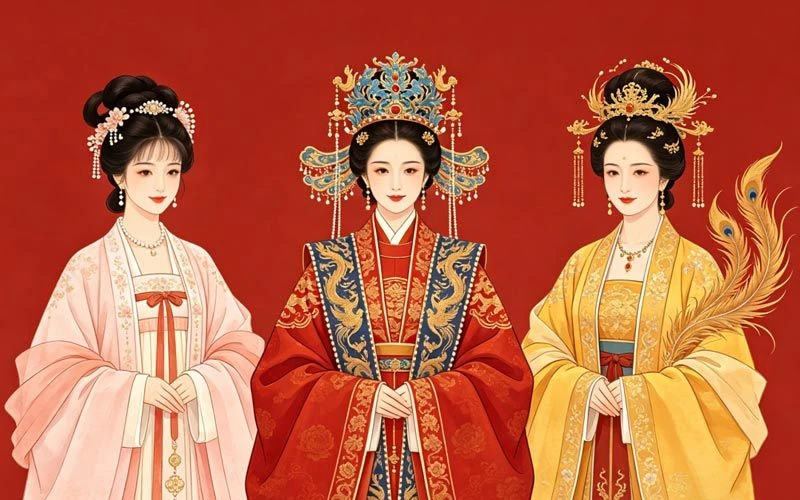
Climb another step. A grand princess was the emperor’s aunt: a sister of the previous emperor, a daughter of the emperor before him. Two reigns had passed since her father sat on the throne. Han practice completed the sequence: princess, senior princess, grand princess. Liu Piao’s own life shows the ladder. Under Emperor Jing she was a senior princess; under Emperor Wu (汉武帝), her nephew, she became a grand princess. The same woman, a new generation, a higher label.
Titles Versus Power
Ritual rank set a floor, not a ceiling. It fixed ceremony, income, and precedence. It did not guarantee influence. A princess with a low title might dominate a court through family backing, imperial affection, or political nerve. A grand princess with the highest label might live quietly, bound by palace rules. The title told observers where a woman stood in the family tree. It could not tell them what she could do.
Princess Taiping (太平公主) proves the gap. As a daughter of the emperor, her formal title stayed at the princess level. Her world was far larger. She moved through the politics of the Tang Dynasty and Wu Zhou (武周) court, gathered allies, commanded resources, and helped drive two palace coups. At her height, her reach rivaled princes and senior ministers. Ambition eventually destroyed her. The rank on paper never captured the force she wielded.
Hexiao Princess (和孝公主) shows the reverse lever. Born to a concubine, she began as a Heshuo princess. Emperor Qianlong (乾隆) favored her so strongly that he raised her to Gulun status, beyond the usual rule. She did not steer national politics like Taiping. Still, her treatment, honors, and marriage privileges outran her formal starting point. Favor opened a door that birth had left closed.
Names carried memory and protocol; people carried appetite and luck. The clever reader should keep both in view. A court title explains the door a woman entered, not the room she turned into a stage.
The table below lists imperial princess titles by kinship and generation.