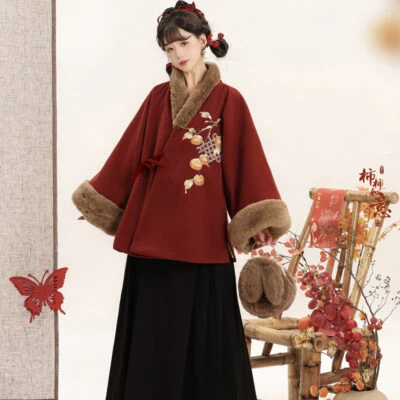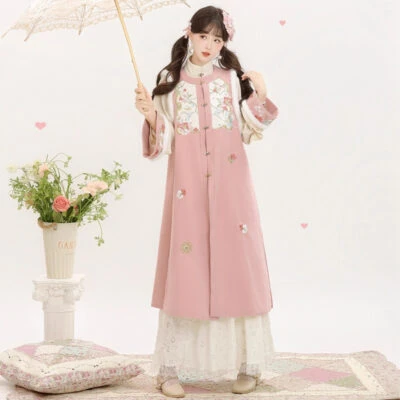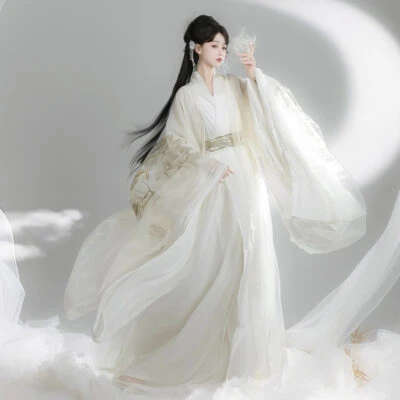
Cross-collar clothing runs through the long history of Hanfu as one of its most stable forms. It keeps appearing across centuries, not as a frozen costume, but as a flexible structure that adapts to new materials, silhouettes, and social tastes. In the late Ming period, women’s cross-collar garments still held this familiar shape, yet they also showed quiet changes in collar width, hemline, sleeve form, and layering. These shifts become clearer when archaeological finds are read alongside painted images. Three cross-collar upper garments recovered from the Wan Huangshi (万黄氏) tomb provide especially useful evidence, because their construction can be compared with figures in the late Ming painting Zheng Jing Xingle Tu (郑经行乐图). Together, they suggest that late Ming women’s dress was moving toward a refined, restrained elegance rather than exaggerated volume.
Cross-Collar Structure
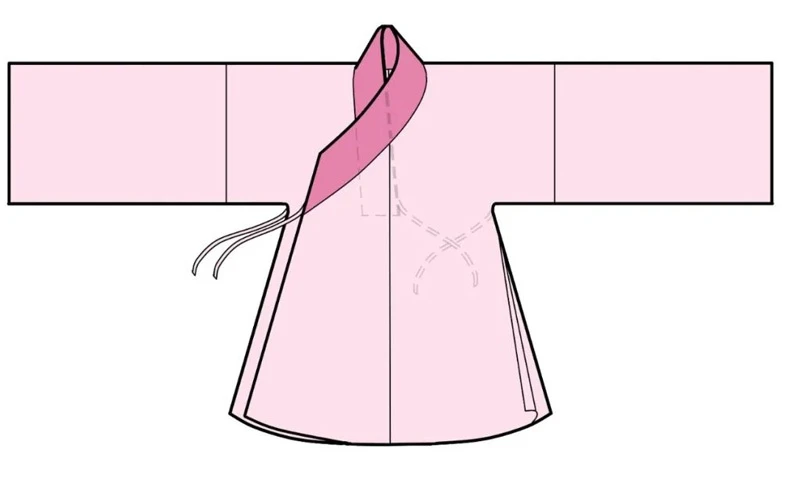
The three garments from the Wan Huangshi tomb are named the yellow gauze floral women’s unlined robe, the satin padded robe with wide sleeves and peony scrolls, and the satin padded robe with straight sleeves and peony scrolls. All three use a cross-front structure. Some pieces include an extended inner front panel, while others do not. Where the inner extension is missing, the ties seem to take over its function, helping the garment close neatly and maintain the expected overlap.
This means that late Ming cross-collar clothing did not follow only one strict rule. The mainstream form still favored an inner front extension, but simpler versions also existed. Using ties to replace part of the inner panel would have saved labor without breaking the visual logic of the outfit. The result is a garment that still reads as cross-collar, even if its internal construction has been streamlined.
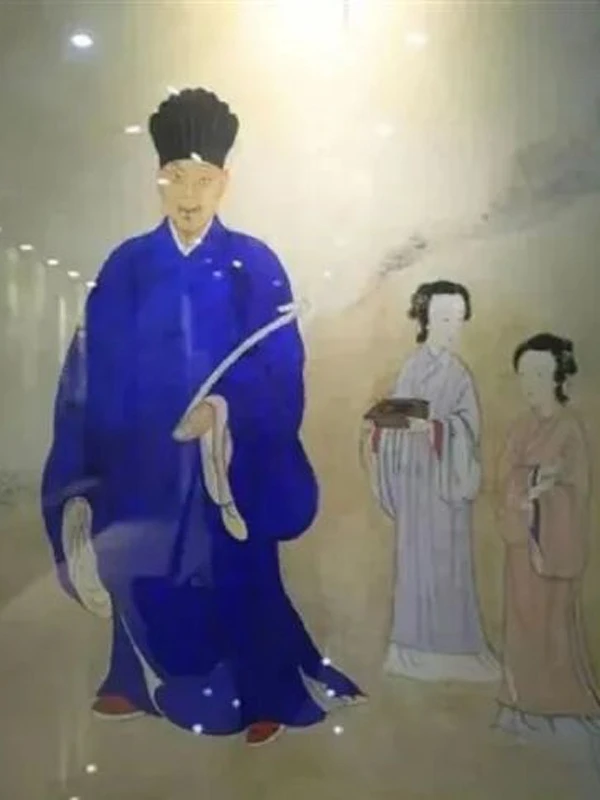
The painting Zheng Jing Xingle Tu supports this reading. Two maidservants in the scene wear outfits that correspond closely to the Wan Huangshi garments. The woman in blue has slightly gathered cuffs, matching the wide-sleeved padded robe. The woman in red has plainer cuffs, closer to the straight-sleeved robe. Their collars are relatively narrow, and their garments appear longer than the excavated examples. Paintings and textiles do not always match perfectly, but the overlap is strong enough to show that these styles were worn in daily life.
Narrower Collars
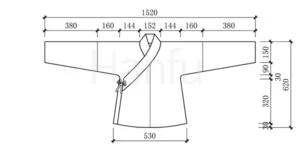
Ming clothing is often remembered for relatively broad collars, yet the Wan Huangshi pieces do not all follow that pattern. The unlined robe has a recorded collar width of about ten centimeters, while the wide-sleeved padded robe measures around eight centimeters, and the straight-sleeved padded robe about five centimeters. The variation is striking. It suggests that collar width was not fixed by a single rule, but shaped by personal taste, garment type, and the desired effect of layering.
A narrower collar makes it easier to show the layers beneath. When the outer garment opens slightly at the neck, the inner edge becomes part of the outfit. This creates a sense of depth without heavy ornament. A woman could adjust her appearance through fabric contrast, color placement, and the order in which garments were worn. The collar becomes a small frame rather than a dominant feature.
Sumptuary regulations in the Ming period certainly influenced dress, but they did not prescribe every measurement down to the centimeter. Within acceptable bounds, people could still make choices. The narrower collars found in these late Ming garments may reflect a growing preference for subtlety. Instead of announcing status through broad, emphatic lines, the outfit speaks through proportion, neatness, and the careful exposure of inner layers.
Flat Hems and Straight Sleeves
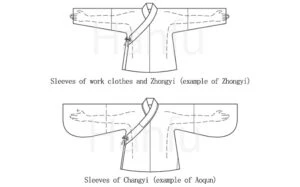
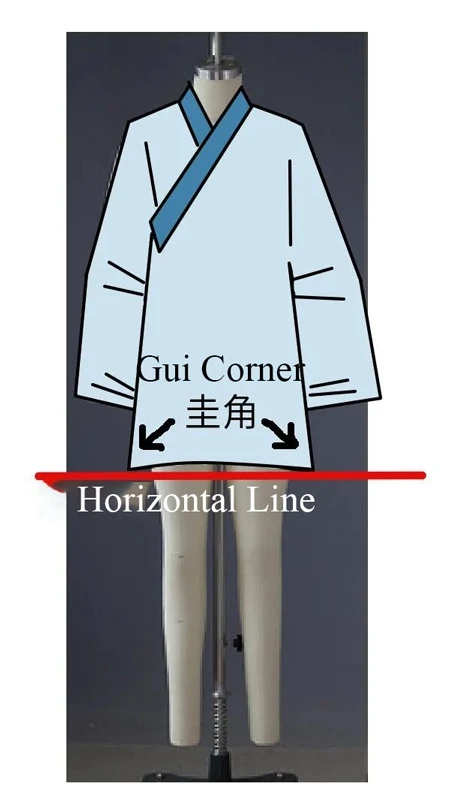
The hemlines of the Wan Huangshi garments also stand out. Since the Song period, many upper garments developed curved hems so that the edge would sit smoothly when worn. Ming examples with nearly straight hems are rare, yet these three pieces show very little curve. The wide-sleeved padded robe, judged from its flat-laid photograph, appears almost entirely without hem curvature. When worn, such a hem could produce sharp lower corners, a visual effect associated with much earlier deep-robe aesthetics from the pre-Qin and Han periods.
This does not mean late Ming dress simply copied ancient forms. Rather, it suggests a renewed interest in calm, balanced lines. A flatter hem gives the body a composed silhouette. It avoids the soft drop of a curved edge and replaces it with a cleaner finish. Other late Ming burials show similar tendencies, including a floral satin lined robe from a Ming tomb in Sensenzhuang (森森庄), Taizhou, Jiangsu, which also has a straight hem. The pattern points to a broader shift toward relaxed refinement.
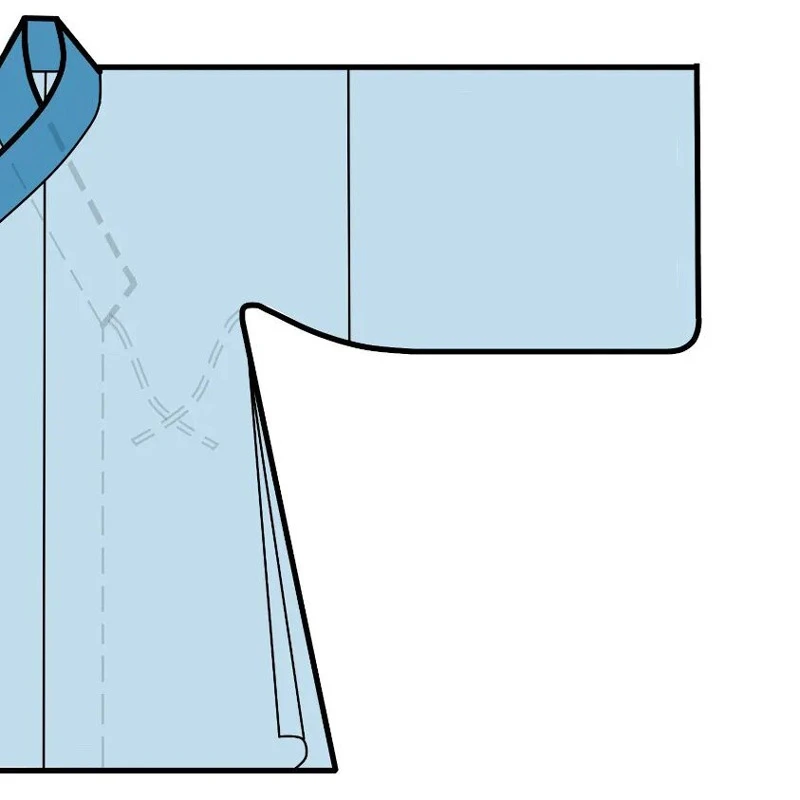
The sleeves follow the same logic. Although the three garments differ in detail, their sleeves look relatively straight and even. They do not swell into the pronounced fish-belly, bow-case, or pipa shapes found in other historical sleeves. This restrained sleeve form continues into the early Qing period. One way to understand the later change in dress is not as an immediate disappearance of Hanfu structure, but as a transformation that began with alterations to collars, front panels, and fastening methods.
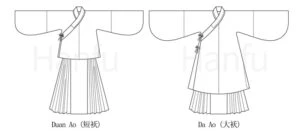
Taken together, these garments feel delicate rather than theatrical. The collars are not oversized, the sleeves are not exaggerated, and the length-to-width proportions remain moderate. The overall impression is graceful, quiet, and well-proportioned. When reconstructed with reference to Zheng Jing Xingle Tu and the Wan Huangshi textiles, the outfit can be imagined with or without a transparent front-opening long vest. Either way, the late Ming woman’s cross-collar ensemble appears as a confident expression of everyday elegance, shaped by practical construction and a taste for understated beauty.