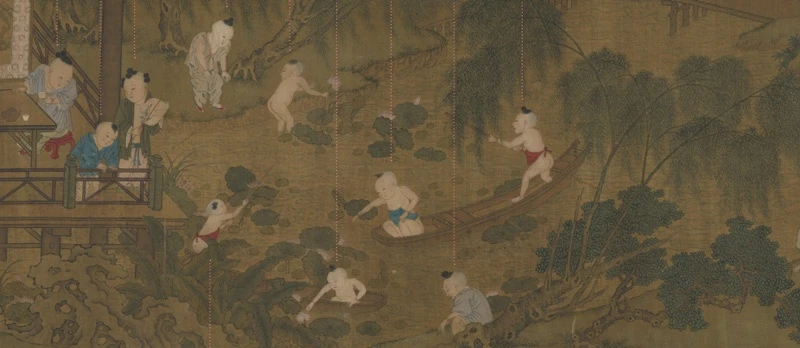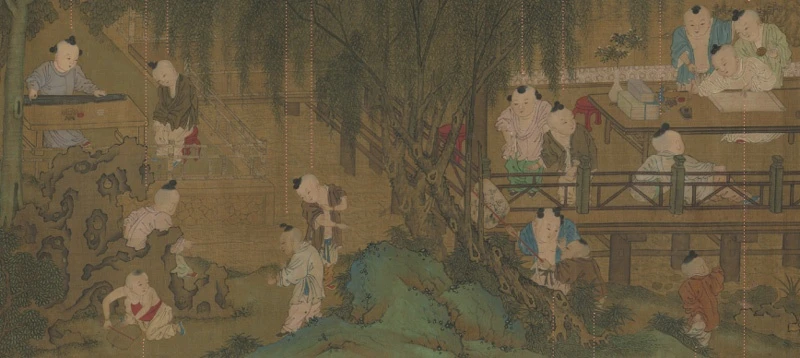
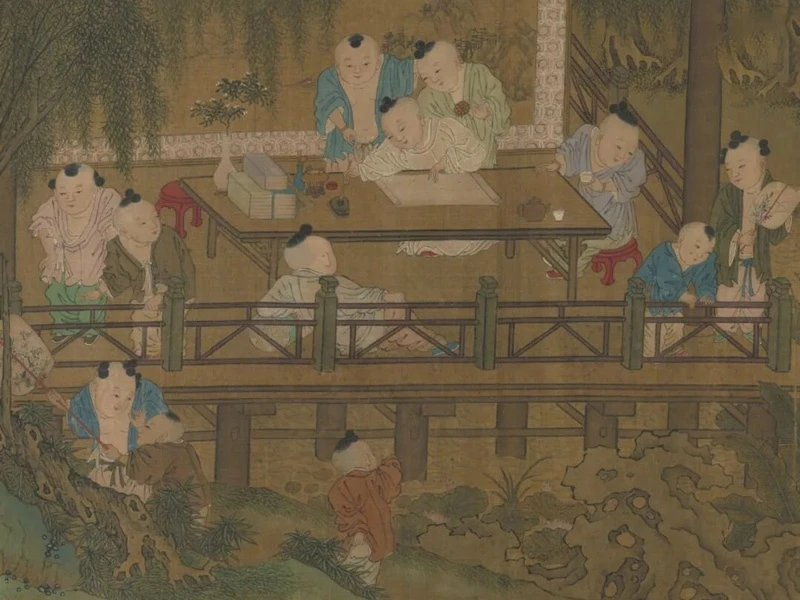
In the long handscroll Changchun Baizi Tu (长春百子图), painted by Su Hanchen (苏汉臣) during the Song Dynasty and now kept in the National Palace Museum in Taipei, more than one hundred children gather across gardens, pavilions, and lotus ponds. The scroll measures 30.6 centimeters in height and 521.9 centimeters in length, and each child carries a different expression, posture, and outfit. These small figures are not merely decorative. Their clothes, accessories, and movements help us read the season, the setting, and the habits of daily life. In the summer scenes, heat shapes what they wear. Light upper garments, simple trousers, and protective underclothes appear again and again, showing how families dressed children for play, comfort, and care.
Light Shirts for Play
In the summer sections, most children wear Shan (衫), a light shirt or robe suited to warm weather. Some of these garments end above the hips, while others reach the middle of the lower leg. Shorter versions allow freer movement, especially for children running beside water or chasing one another under trees. Longer ones look more formal, yet they still appear relaxed in the painting, as if made for outdoor leisure rather than strict ceremony.
A typical outer layer is the Beizi (褙子), a long-sleeved garment with an open side seam. The front and back panels do not join beneath the arms; instead, thin ties are attached near the armpits and along the back. One child wears a brown Beizi, fastened at the chest with two ribbons. This style gives the body room to breathe while keeping the shoulders and arms covered, a practical choice for summer afternoons when shade is welcome but full coverage is not always desired.
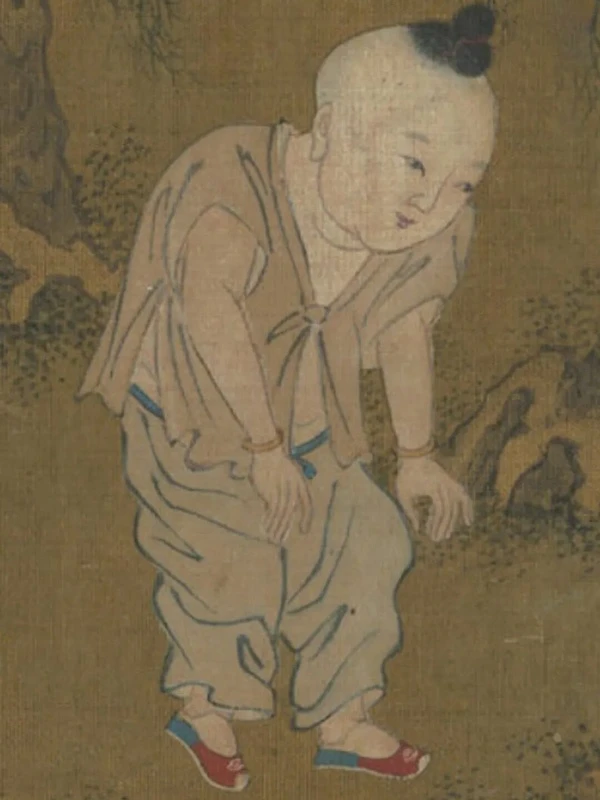
Collars also vary. Some children wear cross-collar shirts, where the front panels overlap at the chest, a familiar feature in traditional Han clothing. Others wear round collars, sometimes called plate collars, which sit flat and open more widely. One child appears in a blue cross-collar shirt, while another wears a white round-collar shirt. The fabrics differ too: some shirts are single-layered for hot days, while others are lined, suggesting they could be worn when the air turns cooler.
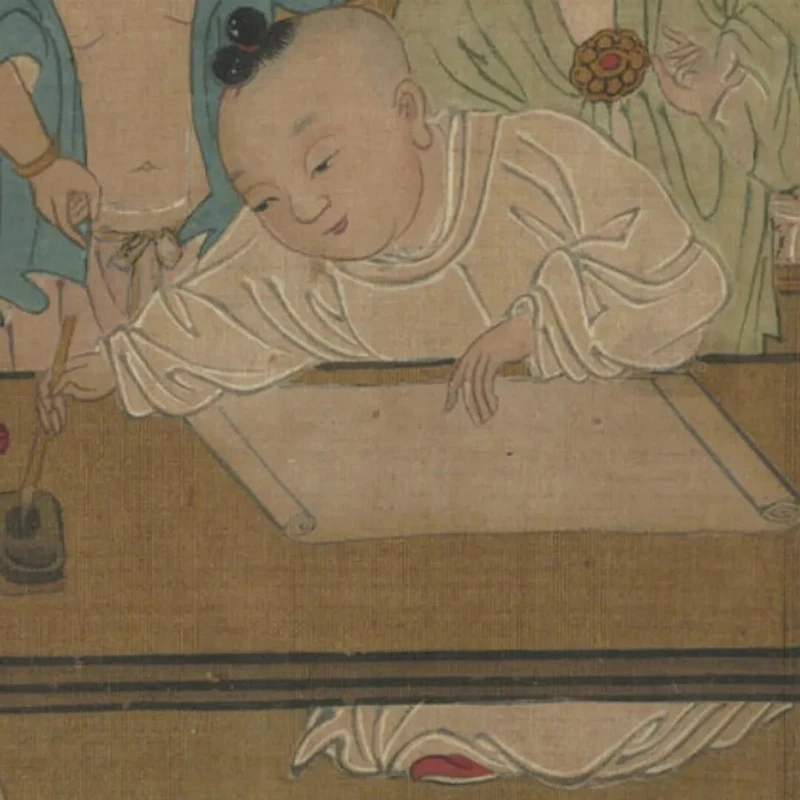
The Red Belly Band
Three children in the summer scene wear a Dudou (肚兜), a small piece of cloth tied around the neck and waist. Their Dudous are red, and they appear near the lotus pond, playing with friends or pausing beside the water. Another child wears a similar garment in blue. These pieces look simple, but they carry a clear purpose. They cover the chest and abdomen while leaving the arms and legs free, so a child can splash, squat, run, and climb without being weighed down by heavy clothing.
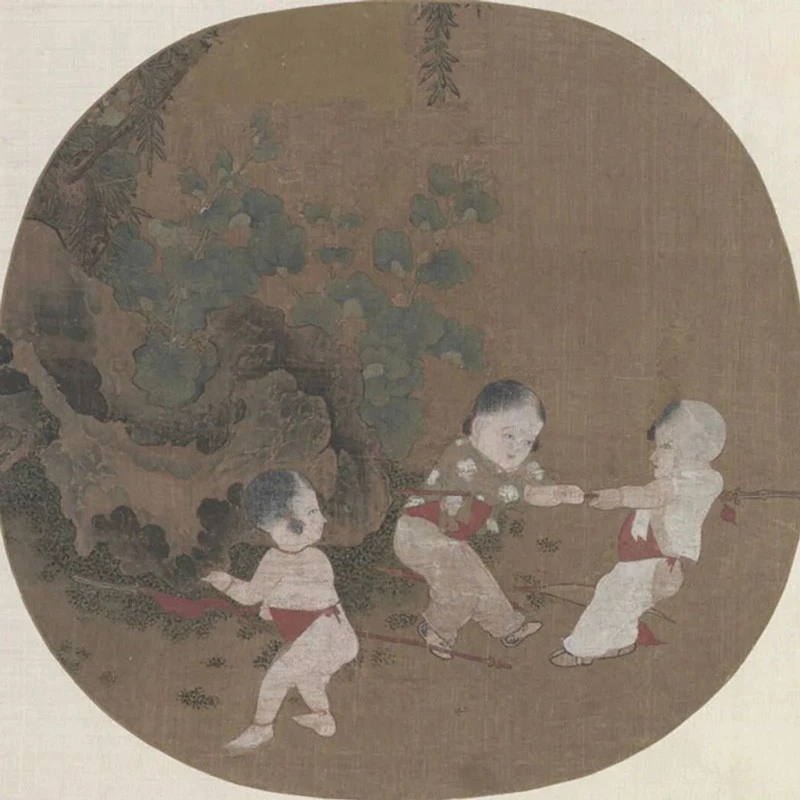
In Song paintings of children, the Dudou appears often. Younger children especially wear it outdoors in summer, because it protects the stomach from sudden wind after sweating. The shape is usually flat-cut, often diamond-shaped, though triangular and trapezoid forms also exist. The top corner is rounded to form a neckline, with loops for silk ribbons or silver chains that pass behind the neck. The side corners carry thicker ribbons, tied at the lower back. The lower point usually reaches the navel, though some versions end in a soft curve.
Some Dudous are cut from a rectangular piece of cloth with rounded corners and an opening at the top, fastened at the back. Many are embroidered with dragons, phoenixes, butterflies, and other lucky motifs. These patterns are not only decorative. They express a mother’s wish for health, safety, and good fortune. A small garment becomes a quiet message of care, stitched into the fabric that rests closest to a child’s body.
Trousers Beneath Summer Sun
Children’s trousers in the Song period came in several lengths and styles, from long pants to shorter ones, and from closed-crotch to open-crotch forms. Their cut was not very different from adult trousers, but the way children wore them was. Adults usually kept lower garments hidden beneath robes, while children, especially boys, often let their trousers show. This habit fits the lively scenes in many infant-play paintings, where movement matters more than formal dress codes.
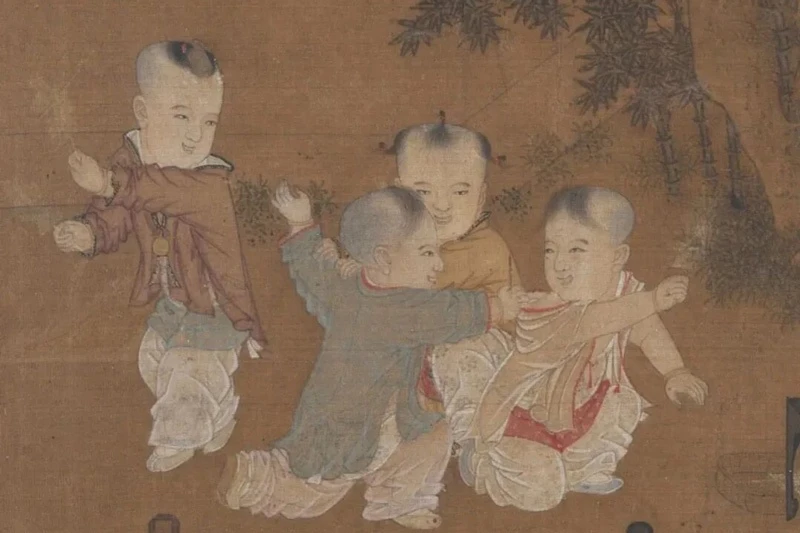
In works such as Xiao Ting Ying Xi Tu (小庭婴戏图), boys wearing short shirts, half-sleeves, or vests display their trousers clearly, and the pants tend to be long. In summer scenes where the upper garment reaches the knees, it can be difficult to tell whether the trousers are open-crotch or closed-crotch. The same problem appears in Changchun Baizi Tu. The painting does not always reveal the exact construction, so certainty is limited.
Even so, a reasonable pattern emerges. Younger children are more likely to wear open-crotch trousers, which make toileting and active play easier. Older children tend to wear closed-crotch trousers, which look more complete and may signal a small step toward adult dress. Together, the shirts, Dudous, and trousers in the summer scenes create a picture of practical clothing: light enough for heat, protective enough for care, and flexible enough for children who spend their days running, watching, laughing, and playing beside the lotus pond.