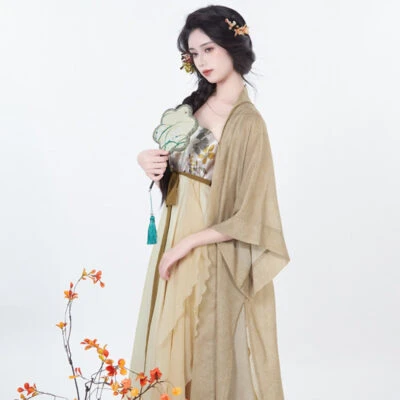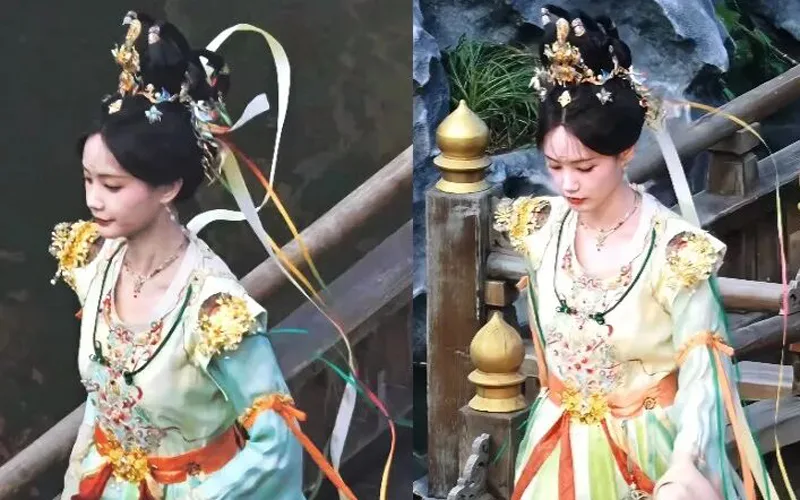
New behind-the-scenes stills of Li Yitong (李一桐) in Gu Yue Feng Hua Lu (古乐风华录) have set off a small storm online. Her costumes carry dense bead fringes, layered floral roundels, tall hair ornaments and unusually long ribbons. Some viewers joke that she looks as if she stepped out of a Dunhuang (敦煌) mural. The comparison is not random. The production clearly borrows from apsaras, the flying figures painted across cave walls. Yet the result is not a museum copy. It is a television costume shaped for movement, camera angles and character contrast. The question is not whether the look is pretty. It is why this old mural language fits a modern drama about music, and how the design turns painted stillness into screen motion.
Dunhuang Echoes
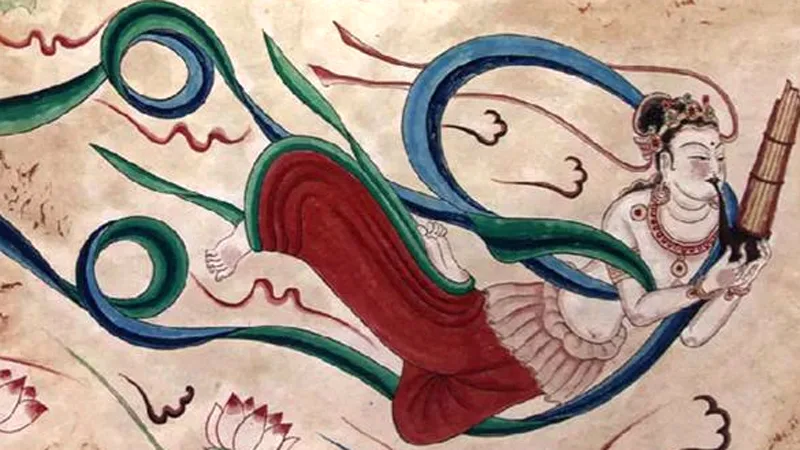
The murals offer two useful types. Scattering-flower apsaras hold lotus buds or flower plates; their poses feel light and open. Music-playing apsaras carry lutes, flutes, drums or clappers, and they seem to perform in midair. Early examples sit close to cave ceilings or above niches. Their lines are firm, ribbons short, flight limited. Later painters loosen the body. Figures grow slender, ribbons lengthen, and the background opens into empty sky. By the Sui and Tang periods, the two types work as a pair: one scatters petals, one plays instruments, often in the same painted group. Long silk strips curl around arms and waists, creating a windblown rhythm even when the figure is still.
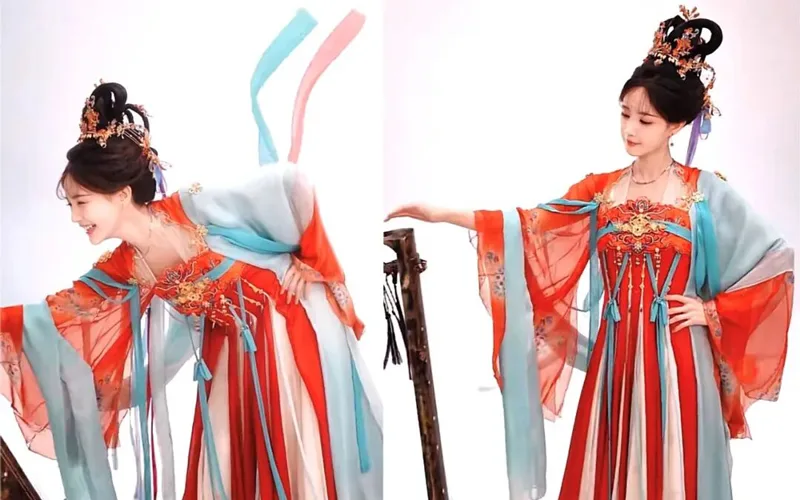
The show does not need every historical detail. It needs the part that reads instantly on camera: color, silhouette, and a sense of air. Apsaras give all three. Their headdresses can be rich without looking heavy, because the eye follows the ribbon lines upward. Their sleeves can be wide, because the pose suggests lift rather than clutter. In a drama about ancient instruments, this visual grammar does two jobs at once. It signals “music” before a character plays a note, and it signals “otherworldly” before the plot explains who she is. The costume team also adjusts what would look stiff on screen. Hairpins are enlarged, waistlines are cleaned up, and ribbon lengths are tuned for walking, turning and fighting.
The mural reference also avoids a common trap in period costume: decoration without direction. Beads, roundels and long sashes could become a pile of pretty parts. Here, the flying figure gives each part a job. The hair ornament lifts the head. The sash draws a curve through the frame. The layered skirt anchors the body so the upper lines can float. That balance matters in close-ups and wide shots. In close-up, the face stays readable under the ornament. In wide shot, the ribbon creates a line the camera can follow. The result feels active rather than staged. Even a still frame keeps a trace of motion, which is exactly what a mural apsara does.
Dual-Role Design
The design also solves a casting problem. Li Yitong plays two parts: Xiyin (希音), a music deity, and Yue Yangyang (越央央), a folk musician. If both women wore similar robes, viewers might need dialogue to tell them apart. The apsara language gives Xiyin a distinct silhouette. Her ornaments are taller, her colors denser, her ribbons longer. Yue Yangyang can stay earthier: simpler hair, shorter sashes, fabric that looks worn by travel. The contrast is not just rich versus plain. It is airborne versus grounded, ritual versus street performance. That difference helps the audience read status, mood and story position before a line is spoken.
The choice also fits the drama’s subject. Gu Yue Feng Hua Lu is built around old instruments and the people who keep them alive. Apsaras are not generic decorations; they are painted musicians and dancers. A figure with a lute or flute belongs in a story about performance. The costume can therefore carry theme without a lecture. When Xiyin appears with long ribbons and a musical bearing, the show connects divine authority with performance. When Yue Yangyang appears with a simpler instrument and practical clothes, the show connects craft with daily life. The same visual system holds both women, but it distributes weight differently. That is more useful than a direct copy of a cave painting.
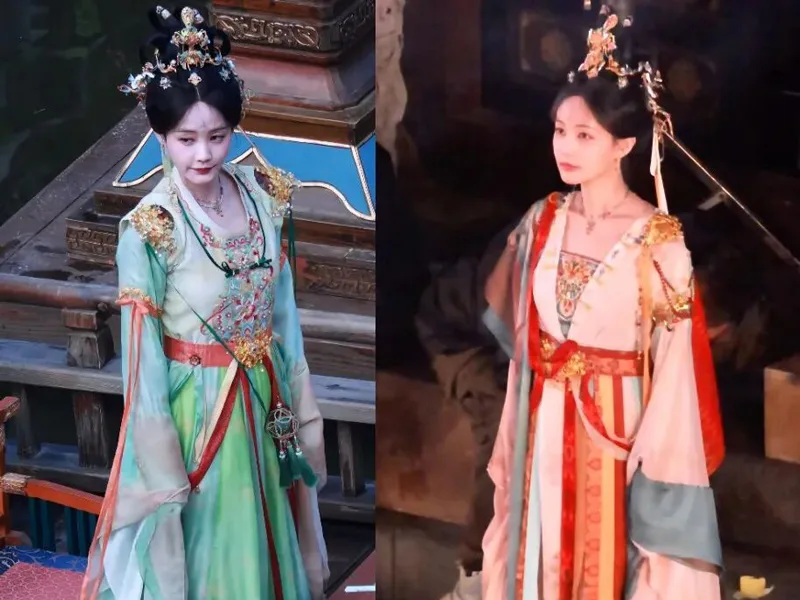
On screen, the look is built for motion. Long ribbons are risky: they can tangle, hide the face or look like loose streamers. The production keeps them controlled. They are attached to create arcs, not chaos. During music scenes, the ribbon follows the arm; during fight scenes, it extends the line of a turn. Dense colors and tall headpieces give the frame a strong center, while the moving sash breaks the symmetry. The camera can move with the fabric instead of cutting around it. This is where the costume earns its keep. It does not just quote a mural. It gives the actor a way to move, and gives the viewer a reason to watch.