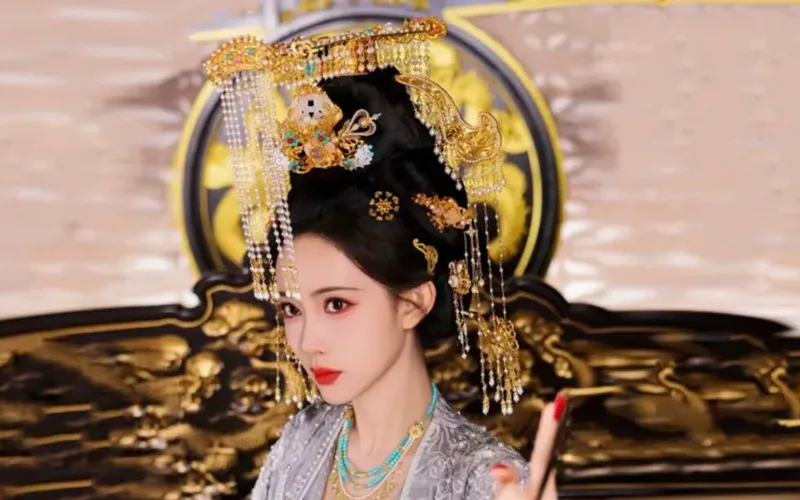
A single row of jade beads can start a historical argument. When Meng Ziyi (孟子义) appears in a regent’s costume in the new drama, viewers see power, ambition, and a familiar silhouette. The crown’s dangling beads make many think of Wu Zetian (武则天). The comparison is tempting: a woman behind a curtain, a court below, a crown above. But television design and historical dress rules are not the same language. One creates mood; the other marks rank. Keeping those two languages apart lets us enjoy the look without turning it into a fake history lesson.
Crown Versus History
The crown in question is not a casual hairpiece. In old Chinese ritual dress, the highest ceremonial crown belonged to emperors, princes, and top nobles at sacrifices, enthronements, and major New Year courts. Its flat board sits lower in front and higher at the back. Jade strands hang in front and behind; those strands are called hanging beads. Their count was fixed by rank: twelve for the Son of Heaven, fewer below. Ear plugs near the ears warned the wearer not to listen to flattery. This whole set was imperial dress. Empresses, princesses, and regents were not normally inside that system.
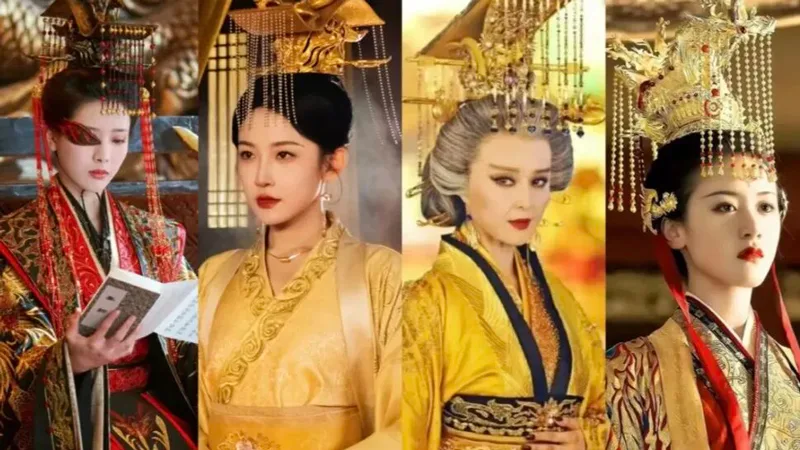
Wu Zetian is the exception that fuels the confusion. After she took the throne, changed Tang to Zhou, and ruled as emperor, records say she used the emperor’s ceremonial crown at major rites. That was a claim of sovereign status, not a queen’s accessory. Costume designers borrow that male crown and soften it for a female face. It reads as authority in one shot. Yet while she was empress or dowager empress, before becoming emperor, ritual rules still placed her in the consort system. A curtain did not equal a throne, and a throne did not always equal a crown.
Many dramas miss this line. A woman listening from behind a screen can be the most powerful person in the room, but her formal crown at a grand court was not the emperor’s beaded board. Using it anyway is a visual shortcut. It tells the audience that she has crossed the boundary. The shortcut works on screen. It just should not be filed under historical reconstruction.
Why does the mistake keep returning? Because the beaded board is instantly readable. It says emperor without a single line of dialogue. A flower crown needs a closer look and some prior knowledge. Television has little time for prior knowledge. So the design team picks the stronger symbol, and the audience gets a clean image of power. That choice is understandable, even clever. It becomes a problem only when viewers treat the image as a documentary record.
What Regents Wore
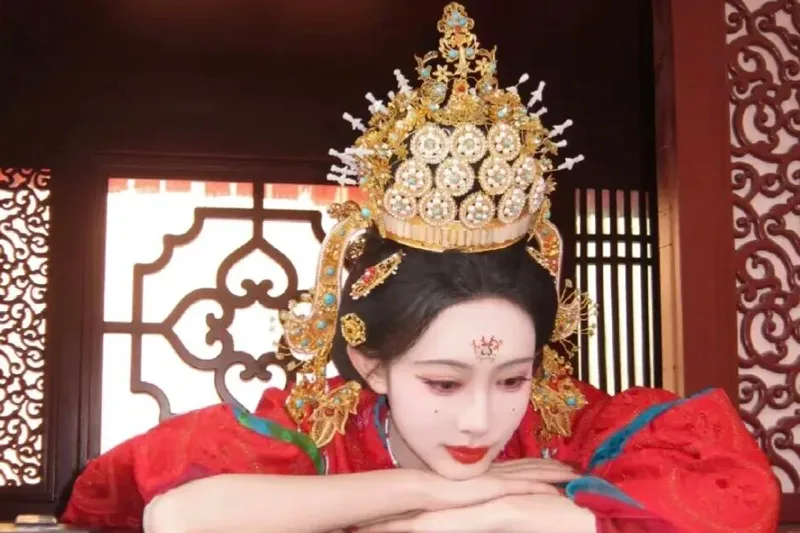
For empresses and consorts at the highest ceremonies, the better match is the flower-and-hairpin crown, also called a flower-tree crown. The Old Book of Tang (旧唐书) describes the empress’s grand robe for investiture, court audience, and assisting at sacrifices. Her hair ornament used twelve flower trees and side hair panels. There was no flat board and no curtain of jade beads. Gold flowers, jeweled filigree, and pins built the crown in layers. The number of flower trees marked rank: twelve for the empress, nine for the crown princess, then downward.
The Empress Xiao (萧) crown found at Yangzhou (扬州) gives a rare physical clue. Its gold flowers and jeweled settings, with side panels reaching outward, show how rich and formal this consort dress could be. It is not a plain hairpin. It is a crown built from many small pieces, bright but ordered. That look fits a woman receiving congratulations from behind a curtain. It says noble rank, ritual duty, and court presence. It does not pretend to be the emperor’s board.
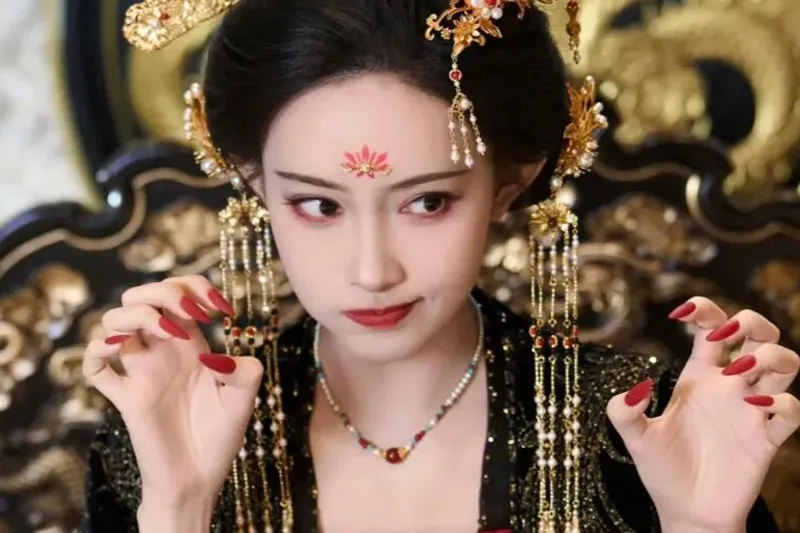
People often mix this crown with the later Ming phoenix crown. They are relatives, not twins. In Sui and Tang dress, flower trees carry the rank; phoenix birds are not required. The female ceremonial system has its own grammar. For a princess or dowager acting as regent, a flower crown at a grand audience is the tighter historical choice. The beaded board belongs to the emperor’s side of the line. Crossing it in real life was politically sensitive; crossing it on screen is a costume decision.
That does not make the drama look wrong. It makes the look dramatic. A regent who wears a soft flower crown can still be sharp, patient, and dangerous. Power does not live only in a crown. It lives in who speaks last, who controls the door, and who can wait. Still, a viewer who knows the dress code can enjoy the fantasy and spot the swap. The costume is a mood, not a manual. The flower crown is the history. Both can be interesting, as long as we do not confuse the two.