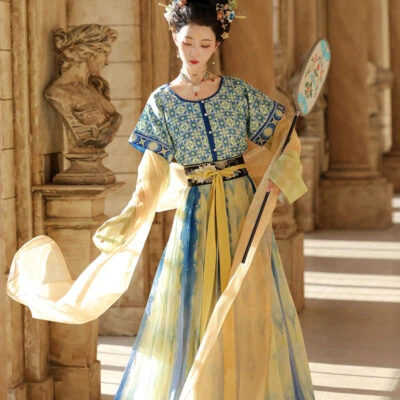
The Xinjiang Intangible Cultural Heritage Hall opened a wool tapestry exhibition on October 10, in the second-floor Silk Road ring corridor that the building keeps as a public display gallery. Forty pieces are on show, drawn from France, Egypt, Iran, Turkey, China and Japan, and the run closes on November 10. The hall, which also serves as the region’s heritage protection centre, organised the exhibition under the guidance of the regional culture and tourism department, with the Badahu Gallery and the Yixing Culture and Art Academic Centre planning and executing it. Admission is free and booked through the hall’s account on WeChat.
What the Show Assembles
Three sections carry the argument rather than one continuous hang, and the order is the argument. The first gathers wool tapestries from West Asia, the Western Regions, the Central Plains, the Mediterranean and Europe: Coptic fragments from ancient Egypt, ancient Peruvian tapestry, a Qing-dynasty wool tapestry thangka, tapestries from Turkey, Egypt and France, and a group of Ming-dynasty Kesi silk tapestry specimens placed beside them. Putting the silk pieces in the same room as the wool pieces makes the change of material visible without a label.
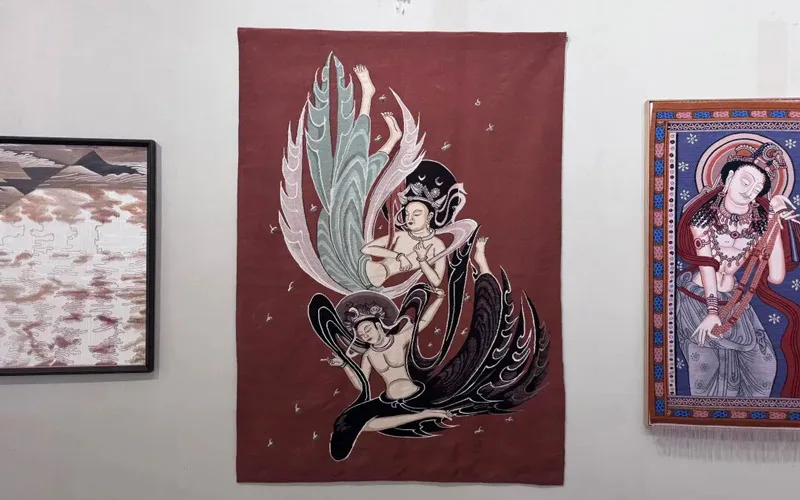
A second section follows what happened to the technique after it travelled east, and it tracks two shifts at once: the fibre turning from wool into silk, and the object turning from a working textile into something made to hang beside calligraphy and painting. The third section is contemporary fibre art, where artists keep the old method and set it against Dunhuang imagery and modern visual language. A tapestry of the Dunhuang flying apsaras is the clearest example of that pairing.
Why the Technique Travelled
Shi Suping, the curator, explains the craft through the single rule that governs it. The technique is Tongjing Duanwei (通经断纬): the warp threads run unbroken across the full width, while the coloured wefts are woven back and forth in separate segments, each covering only the area its motif needs. Where two colour blocks meet, the wefts turn back on themselves and leave a fine gap, and that gap is what gives the surface its carved edge.
Wool was the earlier form of that weave. It was worked in wool and linen first, then carried east from West Asia and the Western Regions along the Silk Road into the Central Plains, where it is credited with prompting the birth of the Chinese silk version. The same road carried it west to the Mediterranean and Europe, while the Andean civilisations of the Americas arrived at their own wool tapestry independently, with no contact at all.
Shi places Xinjiang at the centre of the story rather than at its edge. “As the core hub of the Silk Road, Xinjiang was the key node for the technique’s eastward transmission to the Central Plains, and it holds irreplaceable historical value in the long move from wool tapestry to silk tapestry,” she said. “Wool tapestry weaving is not only a handicraft; its transmission and its surviving pieces are important witnesses to exchange between civilisations.”
She added that the point she wants visitors to carry out of the room is smaller than that. Behind each interwoven piece, she explained, lies a long meeting of Eastern and Western materials, taste and technique.
The Lecture and What Follows
A companion lecture takes the exhibition’s own subject as its title. “Wool Tapestries Found in Xinjiang” runs at 4 p.m. on October 10 in the hall’s second-floor multi-function room, given by Jia Yingyi, a specialist in ancient textiles who works from years of archaeological research on the wool tapestry remains excavated in the region.
The hall presents these smaller thematic shows as a standing programme rather than a one-off, and says it will keep staging compact exhibitions that dig into individual heritage crafts. The wool tapestry show is the current entry in that series, and it stays open until November 10.