On the first two days of October 2026, two programmes opened a few kilometres apart in Wuhan. At the Guqin Terrace, a national-level inheritor of Guangling-school Guqin playing performed with his students and put historical instruments on display. The next morning, from the south gate of Guishan, a parade set out in which a Brazilian student dressed as the ancient player Bo Ya traded lines of verse with passers-by. Neither event was about technique. Both were restaging a story that made one instrument, and one word, stand for being understood.
What the Guqin Is, and What Zhiyin Means
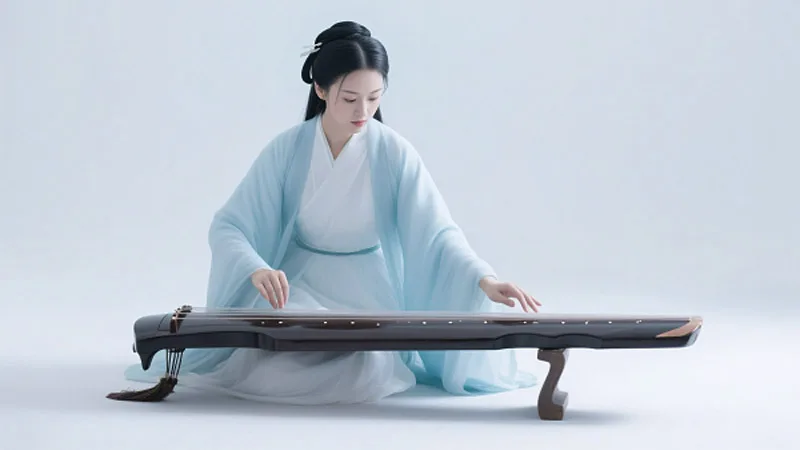
The Guqin is a seven-stringed, fretless Chinese zither that has been played for at least three thousand years, and it ranks first among the four arts a scholar was expected to command: the qin, chess, calligraphy and painting. Zhiyin, literally “one who knows the sound,” is the word the instrument’s founding story gave the Chinese language for the friend who understands you without needing an explanation. UNESCO’s official element record calls it China’s most famous and appreciated traditional solo instrument.
A deliberately quiet instrument, it has seven strings and no bridges, which lets the left-hand fingers slide freely along the surface; thirteen inlaid studs, the hui, mark the harmonic positions on the upper board, and the two boards are coated with lacquer over a base of ash. Its notes fall into three kinds: the open string, the harmonic, and the stopped note pressed by the left hand. The guzheng, which readers often confuse with it, carries twenty-one strings on movable bridges and plays far louder. The Guqin was built for a small room and one listener. Our guides to the most popular Chinese instruments and to classic instruments in Hanfu photo shoots carry the instrument layer in full; this page keeps to the cultural argument.
The Story Behind Zhiyin: Bo Ya and Zhong Ziqi
Earliest among complete tellings is the Lüshi Chunqiu, the Qin-dynasty compendium of statecraft, in its chapter on original flavour. Bo Ya plays, and Zhong Ziqi listens. When Bo Ya’s mind is on the mountains, Ziqi says he hears something towering like Mount Tai. When his mind turns to water, Ziqi says he hears something surging like a river. Bo Ya’s own verdict at the end of the exchange is that Ziqi hears not the notes but his intentions, so completely that there is nothing Bo Ya could play that Ziqi would not already know.
Its ending comes from the Liezi, Questions of Tang. After Zhong Ziqi dies, Bo Ya breaks his instrument and cuts its strings, and never plays again, on the grounds that there is no one left worth playing for. The Xunzi and the Han Feizi both refer to the pair, and Sima Qian’s Records of the Grand Historian repeats the episode, which is why the story is shared heritage rather than one text’s invention. The four-character phrase that grew from it, High Mountains and Flowing Water, now means a bond of mutual understanding. The Guqin’s role in how the tradition pictures a retreat appears in Sword and Guqin Practice Over a River.
Zhiyin as a word predates the story’s fame. It appears in the Book of Rites, in the Record of Music, where the argument runs that only someone who can judge sound can be spoken to about music. What the Han River valley added was the part the ritual text left out: an emotion attached to a person, and a loss that could not be replaced.
Three Times the Guqin Left China
Recognition outside China came in three dated steps, and the first two are older than most accounts assume. In 1976, the International Astronomical Union named a crater on Mercury Po Ya, after the musician at the centre of the story. The crater is 101 kilometres across, sits near 46 degrees south and 20 degrees west, and was first photographed by Mariner 10 in 1974. Chinese-language sources often give the naming year as 1967; the planetary gazetteer does not.
A recording is the second step. In 1977 the two Voyager probes left Earth carrying a gold-plated copper record of music, and the Chinese entry is the Guqin piece Flowing Streams, played by Guan Pinghu. NASA’s track list gives its length as 7 minutes 37 seconds, which makes it the longest item on the record, ahead of the first movement of Beethoven’s Fifth at 7:20. The American composer Chou Wen-chung recommended the piece and argued successfully against cutting it.
Administration supplied the third step: UNESCO proclaimed Guqin music a masterpiece of the oral and intangible heritage of humanity in 2003, and formally inscribed “Guqin and its music” on the Representative List in 2008 under reference 61. China added it to its own first national intangible heritage list in 2006, and in 2010 a Song-period Guqin sold for 22 million US dollars. An earlier bridge to Western readers appeared in 1940, when the Dutch diplomat and sinologist R. H. van Gulik published The Lore of the Chinese Lute, the first extended study of the instrument in a European language. Our own record of Chinese dress at a world fair begins with Let’s Meet Hanfu at Dubai World Expo 2020.
| Year | Event | Why it mattered |
|---|---|---|
| 1974 | Mariner 10 photographs the crater later named Po Ya | The imagery that precedes the naming |
| 1976 | International Astronomical Union adopts the name Po Ya for a Mercury crater | A musician’s name enters planetary nomenclature |
| 1977 | Flowing Streams, played by Guan Pinghu, goes aboard the Voyager probes | Longest track on the Golden Record, at 7:37 |
| 2003 | UNESCO proclaims Guqin music a masterpiece of oral and intangible heritage | International classification of the art, not the object |
| 2006 | China lists Guqin among its first national intangible heritage items | Domestic legal protection follows the international tag |
| 2008 | UNESCO inscribes “Guqin and its music” on the Representative List, reference 61 | The proclamation becomes a standing listing |
A Quiet Instrument and the Idea of Friendship
Volume does not explain the Guqin’s standing, because the instrument loses on every measurable count. It has far fewer surviving pieces than the pipa or the guzheng, its sound carries less far, and until the twentieth century it was not built for public concerts at all. What it does better is answer a different question. The pipa asks how well something is played. The Guqin asks whether anyone is listening in the right way, which is why its best-known story ends with the instrument destroyed rather than performed.
That is also why the instrument travelled so well once it left its own room. Van Gulik’s 1940 study argued that the tradition values timbre over melody, that a single note carries the meaning and the phrase is only its setting. Read that way, the three departures above stop looking like coincidences: a crater and a spacecraft record both reward a sound that has to be listened to closely rather than heard from a distance. Zhiyin is the same proposition applied to a person, and the Guqin tradition treats the two as one idea:
- The open string corresponds to earth, and carries no left-hand work at all.
- The harmonic is the lightest of the three sounds, produced by touching the string rather than pressing it.
- The stopped note carries the sliding and vibrato that listeners read as speech.
Modern teaching has widened who gets to hear it. Guqin classes since 2003 have appeared in most Chinese cities, and the count of learners has been put in the hundreds of thousands. The personification of these instruments in a stage production is covered in Gu Yue Feng Hua Lu, and the folk-arts context sits in Top 10 Folk Arts in China.
Zhiyin in 2026: Three Stages in Wuhan
The Guqin Terrace programme ran from 1 to 3 October 2026, organised with the Wuhan Federation of Trade Unions and the terrace’s management committee, with the Kaiyuantang Qin Society and the Yangzhou Tonglin Qin Society as co-organisers. Ma Weiheng, a national-level representative inheritor of Guqin art in the Guangling school, played with his students and showed both inherited Song and Ming instruments and instruments he had made himself, so that visitors could handle the object, the notation and the sound as three separate layers. His senior student Tao Jian, an inheritor in Hongshan district, has spent years moving the instrument out of the professional’s study.
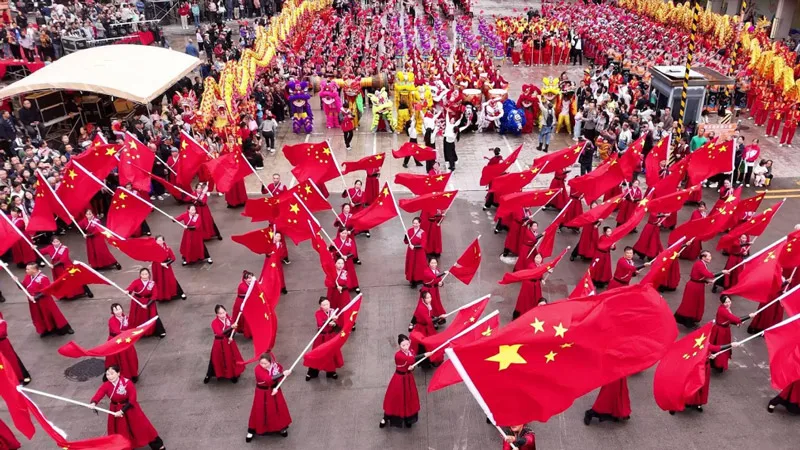
A parade from the south gate of Guishan set out the following morning along a route through Nanmen, Fuyun Pavilion, Guiyue Pavilion, Butterfly Spring and the west gate. Hubei xiaoqu and Hubei dagu shared a stage for the first time, one soft and one hard, working the same scene: the player standing in for Bo Ya plucks and sings his wish to be understood, and the player standing in for Zhong Ziqi answers with drumbeats. Three storytelling pieces at Guiyue Pavilion varied the theme rather than repeating it, on sworn brotherhood, on a soldier’s duty to his mother, and on two officials who built industry together in Hubei.
Sun Runsheng, a Brazilian student who had been studying at Hubei University for a year, took the Bo Ya part. He said the depth of the material was such that it repaid rereading, and that dressing in period clothing and matching lines with Chinese friends was the closest he had come to the story itself.
On 25 October the run closes at the Qintai Concert Hall, where Zhao Jiazhen, a national-level inheritor and president of the China Guqin Association, appears with Huang Mei of the China Conservatory, a fourth-generation inheritor of the Yushan Wu school who has toured abroad on state cultural programmes. Kunqu, the dongxiao flute, the guzheng, piano and hand drum share the programme with the seven-stringed instrument. Two thousand three hundred years after Bo Ya broke his qin, the arrangement is still the point: one player, and whoever else has decided to listen.
Sources
This article draws on English-language scholarship and on official records of the instrument’s international recognition.
- R. H. van Gulik, The Lore of the Chinese Lute: An Essay in Ch’in Ideology, Sophia University, Tokyo, 1940, the first extended study of the Guqin in a European language.
- John Knoblock and Jeffrey Riegel, The Annals of Lü Buwei, Stanford University Press, 2000, standard English edition of the Lüshi Chunqiu containing the Bo Ya and Zhong Ziqi passage.
- A. C. Graham, The Book of Lieh-tzu, 1960, English edition of the Liezi, Questions of Tang, the source of the story’s ending.
- UNESCO Intangible Cultural Heritage, element record “Guqin and its music,” reference 61, proclaimed 2003 and inscribed on the Representative List in 2008.
- NASA, “Golden Record Sounds and Music,” the official Voyager track list giving the Chinese entry as Flowing Streams performed by Kuan P’ing-hu at 7:37.
- IAU Gazetteer of Planetary Nomenclature, Mercury feature “Po Ya,” adopted 1976, diameter 101 kilometres.
- Hubei Daily report and the published programme for the October 2026 Guqin Terrace exhibition and concert series in Wuhan, listing Ma Weiheng, Tao Jian, Zhao Jiazhen and Huang Mei.