
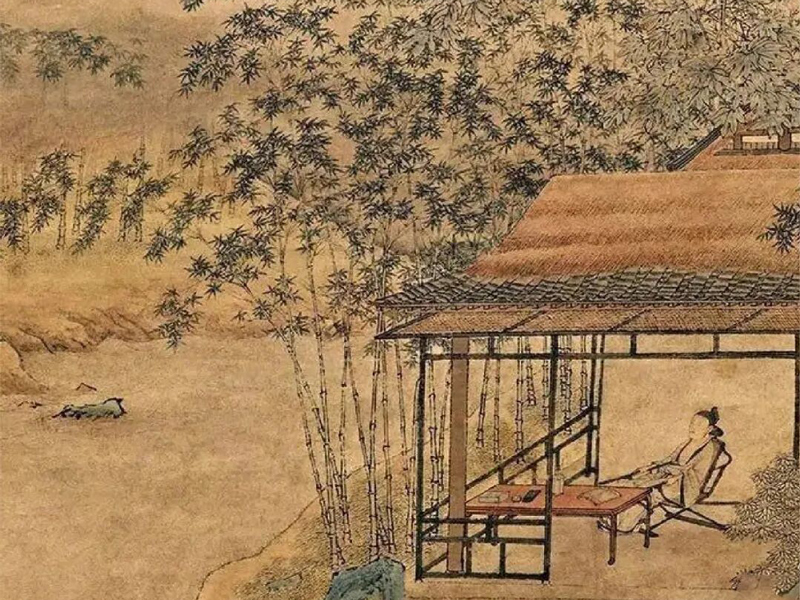
Could You Survive a Summer in Ancient China? The answer might surprise you. While we crank up the air conditioning and complain about heatwaves, our ancestors faced scorching temperatures without a single watt of electricity. Yet they didn't just survive – they thrived, crafting ingenious solutions that turned summer's curse into a season of creativity.
From water-powered cooling systems that would impress modern engineers to frozen treats that rival today's gelato, ancient Chinese wisdom offers a masterclass in living well with less. So forget what you think you know about pre-modern life. Step back in time to explore how emperors and commoners alike beat the heat – and discover why their methods might just inspire your own summer strategy.
1. Water-Powered Cooling
Long before centralized air conditioning became a modern staple, the Han Dynasty (206 BCE – 220 CE) had already perfected the art of architectural cooling. The Weiyang Palace (未央宫) in Chang'an featured a "Cooling Hall" strategically positioned near water sources. The principle was elegantly simple: flowing water naturally lowered ambient temperatures through evaporation. This wasn't mere luck – it was deliberate engineering that recognized water's cooling potential centuries before mechanical systems emerged.
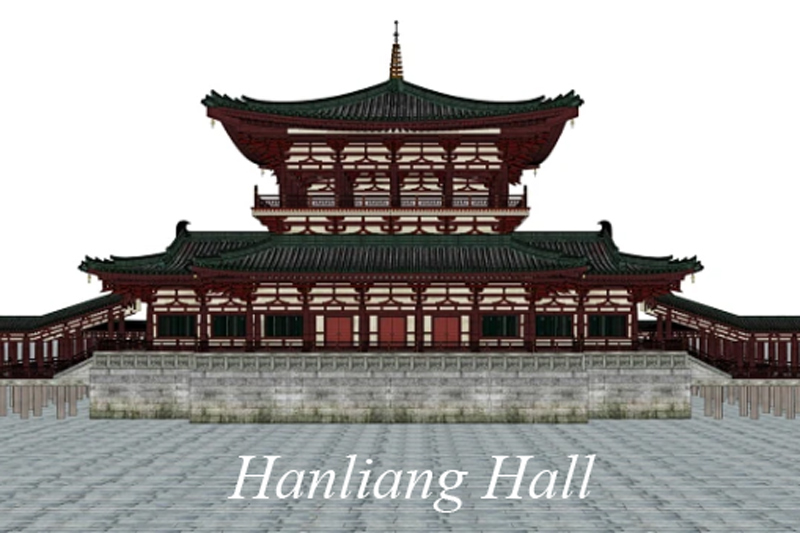
By the Tang Dynasty (618–907 CE), the technology had evolved dramatically. Emperor Xuanzong's Hanliang Hall (含凉殿) took cooling to new heights – quite literally. According to the historical record Tang Yulin (唐语林), waterwheels lifted water to the roof, where it cascaded down all four corners like liquid curtains. The falling water didn't just create a visual spectacle; it powered rotary fans that circulated chilled air throughout the hall. Court officials reportedly shivered during imperial audiences, forcing the emperor to drape robes over his frozen ministers. For ordinary citizens, a scaled-down version called the "self-raining pavilion" offered similar relief – water streaming from eaves like summer rain, turning courtyards into cool sanctuaries.
2. Ice Age Innovations
Ancient ice management was more sophisticated than most modern minds imagine. The Shi Jing (诗经), China's oldest poetry collection, already mentioned ice harvesting – "chiseling ice with great effort, storing it in ice cellars." By the Zhou Dynasty (1046–256 BCE), ice storage had become so important that a dedicated official position called the Bingren (冰人), or "Ice Man," was created to oversee the entire operation. These officials managed massive underground ice houses that could preserve winter ice well into the sweltering summer months.
This ice wasn't just for show. The Bingjian (冰鉴), a bronze vessel dating back to the Warring States period (475–221 BCE), functioned as the world's earliest refrigerator-freezer hybrid. Its outer compartment held ice, while the inner section stored wine and food. But here's the clever twist – cold air escaped through perforations in the lid, simultaneously cooling the surrounding room. One device, two functions: food preservation and space cooling. It was the ancient equivalent of a combined refrigerator and air conditioner, demonstrating that multifunctional design isn't exclusively a modern obsession.
3. Pillows and Bamboo
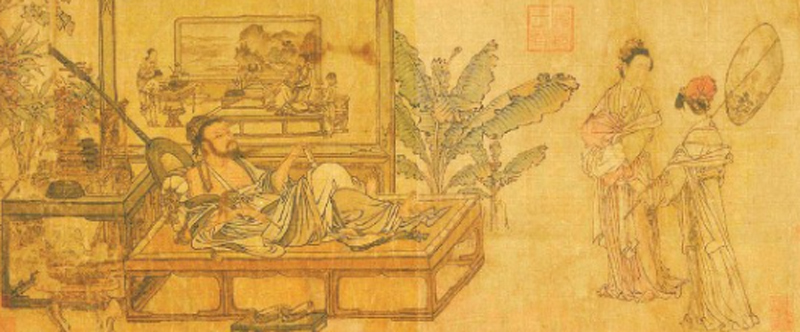
Sleep presented a particular challenge in pre-modern summers. How do you rest when your bed feels like a furnace? The porcelain pillow emerged as an unexpected solution. Already widespread by the Song Dynasty (960–1279 CE), these ceramic sleeping surfaces leveraged natural thermal conductivity – ceramic draws heat away from the body, creating a persistent cooling sensation. The poet Li Qingzhao (李清照) famously wrote about her "jade pillow" in the dead of night, feeling the chill seep through. Another Song poet, Zhang Lei (张耒), described the visceral shock: "Bring it into the room, cool wind arises; the brain feels cold, the scalp tingles."
For those who preferred embracing something cooler, the Zhu Fu Ren (竹夫人), or "Bamboo Wife," offered an ingenious alternative. Crafted from woven bamboo strips into a hollow, cylindrical shape, this sleeping companion allowed air to circulate freely through its lattice structure. The ventilation principle was identical to how wind tunnels through narrow city alleys – creating continuous airflow that wicked away body heat. The poet Su Dongpo (苏东坡) captured its appeal in verse: "Keep me company like a wooden companion, gift your silent bamboo wife." These weren't just functional objects; they represented a cultural philosophy that found poetry in practical living.
4. Frozen Delights
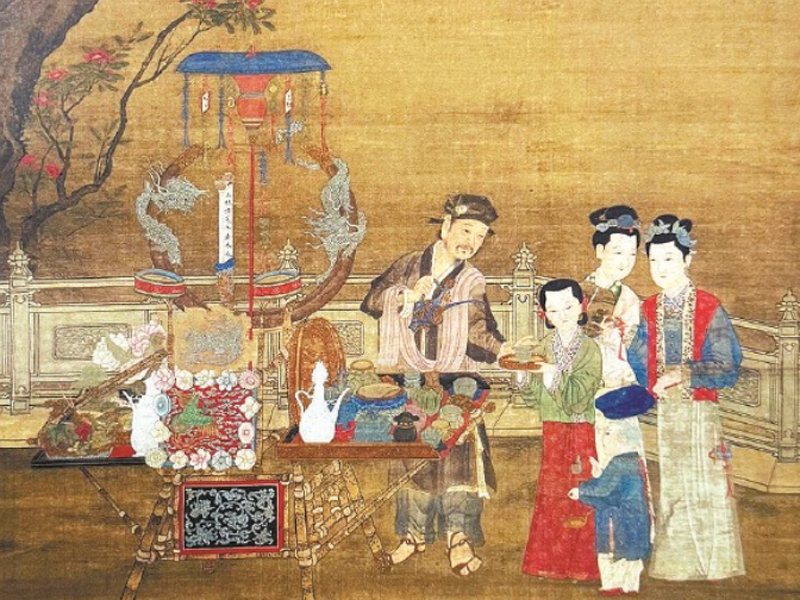
Cold beverages weren't invented by modern smoothie chains. During the Spring and Autumn period (770–476 BCE), people already enjoyed chilled fermented rice wine. The ancient anthology Chu Ci (楚辞) praised this frozen delicacy: "Straining the dregs, drinking the chilled liquid – what refreshing coolness!" By the Song Dynasty, the cold drink industry had exploded into a full-fledged commercial phenomenon. According to Tokyo Menghua Lu (东京梦华录), the capital city Bianliang (汴梁) was filled with street vendors hawking "ice-cold water" at every intersection – beneath large blue umbrellas, behind red wooden counters that looked remarkably like today's bubble tea shops.
The variety was staggering. The Wulin Jiushi (武林旧事) cataloged over a dozen chilled treats: frozen glutinous rice balls in shaved ice, mung bean with sugar, pear juice, papaya drink, plum brine, ginger-honey water – the list reads like a modern café menu. But the crown jewel was Sushan (酥山), a Tang Dynasty creation that layered ice with whipped cream and butter shaped into miniature mountain ranges, decorated with edible flowers. Think of it as an ancient ice cream mountain – centuries before Italy claimed gelato's invention. These weren't mere snacks; they represented sophisticated food science that understood freezing, sweetening, and textural contrast.
5. The Mindset Trick
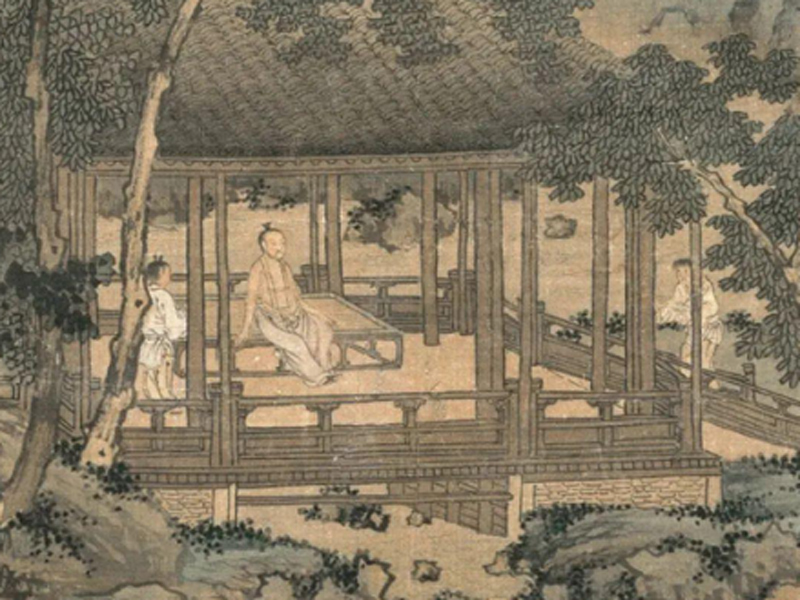
Beyond physical innovations, the ancients cultivated something equally powerful: mental resilience. The Tang poet Bai Juyi (白居易) articulated this philosophy most clearly in his poem "Dispelling Summer Heat": "Why escape the oppressive heat? Sit calmly in your courtyard. With nothing before your eyes, cool breeze comes through the window. The mind calms, and the body cools naturally." This wasn't empty mysticism – it was practical psychology. When you stop fighting the heat, you stop generating the stress that makes heat feel unbearable. Bai even observed monks who remained perfectly comfortable in unairconditioned temples while everyone else ran around in panic.
This "calm mind brings coolness" approach complemented all the physical technologies. The porcelain pillow, the bamboo wife, the frozen desserts – they worked better when paired with a patient, unhurried attitude toward summer. Ancient wisdom didn't pit technology against mindset; it integrated both. Today, as we sit in our artificially chilled rooms, we might ask ourselves: have we lost something in our quest for absolute climate control? Perhaps the real lesson isn't just about ice houses or water-powered fans. It's about learning to dance with the seasons rather than conquering them – an art that modern life has largely forgotten but could desperately use.
So this summer, consider borrowing a page from ancient history. Swap heavy synthetics for breathable linen. Brew a batch of chilled plum juice. Find a shady spot and simply sit – without a screen, without a schedule. You might discover that ancient China's greatest cooling invention wasn't a device at all. It was an attitude: the quiet confidence that summer, with all its intensity, can be not just endured but enjoyed. And that, perhaps, is the coolest trick of all.
