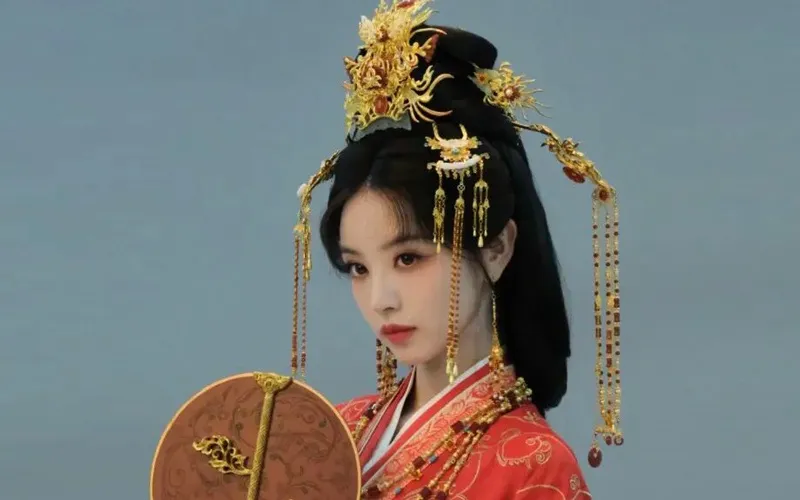
Switch on a costume drama and a glittering train of beads may swing past a character’s shoulder. It looks seductive on camera. But would a real woman in imperial China have worn such a thing to buy vegetables, greet a neighbor, or climb a staircase? The answer is more restrained than the screen suggests. The ornament in question is Buyao (步摇), a hairpin with moving parts. Its swinging leaves, pearl strings, and silk tassels catch light and motion. Yet length was never a free-for-all. It followed occasion, rank, and the simple physics of walking through a door. A pin could shimmer, but it also had to survive a busy day.
Daily Lengths
Most surviving everyday pieces from the Tang Dynasty, Song Dynasty, and Ming Dynasty keep their dangling sections under ten centimeters. That figure refers to the moving parts, not the pin or the upward spray of flowers. Ten centimeters is short enough to tremble with a step and still stay clear of collarbones, sleeves, and comb teeth. Excavated gold and silver examples often sit within this range. They were made for movement, not for a camera close-up. A slight sway at the temple was enough to draw the eye without turning the wearer into a walking chandelier.
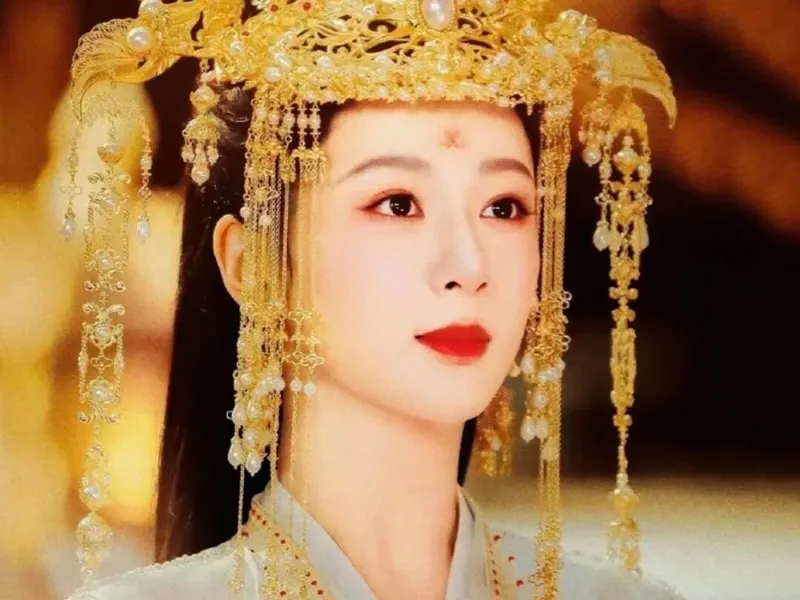
A woman in an ordinary household had tasks. She bowed, served tea, lifted a child, threaded a needle. A long cluster of beads would knock against her shoulder or snag on fabric. Even a wealthy lady in a private garden wanted her hair to survive a breeze. Short drops offered a small shimmer without turning every gesture into a rescue mission. That practical logic explains why the modest length appears again and again in museum cases, far from the exaggerated trains seen on television. The pin had to cooperate with the body, not compete with it.
Location matters too. In a studio, a hairpin can be glued in place and lit from three angles. In a real courtyard, a woman might walk through narrow corridors, pass under low eaves, or ride in a carriage. A dangling ornament that looks delicate on screen can become a hook for curtains, a trap for embroidery thread, or a pendulum that hits the face when she turns. Daily wear favored control. The pin could still be beautiful, but beauty had to tolerate a life in motion. That is why short drops keep appearing in ordinary graves and family portraits.
This does not mean every ordinary woman owned identical pieces. Materials varied by income, region, and fashion. Yet the underlying rule held: if the ornament was meant for routine use, its swinging parts stayed compact. The hairpin did not need to announce itself from across a room. It worked at speaking distance, where a slight sway and a glint of gold were enough. A quiet ornament can be just as persuasive as a loud one, especially when its owner has work to do.
Ceremony Only
Long drops did exist. They belonged to formal dress, especially after the Tang period, when elaborate headpieces and ceremonial pendant plaques, called Tiaopai (挑牌), became part of grand outfits. A Ming Tiaopai could hang twenty to thirty centimeters. Some Qing Dynasty examples reach beyond forty. These pieces were not designed for errands. They appeared with ceremonial robes and formal shawls at weddings, ancestral rites, and high-status gatherings. Their job was to hold still in a portrait and flash under candlelight. The wearer moved slowly because the occasion demanded it, not because the jewelry was ordinary.
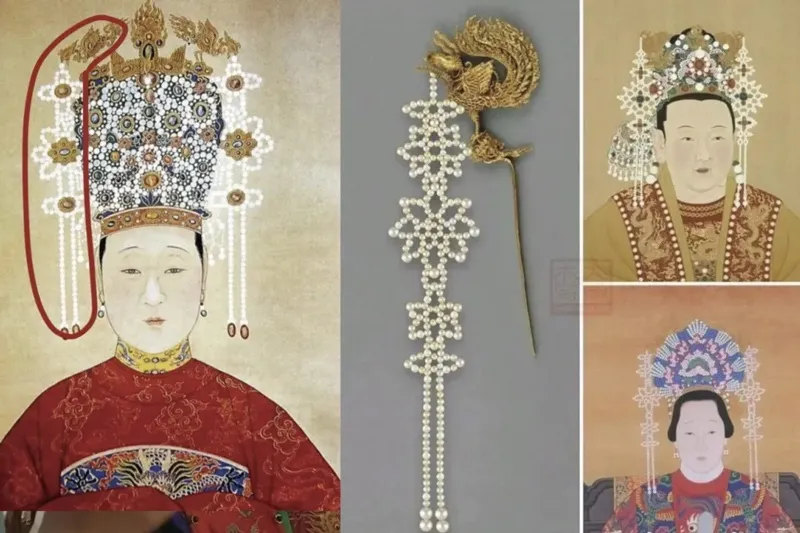
Even then, flexibility was built in. Many long pearl strings and jade tassels were detachable. A woman could wear the full assembly for a solemn event, then remove the heaviest sections for quieter visits. The same hairpin could shift between display and practicality. That design choice softens the image of a helpless figure buried under jewelry. It shows a wardrobe with settings, like a modern coat with a removable lining. Ceremony had its own language, and removable parts let one object speak in more than one register.
The Southern Tang tomb found in the western suburbs of Hefei (合肥), Anhui (安徽), offers a useful reality check. Reports describe two hairpins with rods about nineteen to twenty-one centimeters long. Their longest hanging elements mostly stay within fifteen to twenty centimeters. Photographs can make them look enormous, but scale matters. The tomb pieces support a middle ground: impressive length, yes, but not the waist-length waterfalls invented by set designers. They remind us that even dramatic pieces had to obey the weight of metal, the strength of thread, and the limits of a human neck.
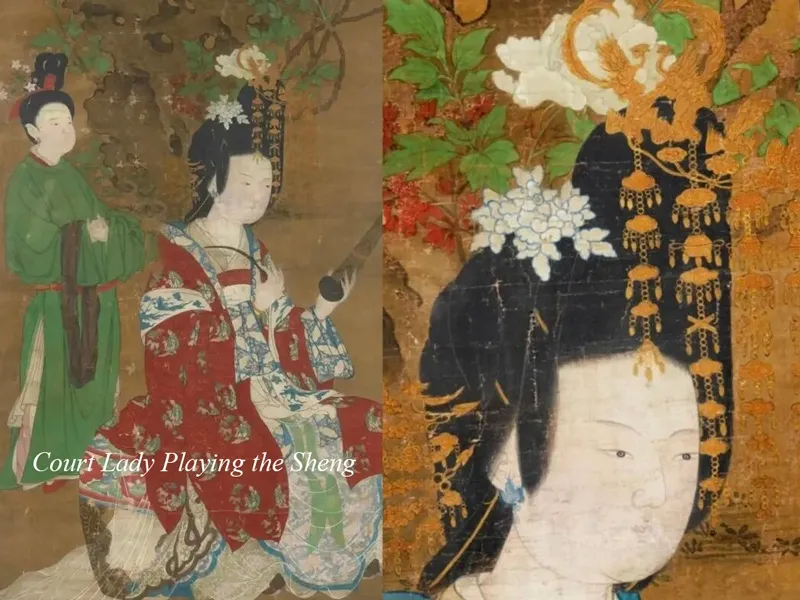
Paintings add another layer. Court Ladies Adorning Their Hair with Flowers (簪花仕女图) shows ornaments near the forehead, yet they rarely block the eyes. A rare exception, Court Lady Playing the Sheng (吹笙仕女图), appears to place a long drop near the nose; with the high hairstyle of the period, the longest section may equal twenty to twenty-five centimeters. Such cases are uncommon and may include artistic license. In traditional wear, hairpins more often sat at both sides of the bun, sometimes paired, sometimes with a crown. They swayed by the temples, not across the pupils. So enjoy the on-screen spectacle, but read the length as costume fantasy, not a shopping guide.