
On June 12, 2026, the Heping District Culture and Tourism Bureau in Tianjin hosted a heritage-day event that paired an endangered craft with a literary reading — a format designed to make intangible heritage feel less like a museum exhibit and more like a lived experience.

The event, titled "Floral Charm, Book Fragrance: Jin-Pai Ronghua," took place at the Heping District Intangible Heritage Exhibition Hall. Jin-pai ronghua — Tianjin's regional velvet-flower tradition — was inscribed as the district's eighth batch of intangible heritage items. The name "ronghua" plays on the Chinese word for "prosperity and glory," a pun that has sustained the craft's popularity in wedding and festival contexts for centuries.
Inheritor Qin Qi led the craft demonstration, tracing ronghua's history from Tang Dynasty palace workshops to Tianjin's local folk tradition. She displayed raw materials — silk thread and copper wire — and explained the traditional technique of winding, twisting, and shaping filament into three-dimensional flower forms. Participants then tried a simplified version using flexible crafting wire instead of silk, making the process accessible to beginners while preserving the core shaping logic.
The literary component, curated by Tianjin Music Radio host Zhen Ge, connected ronghua to classical flower imagery in Chinese literature. Readings traced the lily's purity, the kapok's independence, and the February orchid's resilience — qualities mirrored in the modest, enduring craftsmanship of ronghua itself. The dual-track format turned a single craft demonstration into a cultural narrative: the flowers on the page and the flowers in the hand reinforced each other.
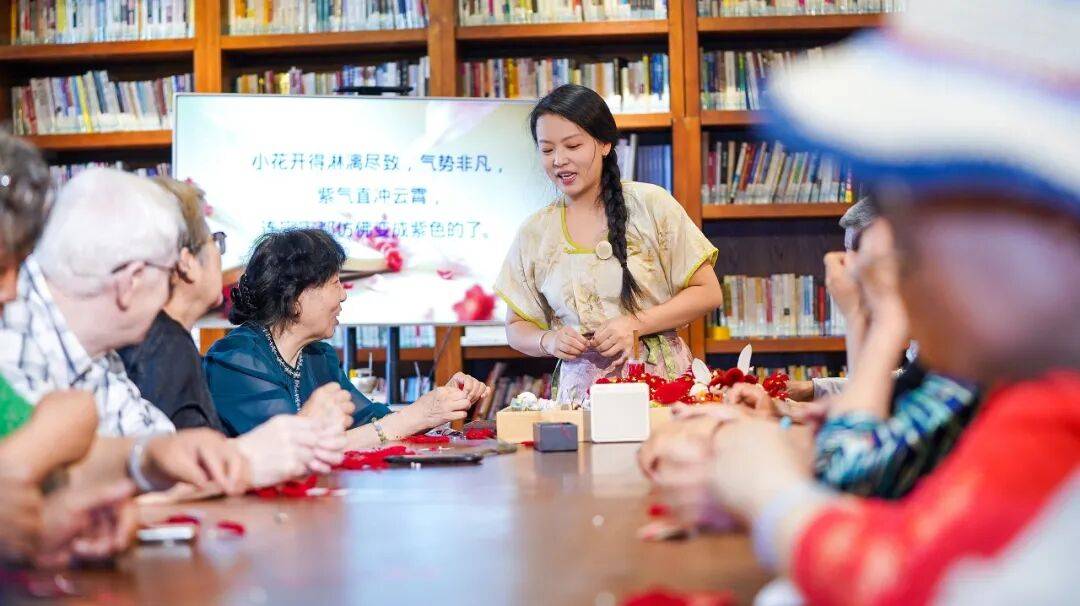
The Heping District approach reflects a broader trend in Chinese heritage programming. Rather than staging passive exhibitions, local bureaus are designing events where visitors hear, read, and make — three sensory channels that anchor memory far better than visual display alone. Qin Qi's simplified wire-flower method, stripped of silk-thread complexity but retaining the shaping steps, makes ronghua replicable at home, extending the craft's reach beyond the exhibition hall into everyday domestic practice.
The event's community-level partnership structure also deserves attention. Heping District Culture and Tourism Bureau served as the lead organizer, but the execution chain included the district library (providing reading materials and venue logistics), the district culture palace (handling event production), Tianjin Music Radio (supplying a professional host and broadcast amplification), and the Tai'an Road community office (mobilizing local residents). Each partner contributed a distinct capacity that the culture bureau alone could not provide — a distributed production model that reduces cost while increasing reach. The radio host's involvement, specifically, turned a neighborhood event into content that reached listeners across Tianjin, multiplying the audience beyond the physical attendees inside the exhibition hall.
Ronghua's status as a district-level heritage item — rather than a city-level or national-level designation — means it receives less institutional funding and media attention than marquee crafts like kesi or Su embroidery. The Heping District event compensates for this visibility gap by designing programming that generates its own content: participant-made flowers, recorded literary readings, and radio broadcast segments that circulate beyond the district's boundaries. For smaller-scale heritage items that cannot rely on national prestige to attract audiences, this self-generating content strategy may be the most viable path to sustained public awareness.
