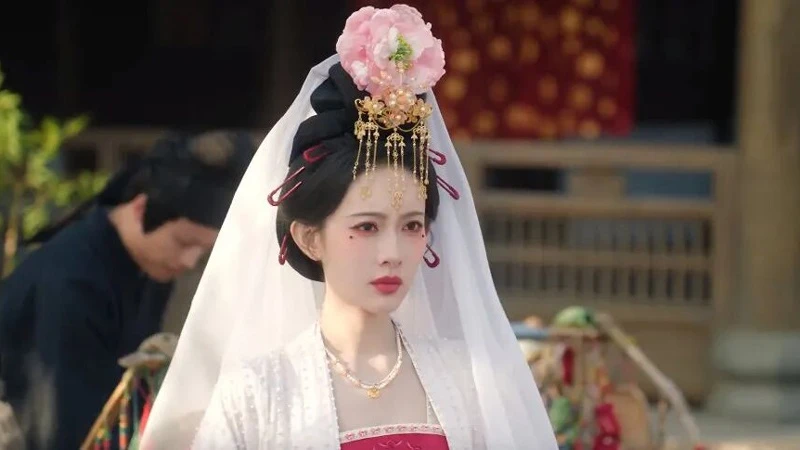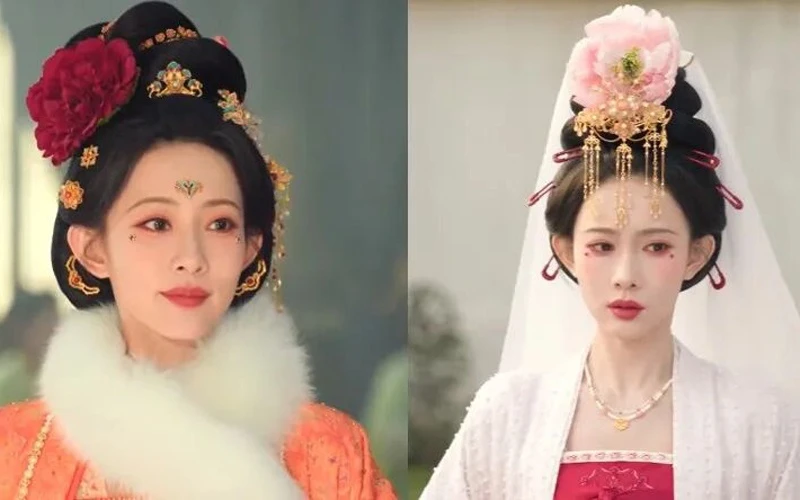
In Tigers Sniff the Rose (尚公主), Meng Ziyi (孟子义) wears two oversized peonies that refuse to whisper. One deep wine-red bloom sits beside her bun; a pink one faces forward like a soft spotlight. They look theatrical, almost too large for a human head. So did real women of the Tang dynasty actually pin dinner-plate flowers to their hair? The answer is more interesting than a simple yes. Court paintings, silk craft and fashion competition suggest that big blooms were not random props. They were a language of rank, mood and seasonal display. The show also asks us to look closely: is this historical accuracy, stylish exaggeration, or both? The costume team clearly wants a reaction. And a reaction is exactly what a bold headpiece should provoke.
Peony Power
Chang’an (长安) elite women did wear large flowers, especially peonies. Court Ladies Adorning Their Hair with Flowers (簪花仕女图), attributed to Zhou Fang (周昉), shows women with generous blossoms perched on high coiffures. Some shapes match Meng’s peonies closely. These ornaments came in two main types: fresh flowers and handmade imitations. Fresh peonies, herbaceous peonies, lotus and similar blooms were fixed by pushing a long stem into a gap in the bun. If the stem was brittle, a thin silver wire wrapped it and hooked it to a hairpin. That way, a woman could walk, bow and chat without losing her garden. The method was simple, but the effect was not casual; it required a stable base and a careful eye. It also demanded confidence.
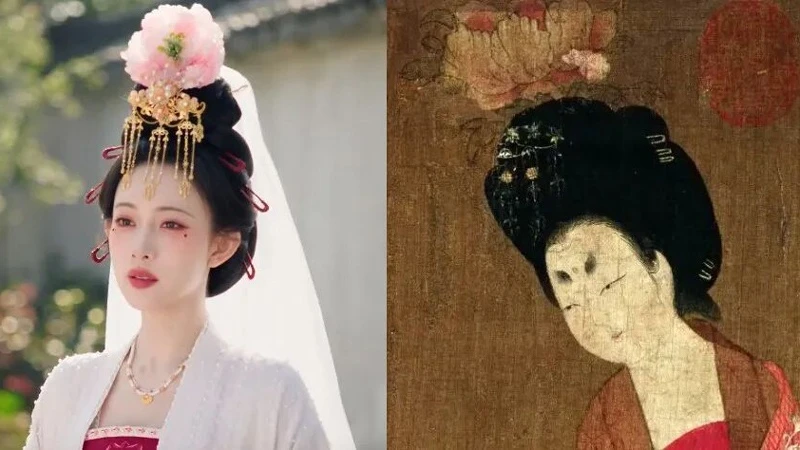
Handmade flowers, often called imitation blooms, used silk, gauze, damask and ramie. Dyers matched petal colors to living plants, while craftspeople shaped layers and veins until the result looked convincingly fresh. Their advantage was practical: no wilting, no seasonal limit, and no fear of rain. Some bases were built directly as hairpins, making them easier to secure than real stems. Scholars often guess that the huge blossoms in the painting are such fabric flowers. For a court lady, a flower was not just decoration; it was engineered display. A single bloom could show craft, expense and leisure all at once. It could also survive a long banquet, which fresh petals might not. That durability made imitation flowers useful for repeated formal events.
Flower wearing itself is old. Early records link small orchids and chrysanthemums to rituals and seasonal customs, not to giant peonies. Earlier courts and later dynasties rarely favored dinner-plate blossoms. The Tang taste stands out. Why? High hairstyles such as towering buns and looped shapes created broad surfaces that could carry large flowers. Wide sleeves and long skirts needed a bold visual counterweight at the head. A giant peony made the whole silhouette feel open, confident and deliberately grand. The flower did not float alone; it answered the volume of the dress and the height of the hair. In that balance, exaggeration became proportion. A tiny bud would vanish against such a frame.
Tang Logic
Competition also played a part. A Tang miscellany describes women in Chang’an comparing the flowers on their heads during spring outings and banquets. They judged species, size and rarity. Some families reportedly cultivated rare varieties at home simply to win social points at a gathering. In that setting, a flower was a luxury label. Peonies carried extra weight because Tang poetry and court lore tied them to wealth, honor and good fortune. The famous spring scene of Emperor Xuanzong (唐玄宗) and Yang Guifei (杨贵妃) admiring peonies at Pavilion of Aloeswood pushed the flower’s prestige even higher. A blossom could therefore say what a woman could not: my family has taste, money and access. That social game made size and rarity meaningful.
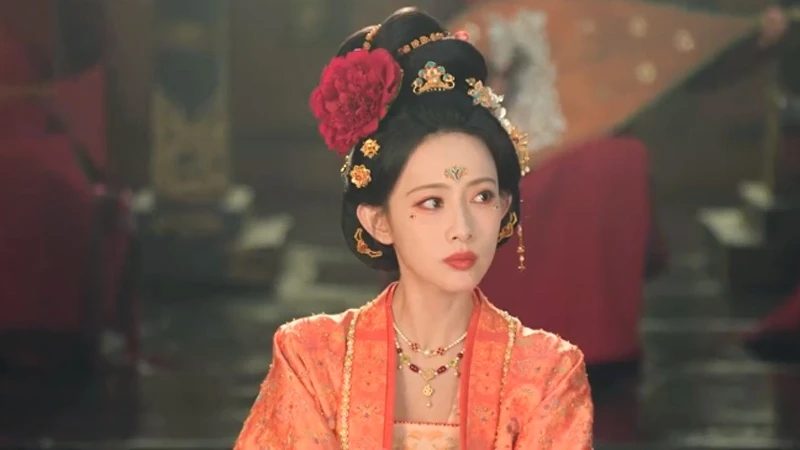
That context helps explain why a princess on screen might wear one huge bloom instead of a cloud of tiny buds. In Tigers Sniff the Rose, Mu Wanyao (暮晚摇) is royal. A peony suits her rank. Color also does narrative work. The pink flower, paired with pale gauze, feels relaxed and springlike, fitting a garden party or a peony-viewing gathering. The wine-red bloom is sharper and more commanding, a choice for a formal imperial birthday banquet. The flower changes with the scene, much like jewelry or makeup. It is costume storytelling, not just a pretty headpiece. The audience can read her mood before she speaks, simply from the bloom above her face. That clarity is useful in a visual medium.
Many recent Tang-set dramas scatter small, delicate ornaments through the hair. They look safe, but they can flatten the period’s visual confidence. Tigers Sniff the Rose takes a risk with full peonies. The result may look exaggerated to modern eyes, yet that boldness is the point. Tang fashion loved scale, motion and swagger. A flower the size of a hand may seem impossible now; on a high bun in Chang’an, it made sense. So, does Meng Ziyi’s peony styling work for you? Does it feel like a princess of the Tang, or like a costume asking for a second look? Either way, the flower has done its job: it made you stop and stare. And in a drama full of court politics and public performance, stopping the eye is no small power.