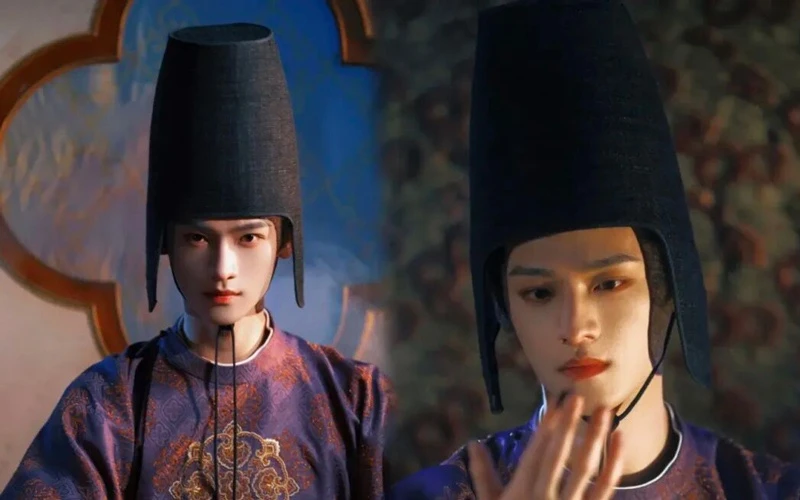
In the upcoming costume drama Tigers Sniff the Rose (尚公主), Quan Yilun (全伊伦) plays Liu Wenji (刘文吉), a character who becomes a palace attendant in the novel’s middle and later chapters. His tall, half-see-through headpiece has set off a small storm online. “That hat screams eunuch!” one viewer wrote. The claim feels intuitive, because screens love shorthand. Yet the shape has a longer, stranger life than the meme suggests. It belongs to a family of caps worn by officials, guards, and attendants in Tang court dress and earlier eras. The real question is not whether it looks like a eunuch hat, but why costume dramas keep borrowing one silhouette and pairing it with the wrong clothes.
Cage Crown Clues
The hat is often called a cage crown or cage cloth. A soft version appears among Han finds at Mawang Dui (马王堆), made from fine black lacquered yarn. Later, during the Wei-Jin and Southern and Northern Dynasties, it hardened into a shell. It did not sit directly on the skull. Under it, wearers put a flat cloth cap (平巾帻); the outer cage hid that base. Early images show short side flaps; later versions covered the ears. Men and women both wore it at one point, and palace women in Wei-Jin figurines wear it too. Officials and inner attendants also used it, which matters: an attendant was still an official, not a walking punchline.
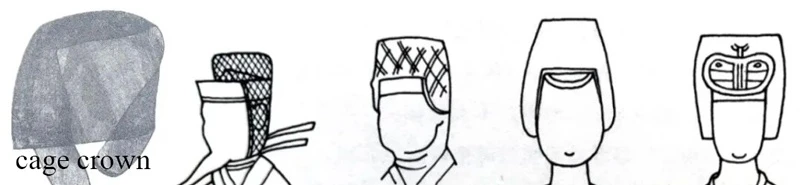
By the Tang dynasty, the cap appeared in formal settings. Old Book of Tang (旧唐书) lists crimson gauze robes, white inner layers, black borders, belts, knee covers, swords, and pendants for serious court dress. A cage crown with that outfit reads as ceremony. In Tigers Sniff the Rose, however, Liu wears a round-collar robe. That pairing is like putting a ceremonial hat on a work uniform. The head looks heavy; the body looks underdressed. Costume teams often trim historical rules for camera speed, but the mismatch explains the “odd” feeling better than a simple eunuch label.
The cage crown also refuses one fixed meaning. In tomb art and paintings such as Ode to the Goddess of the Luo River (洛神赋图) and Portraits of Emperors of Successive Dynasties (历代帝王图), attendants wear it over a hidden base cap. It can signal rank, service, or ritual role. Modern viewers see a tall translucent cylinder and think “palace eunuch,” because many dramas use that image for eunuchs. The silhouette became a shortcut. Shortcuts are not lies, exactly; they are compressed history. The trouble starts when a shortcut is treated as a complete rule. A hat can point to an office without proving the wearer’s exact job, moral alignment, or screen destiny.
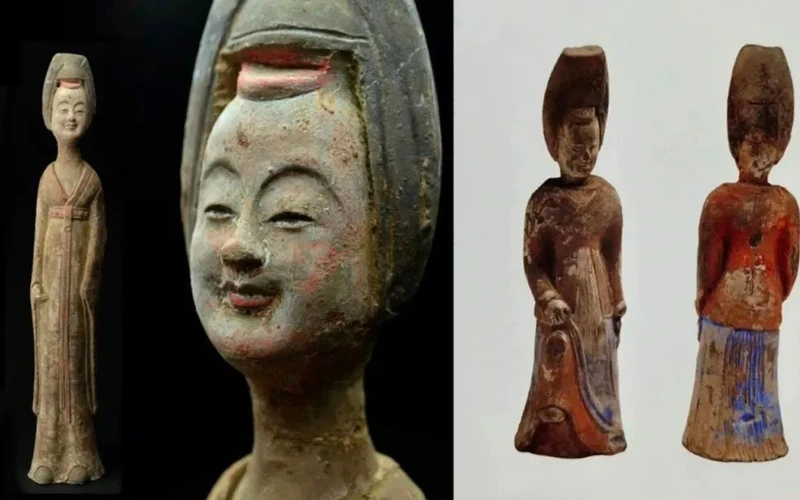
Tang Dress Trouble
Tigers Sniff the Rose costume choice seems to lean toward Tang flavor. Quan’s Liu gets the cage crown and a round-collar robe. That combination can look clean in a workshop scene, but it fights the hat’s ceremonial weight. Tang court dress had layers and color logic: crimson gauze, white lining, dark edging, a knee cover, a belt, and hanging ornaments. Remove those layers, and the crown floats. Viewers may not know the rule book, but they feel the imbalance. The eye reads “formal head, casual body,” so the whole figure seems top-heavy.
This is where screen language differs from museum language. A drama needs characters to be recognizable in a wide shot, a close-up, and a rain scene. It may simplify a cap, darken a gauze, or shrink a flap. Those choices can work. They fail when a single borrowed item carries a different social code than the garment beside it. A cage crown over crimson ceremonial robes says “court ritual.” The same crown over a plain round-collar robe says “office worker in a borrowed hat.” Neither reading is criminal, but one is much easier to believe.
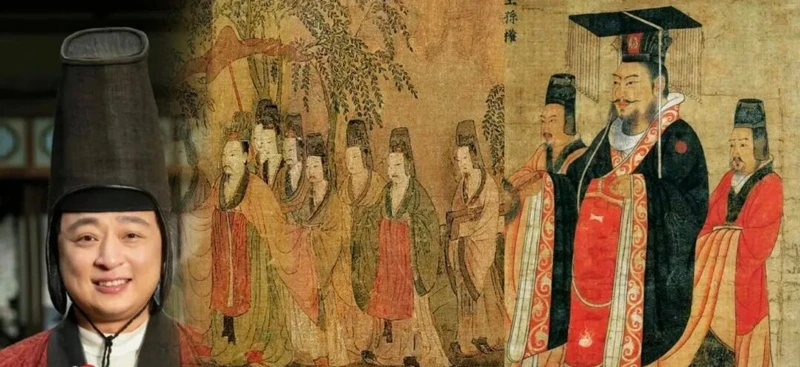
Liu’s role adds another layer. In the novel, he becomes a palace attendant, and the story gives him a morally mixed path. That gray space is more interesting than the hat meme. A good actor can make the character feel dangerous, loyal, tired, or sharp without turning him into a costume label. The hat is a clue, not a verdict. If the drama uses it to hint at access, proximity to power, and hidden rules, the odd silhouette can become useful. If it uses the hat as a lazy “eunuch sign,” the costume will keep creaking.
Ming Hat Shift
Ming palace attendants developed even clearer headwear. Early and middle Ming caps could show a curved arc; later examples rose like standing tiles, with a brim for ranked wearers. A later text describes bamboo-wrapped cloth rising above the cap by about an inch, shaped like an upright tile. Those caps are often what audiences recognize as “eunuch hats,” especially when dramas push the shape for easy reading. Tang cage crowns and Ming attendant caps are cousins in silhouette, not twins in meaning. Ming examples can carry a stronger institutional stamp: rank, department, and court faction.
Tang examples can belong to ritual dress or service roles with a wider field of wearers. Mixing their visual cues is common on screen, yet it blurs why a hat mattered. A viewer who sees only “creepy eunuch” misses the office behind the cloth. The cap may mark access to the inner court, but it does not erase the wearer’s rank or duties. That distinction gives a costume its spine. Without it, a hat becomes a scarecrow: eye-catching, hollow, and easy to knock down.
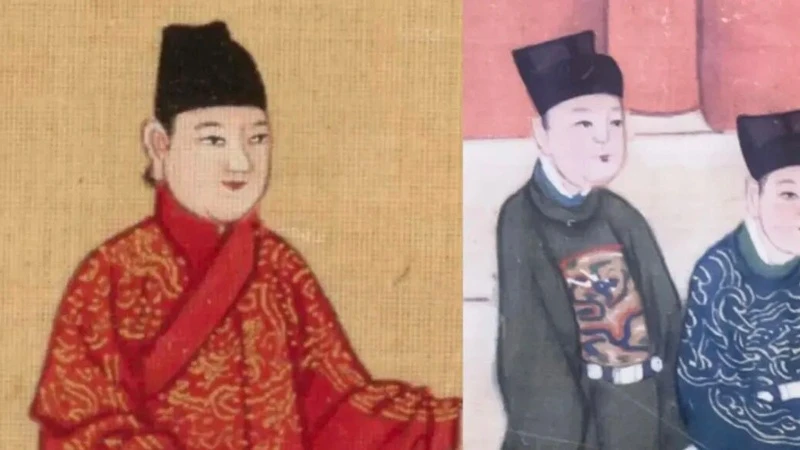
So does Liu’s hat prove he is a eunuch? It points toward a palace attendant role, and the novel supports that reading. It does not prove every wearer in every era was a eunuch, nor that the hat alone makes a costume correct. The bigger issue is fit: crown, robe, scene, and character should speak one language. When they do, a strange tall hat can become a quiet threat. When they do not, it becomes a meme. Liu’s morally mixed arc may still surprise viewers; the hat has already done its first job by making them ask.