
Tianshui, a city in Gansu Province best known as the legendary birthplace of Fuxi — one of China's primordial cultural heroes — will host a large-scale Hanfu community event on June 20-21, 2026, coinciding with the traditional summer solstice period. The event, organized by the Tianshui Municipal Bureau of Culture and Tourism and operated by the Tianshui Cultural Tourism Investment and Development Company, is expected to draw hundreds of Hanfu enthusiasts from across northwest China.
Why Fuxi and Why Tianshui
Fuxi is credited in Chinese mythology with inventing writing, fishing, trapping, and establishing the system of early Chinese governance. Tianshui's Fuxi Temple (also called Taihao Palace) is one of the most important Fuxi worship sites in China, and the city has a long-standing tradition of holding ritual ceremonies at the summer solstice, which in the traditional Chinese calendar marks the "peak of yang" and is associated with ancestral veneration.
The Hanfu community's adoption of the Fuxi memorial as a dressed-up occasion reflects a broader pattern: traditional festivals and ritual dates are increasingly being used as themed Hanfu event windows. The Dragon Boat Festival, the Qixi Festival, and the Mid-Autumn Festival have already developed active Hanfu-event calendars; the Fuxi memorial represents an expansion into heritage-ritual dates that are historically significant but less commercially developed.
Event Program (June 20-21)
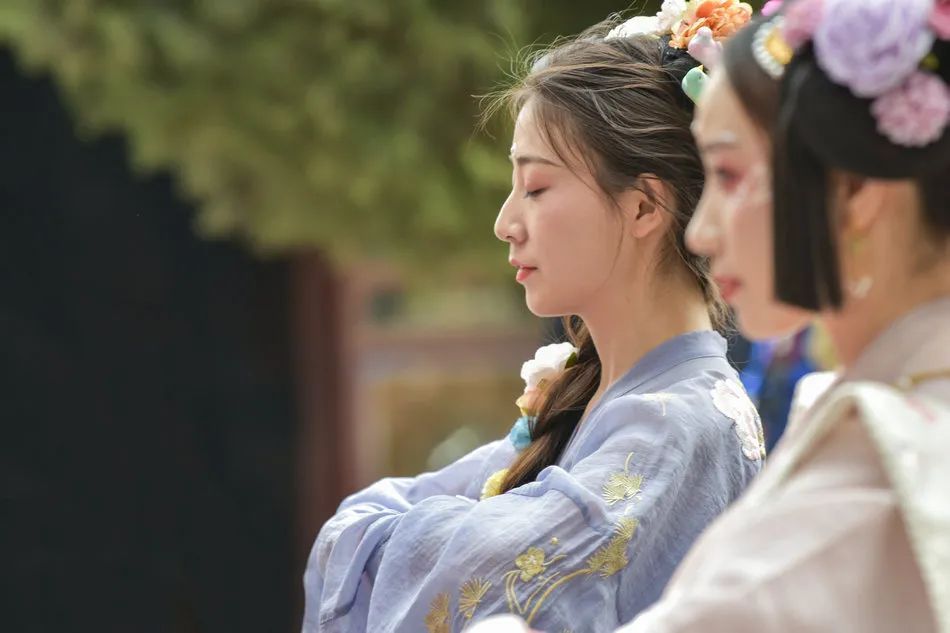
The two-day program is split between a garden tour (June 20 afternoon) and a formal memorial ceremony (June 21 morning). The garden tour portion allows participants to wear Hanfu while walking the Fuxi Temple grounds and surrounding areas, with photo sessions organized by the event's supporting partners, including the Tianshui Performance Company's "Oriental Smile" arts center and the local online platform Tianshui Online.
The June 21 ceremony is the more formal element. It follows a traditional ritual structure, with participants in Hanfu performing a series of bowing and offering sequences. The ceremony is not a reenactment of a specific historical ritual; rather, it is a contemporary ritual composition that draws on multiple dynastic precedents. Organizers have stated that the goal is to create a "culturally respectful but accessible" experience for participants who may not have prior ritual knowledge.
Who Is Participating
The event spans both the "Hanfu circle" (enthusiasts who wear Hanfu as a hobby and often identify with a specific dynasty or sub-style) and the general public. Tianshui's local cultural authorities have been actively promoting the event as a tourism and heritage-education opportunity, and discounted or free entry to the Fuxi Temple is being offered to participants in Hanfu. Several Hanfu community groups from Lanzhou, Xian, and Chengdu have announced group travel plans to attend.
The cross-city participation is notable because it signals the maturation of the Hanfu event ecosystem. Two or three years ago, most Hanfu events were hyper-local: a park meetup organized via WeChat groups, with little coordination beyond a single city. The Fuxi memorial event, with its multi-city participant base and municipal-government backing, reflects a shift toward larger, more formally organized regional Hanfu gatherings.
The Tianshui event is one of several Hanfu-heritage crossovers scheduled for June 2026. The timing is deliberate: June is both a peak month for domestic tourism and a period when many local governments roll out cultural-heritage programming to coincide with the national Cultural and Natural Heritage Day (which fell on June 14 in 2026). The overlap allows Hanfu events to plug into existing government heritage promotion budgets and venues.
For the Hanfu community, the practical benefit is access: heritage sites that might not otherwise host Hanfu events are opening their doors for these occasions. For the heritage sites, the Hanfu events bring in a younger, more visually active audience that generates social-media content — a priority for cultural institutions seeking to expand their reach beyond older, scholar-oriented visitors.
What to Expect
For participants, the Tianshui event offers a relatively rare opportunity to wear Hanfu in a setting where the clothing is directly connected to the site's cultural meaning. The Fuxi Temple is not a general-purpose tourist destination; it is a ritual site, and wearing Hanfu there carries a different symbolic weight than wearing Hanfu in a scenic area or a commercial ancient town.
The event also highlight a tension that has been building in the Hanfu community: the balance between "correct" historical dress and accessible, enjoyable community events. The Fuxi memorial's organizers have opted for accessibility — no specific dynasty requirements, no mandatory ritual knowledge — and this approach has drawn both praise (for lowering barriers to entry) and criticism (from rigor-oriented enthusiasts who argue that ritual events should enforce historical accuracy). The tension is likely to surface again as more heritage sites host Hanfu events later in 2026.
