

When photos from the set of Wanhua Shijie (万花世界) appeared online, audiences quickly split into two camps. Some praised the look, while others felt something was off. The costume on actress Ju Jingyi (鞠婧祎) clearly aims for a Tang Dynasty (唐朝) vibe, but the details feel awkward and inauthentic. Why does a dress that seems historically inspired end up looking so strange on screen?
The answer lies not in total invention, but in a clash between ancient forms and modern beauty standards. The design team did follow real early Tang clothing structures, yet they adjusted the fit, fabric volume, and decorative details to suit today’s cameras and taste. Those changes, meant to make her look slim and ethereal, actually broke the relaxed, grand spirit of the original era. Let’s break down what the costume gets right, and where it takes a wrong turn.
The Right Base
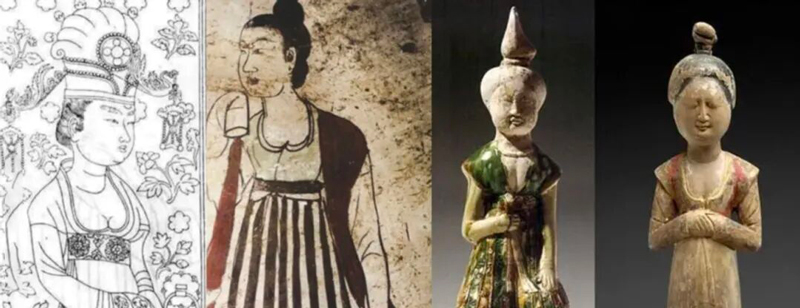
At first glance, the outfit’s skeleton is surprisingly faithful to early Tang women’s fashion. Ju Jingyi wears a double-loop chignon, a typical hairstyle of that period. Her upper garment uses the Tanling (坦领) shape—a low-cut, open-neck style. Historical paintings and dancer figurines from early Tang show the exact same collar design, including heart-shaped versions. A matching half-sleeve jacket worn outside also follows the period’s taste. But note: real Tanling did not usually have buttons down the center. Instead, the fronts overlapped naturally. Placing too many buttons in the middle would look crowded and ruin the clean line. So the basic idea of her top is correct.
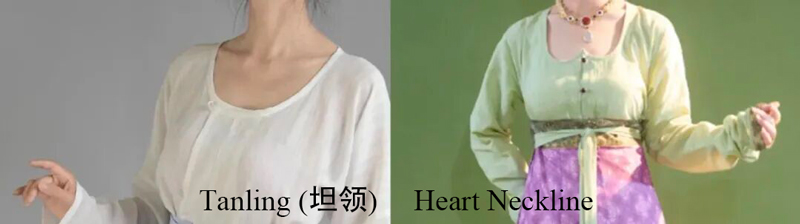
Scholars have studied these features carefully. Shen Congwen (沈从文), in his book Research on Ancient Chinese Costume (中国古代服饰研究), points out that early Tang clothes had short sleeves ending at the elbow, hemlines stopping at the waist, and open fronts worn without fastening. The style was simple, clean, and never overly decorated. Ju’s costume does keep the Tanling structure and its center opening method, so that part aligns with historical records. The design team clearly did their homework on the big picture.
Her lower garment is a Jiaoshu skirt (交输裙), also called a po skirt (破裙). This type first appeared in the Han Dynasty and thrived in the Tang. Think of it like a modern panel skirt—strips of fabric cut on the bias and sewn together. The pieces overlap in staggered layers, creating a natural, flowing hem. This is very different from the fuller, chest-high skirts of the High Tang or the wide, sweeping hems of the Late Tang. So the overall shape of her dress does come from authentic early Tang prototypes. The problem, however, lies in the details that were modernized.
The Modern Missteps
The biggest issue is the tight fit. Look at early Tang tomb murals and clay figurines. Their clothes have generous volume, making the wearers look relaxed and at ease. Ju Jingyi’s Tanling top, however, uses modern seam cutting that cinches at the waist and hugs the arms. The fabric clings to her torso, leaving almost no extra room at the shoulders, chest, or waist. This skinny-fit shape is designed to make her appear slimmer—a current beauty ideal. But it completely loses the loose, spontaneous, and grand mood of the early Tang. This is the number one reason viewers say her outfit feels “weird” and “not ancient.”
Second, the row of buttons along the center front is far too dense. Check the murals from Zhao Ling (昭陵) Tomb or Princess Yongtai’s (永泰) Tomb of the early Tang, plus actual half-sleeve garments unearthed from that time. They show that early Tang clothes were understated and elegant. The front opening had very few buttons, if any. Most clothes used a simple tie or just a couple of knots. Less was more. That dense line of small buttons is a decorative trick seen more often in Ming and Qing Dynasty clothing, not Tang craftsmanship. By adding so many fasteners, the costume weakens the clean, powerful look that defined early Tang fashion.
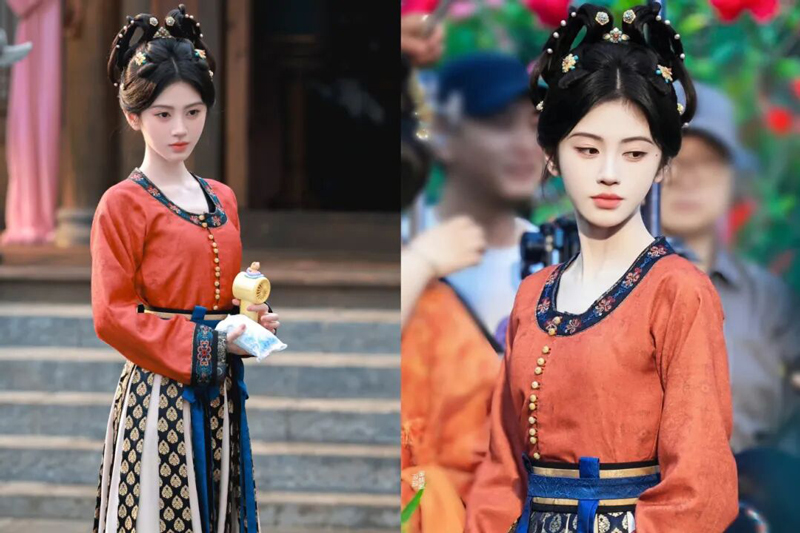
Third, the embroidery pattern on the collar and hem is a modern invention. Real early Tang decorations had a very clear system. You’d find linked pearl circles, scrolling vines, rosettes, and geometric medallions. These designs are symmetrical, full, and carry the bold, flourishing spirit of the early Tang golden age. But the wispy, flowing lines on Ju Jingyi’s collar are light and delicate, with a color style more like early 20th-century Republican China. No Tang tomb or artifact has such a pattern. It is a typical modern “Guochao” (国潮) decorative motif, not a historical one.
In another outfit from the same show, Ju wears a simpler Tang-style dress with fewer adjustments. That one works much better because it avoids over-tightening and excessive decoration. So the lesson is clear: Wanhua Shijie costumes can be enjoyed as creative Chinese period drama fashion, but they should never be mistaken for accurate Tang Dynasty reconstruction. The odd feeling comes from replacing the original era’s relaxed grandeur with today’s love for slimness, delicacy, and fairy-like elegance. It is a typical screen adaptation—ancient shape serving modern taste. Do you like Ju Jingyi’s remixed Tang style?
