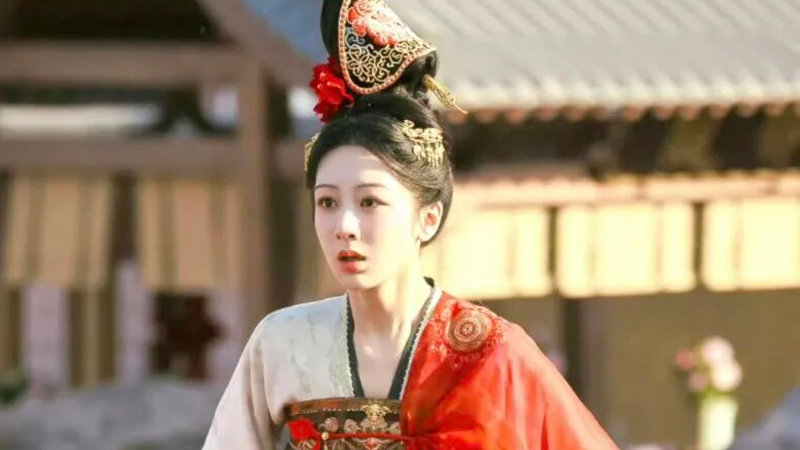
For most Chinese viewers, the Shang Si Festival (上巳节) feels like a forgotten ghost from history books. Yet two recent period dramas — Flourished Peony (锦绣芳华) starring Yang Zi (杨紫) and Li Xian (李现), and The Princess Royal (度华年) — have unexpectedly revived its most poetic ritual: Qu Shui Liu Shang (曲水流觞), or “floating wine cups along a winding stream.”
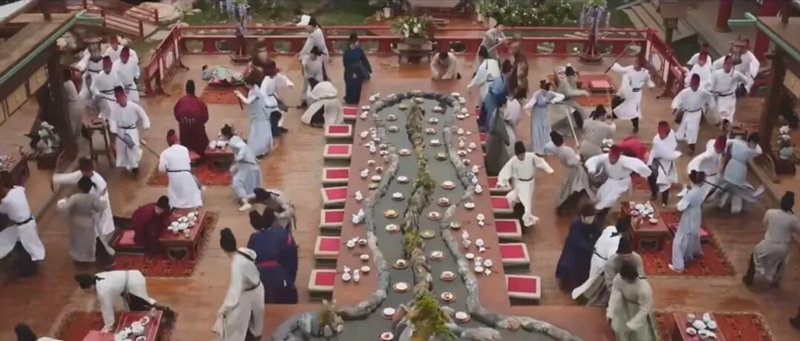
In Flourished Peony, a banquet scene just before a military coup shows nobles seated by an artificial creek, watching tiny cups drift downstream. Viewers instantly recognized it: this is exactly what Wang Xizhi (王羲之) described in his famous “Preface to the Orchid Pavilion Collection.” But where did this tradition come from? Why did it disappear from daily life? And can television dramas truly bring it back?
The Wine Cup That Changed Calligraphy
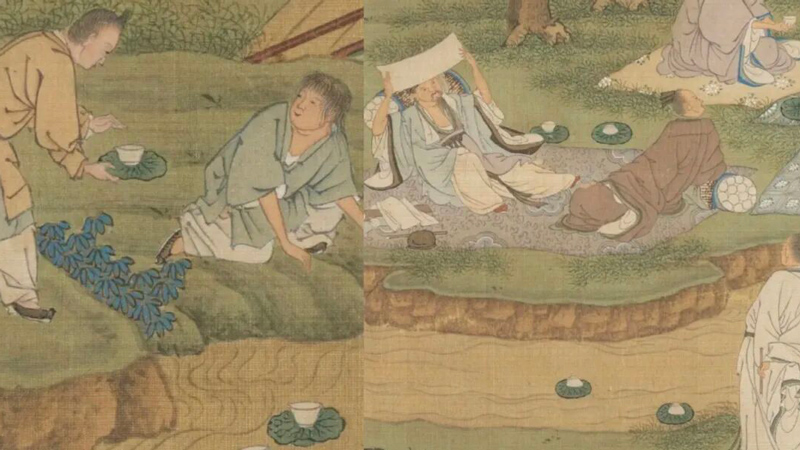
The ritual’s heart is the shang (觞) — a shallow cup with two flat ears, designed to float. The earliest shang appeared in the Book of Songs (诗经), where it was called “si gong.” But the true golden moment happened on the third day of the third lunar month in the year 353 CE. That day, Wang Xizhi invited 41 scholars to Lan Ting (兰亭), a pavilion in Kuai Ji (会稽), modern-day Shaoxing. They sat along a meandering stream. Servants used thin bamboo poles to gently push decorated wine cups downstream. Whenever a cup stopped in front of someone, he had to drink and improvise a poem.
Wang Xizhi, already tipsy, picked up a brush and wrote 324 characters on the spot. That draft became Lan Ting Ji Xu (兰亭集序), revered as “the best running script under heaven.” The calligraphy captured the playful, unforced spirit of the gathering — neither drunken chaos nor stiff formality. Historians believe the tradition came from an even older custom: on Shang Si day, people bathed in rivers to wash away bad luck, a rite called Fu Xi (祓禊). Floating wine cups was a refined extension of that water worship.
Hidden Meanings in Every Ripple
Why did the Chinese elite love this game for over a thousand years? Look closer at the details. The winding stream was never random — its bends symbolized life’s unexpected turns. The drifting cup represented fate, stopping for no one. Participants had to remain relaxed yet ready, enjoying the moment while sharpening their wit. This perfectly matched the classical ideal of “pleasure without indulgence, sorrow without injury.” A Southern Dynasty writer recorded that as early as the Western Zhou, royal courts held “winding water feasts” to honor heaven and earth with floating libations.
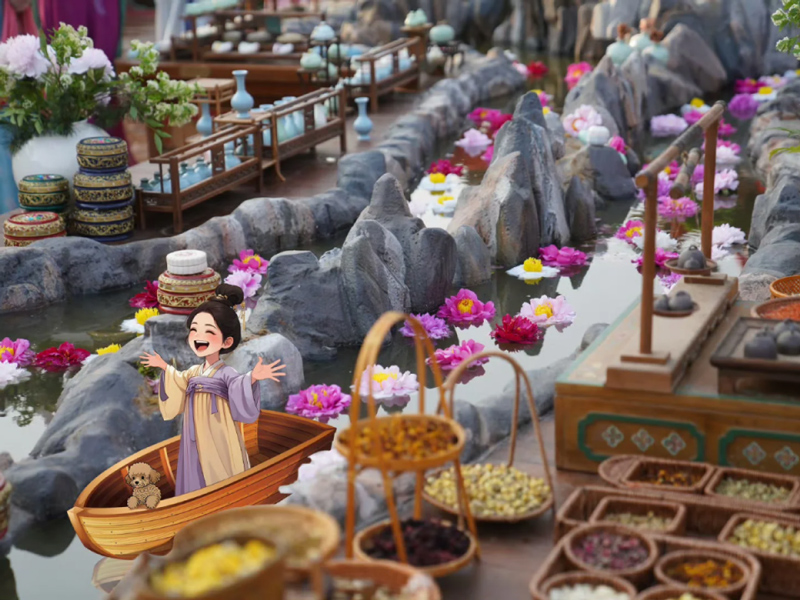
By the Tang and Song dynasties, rich families upgraded the game into a mobile banquet. They sent dishes floating on gilded silver plates or delicate porcelain. Between the streams, they placed Taihu (太湖) scholar’s rocks and sweet flag bonsai for visual poetry. The 2018 hit drama The Story of Minglan (知否知否应是绿肥红瘦) showed a miniature version arranged on a tabletop — proof that the tradition shrank from landscapes to furniture as indoor living took over. But the core never changed: the stream forced spontaneity. You couldn’t memorize poems beforehand. You had to feel the breeze, hear the water, and speak from the heart.
Where Did the Real Magic Go?
Ironically, Japan has preserved more active Qu Shui Liu Shang (曲水流觞) events than China. Every spring and autumn, Kyoto and other cities organize public reenactments where anyone can dress in period costume, float a cup, and try composing a haiku. The Japanese adapted the ritual during the Tang dynasty and kept it alive as seasonal cultural education. In China today, most Shang Si celebrations have shrunk to Hanfu parades or “floating feasts” that are just ordinary meals without poetry or calligraphy. The elegant conversation — the soul of the game — is missing.
That’s why screen adaptations matter. The Princess Royal’s production team reportedly studied Tang dynasty paintings to rebuild the stream’s exact slope and cup speed. Actors trained to write verses in character. When the scene aired, young viewers flooded social media asking: “Can we actually do this at a park?” A few niche art collectives in Suzhou and Hangzhou have started hosting private Qu Shui Liu Shang gatherings again. They use real creeks, real cups, and a simple rule: no phones, no pre-written lines. If the cup stops at you, you have one minute to say something original — or drink three cups as penalty.
Could this become a mainstream hobby again? Possibly. The 2025 hit Flourished Peony has already sparked a 200% increase in online searches for “Shang Si Festival events.” What people crave isn’t just historical accuracy — it’s the feeling of being surprised by their own creativity. A drifting cup doesn’t care if you’re rich or poor, famous or unknown. It only cares if you’re present. And in an age of scripted reality shows and filtered photos, that old wobbly cup might be the most radical thing we can still do together.
