Yang Yun (杨云) works on gourds rather than vases. The Zibo artisan bends fine metal wire along a pattern drawn on a curved gourd body, then fills the gaps with coloured sand, and has carried the technique onto hairpins, pendants and bookmarks that young buyers now give as gifts. Zibo News reported on Oct 21 that her studio also turns ostrich eggshells, a material with no market of its own, into pieces a local farm buys back at 380 yuan each.
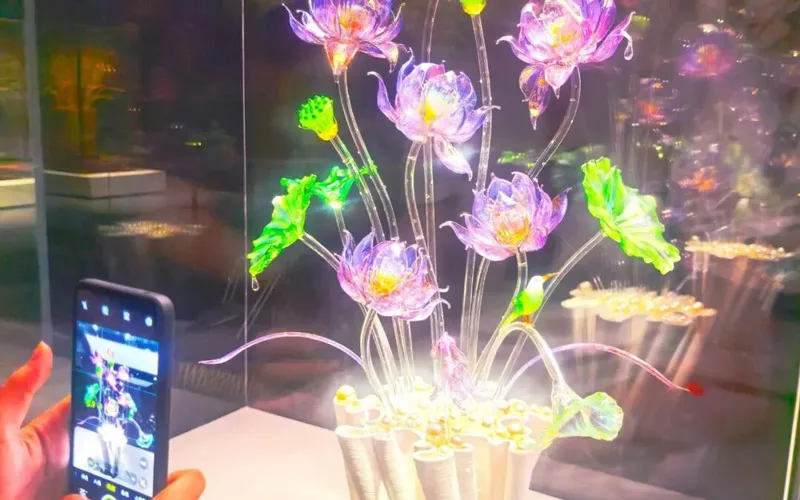
Wire Work on a Curved Gourd
The sequence is fixed. A gourd body is chosen for shape and surface; the design is drafted onto the body and then drawn out as a line sketch; glue is applied along the lines; the wire is bent to follow them, which is what gives the craft its name, wire inlay; finally coloured sand is packed into the cells the wire has created.
Curve is the difficulty. A gourd bulges and narrows, so the sand sits at different depths and the wire has to be shaped in three dimensions rather than laid flat. A piece based on the qilin bringing auspiciousness took more than 20 days, and the finest wire work generally needs three days at minimum. Yang’s grounding is family-based, in woodwork, carving and hand painting, followed by a degree in fine art at the China Academy of Art, and she layers hand painting, carving and pyrography onto the same body. The longer history of Chinese cloisonne is set out in this site’s account of the craft.
Free Classes, Then a Teenager’s Orders
Teaching came before product. Yang founded a heritage teaching studio in Yiyuan county and opened free classes to anyone who applies, drawing students from across the country, and took the same lessons into the Yiyuan mountains for children there.
Since 2017 she has run separate free courses for disabled and special-needs children, designing simplified versions of the technique, and the programme has worked with more than 30 such children and drawn over 300 teenagers into hands-on sessions. One apprentice, Chu Changran (褚常然), has studied with her for four years; his high-school teacher called him a self-taught talent at drawing, and he now completes pieces and takes orders of his own.
Small objects were the entry point for others. Yang developed hairpins and pendants as simple gift items and taught the shortened method to a high-school student from a family with little income, who went on to sell finished pieces in parks and on plazas. The range of traditional hairpins these pieces borrow from is catalogued in a guide to ten hairpin types, and the wire-inlay hairpin has an earlier treatment of its own.
Eggshells That Had No Buyer
Her Douyin account, filmed as process rather than product, brought orders directly: one video produced a run of private messages and then commissions. Alongside gourd speakers and award-winning designs built on Yiyuan’s landscape, the ostrich eggshell project came out of a conversation with a farm in Zhangdian district whose shells had no outlet; the craft gave the shell a surface, and the farm now buys finished pieces back at a fixed price.
Zibo’s own inventory is large: 14 national-level heritage items, 96 provincial and 460 municipal, across ten categories, with more than a thousand registered inheritors, according to the city’s culture centre. The same round of reporting covered a glassmaker born after 2000, Sun Qiye, who reworked seven traditional techniques and whose nine-dragon, nine-phoenix glass crown went on show at the National Museum, and a Zhoucun silk weaver, Zhai Xianbao, 66 years at the loom, whose reconstruction of a set of local views took a year and more than 40,000 pattern plates.
What the eggshell shows is that the technique is a set of moves rather than a fixed object. Wire has to hold an edge, sand has to fill a cell, and the body has to take glue and keep its shape; find a material that does all three and the same steps apply unchanged. Yang’s own version of the argument is narrower: keep the wire method intact, and let the surface change.