Throwing molten iron at a cold wall is the whole of dashuhua, the firework a village in Hebei invented for itself when nobody could afford powder. The performance belongs to Beiguan fort in Nuanquan town, in Yuxian county, and it has run for more than five centuries at the turn of the lunar year and at the Lantern Festival, with a furnace, a willow ladle and a sheepskin coat worn inside out.
A Fort That Forged Its Own Festival
Yuxian sat on the Ming frontier, and the county answered the frontier with forts: walled villages built for defence, Beiguan among them, garrisoned by soldiers who farmed in peace and fought in war. A garrison needs tools and weapons, tools and weapons need iron, and iron needs a furnace, so smelting and casting took root in a farming town and stayed.
The story the town tells about the first performance is about money. Fireworks were for the rich, a village could not buy them, and the blacksmiths had already seen what a ladle of iron does when it meets stone. What they built from that is a firework made of the same iron they were melting anyway, thrown at their own gate.
A pun carries the wish, because flower and prosper are one sound apart in Chinese, so a wall of sparks doubles as a blessing on the year’s business.
Two Jobs: One Keeps the Fire, One Throws
The work splits in two. The furnace keeper melts pig iron to 1,600 degrees Celsius, holds the heat steady, and carries the ladle of liquid iron to the wall in a lined pot; the thrower takes it from there. A single show can consume more than 500 kilograms of scrap iron, with broken iron and bluestone mixed into the charge, and gathering that scrap used to be a village job in the weeks before the night.
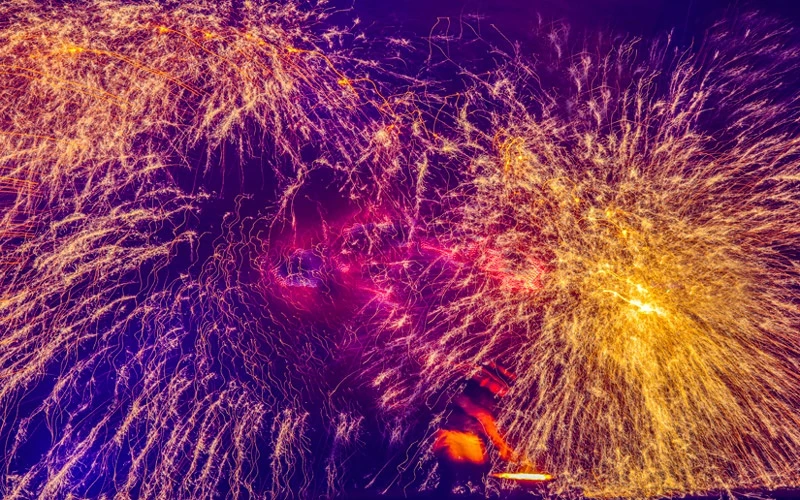
One throw is one arc. The iron hits brick, breaks into tens of thousands of droplets and cools as it flies, which is why the wall has to be cold and the night has to be dark for the spray to read. Sound arrives after the light, and the crowd reacts twice.
Why the Ladle Is Willow and the Coat Is Inside Out
The tools are chosen for the temperature. The ladle is cut from willow root, soaked in water for three days and dried over a low fire, so a film of moisture sits under the char and the wood survives long enough to release the iron. The coat is sheepskin worn with the fleece outward, and the head is covered with felt or a straw hat; fleece smoulders instead of catching, and the hat takes the sparks that fall back down. A thrower finishes soaked in sweat, and burns are part of the trade rather than an accident in it.
Furnace work is its own skill. The lining is rebuilt between runs, the charge is matched to the iron, and the colour of the melt is read by eye. Liu Shangde, a national-level inheritor from Beiguan, spent six years on that side of the work before he threw at all, learning the furnace first, then the charge, then the heat.
Twelve-Metre Plate
Tourism moved the show off the gate. Venues now build a steel plate shaped like a wall, twelve metres wide and six metres high, as the provincial art centre in Shijiazhuang did for a performance on 23 February 2024, which lets a thrower work in a city square with a crowd in front and nothing historic behind. The surface changes the result: brick pulls heat out of the iron and shatters it in a way a steel plate only approximates, and throwers adjust the force of the throw to suit it.
Inside the town, the pressure is different. Wang De, near sixty, is a thirteenth-generation thrower who learned the work from his father Wang Yuwen at fifteen and still farms in Beiguan. A national listing protects the technique on paper; whether the next pair of hands appears depends on whether a night’s work still pays enough to keep a farmer at a furnace in February.
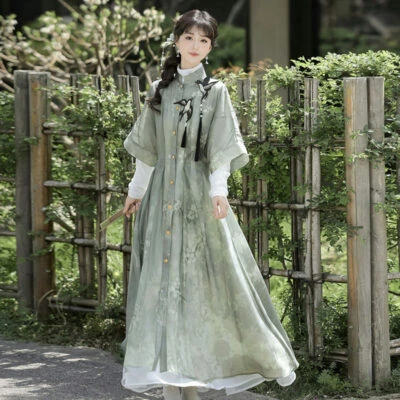
For a visitor the arithmetic is simple. The show needs darkness, so it runs in winter, at the turn of the lunar year and at the Lantern Festival, in a valley cold enough for the iron to keep its shape in the air. Nothing about the costume is decorative: a sheepskin worn fleece-out is workwear for a man standing under a shower of sparks, not traditional chinese clothing, and a spectator who arrives in chinese traditional dress has dressed for a photograph and not for the heat.
What survives here is a technique that has barely changed, because it cannot. The ladle, the coat, the cold wall and the angle of the throw are all set by 1,600 degrees. Everything around them, the ticket, the steel plate, the coach park, the phone screens held up in the front row, is new, and the technique has absorbed all of it without moving a centimetre.