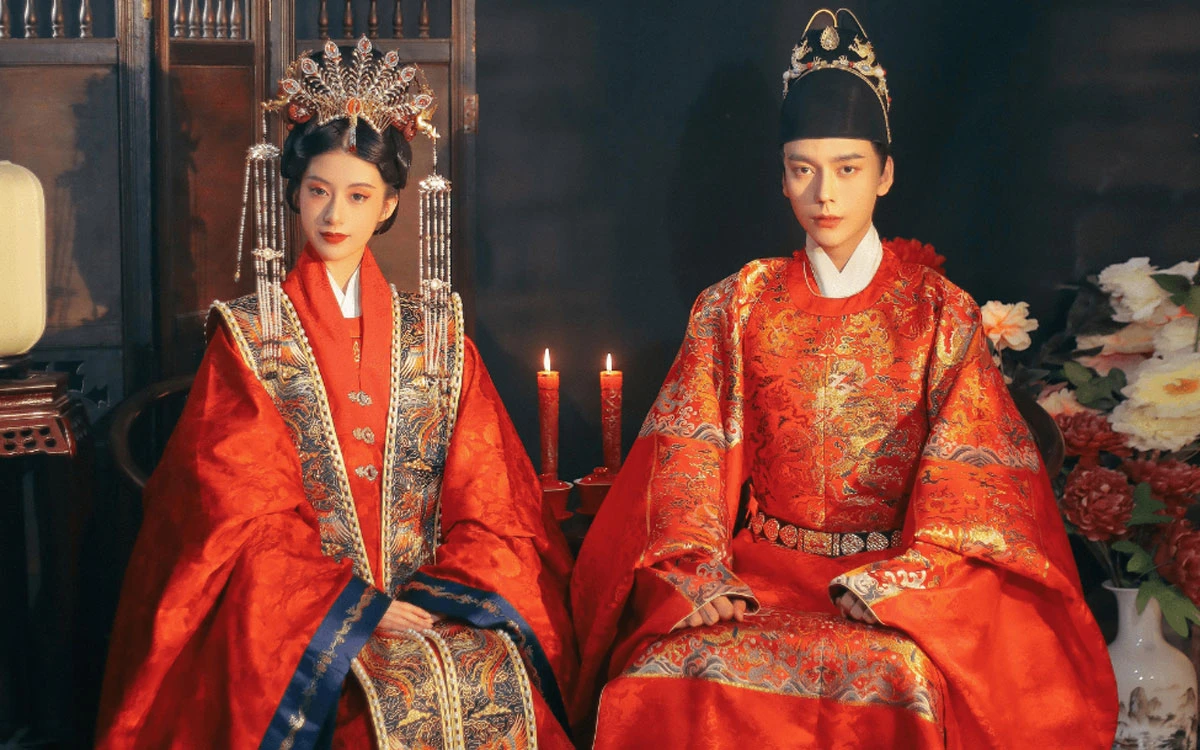
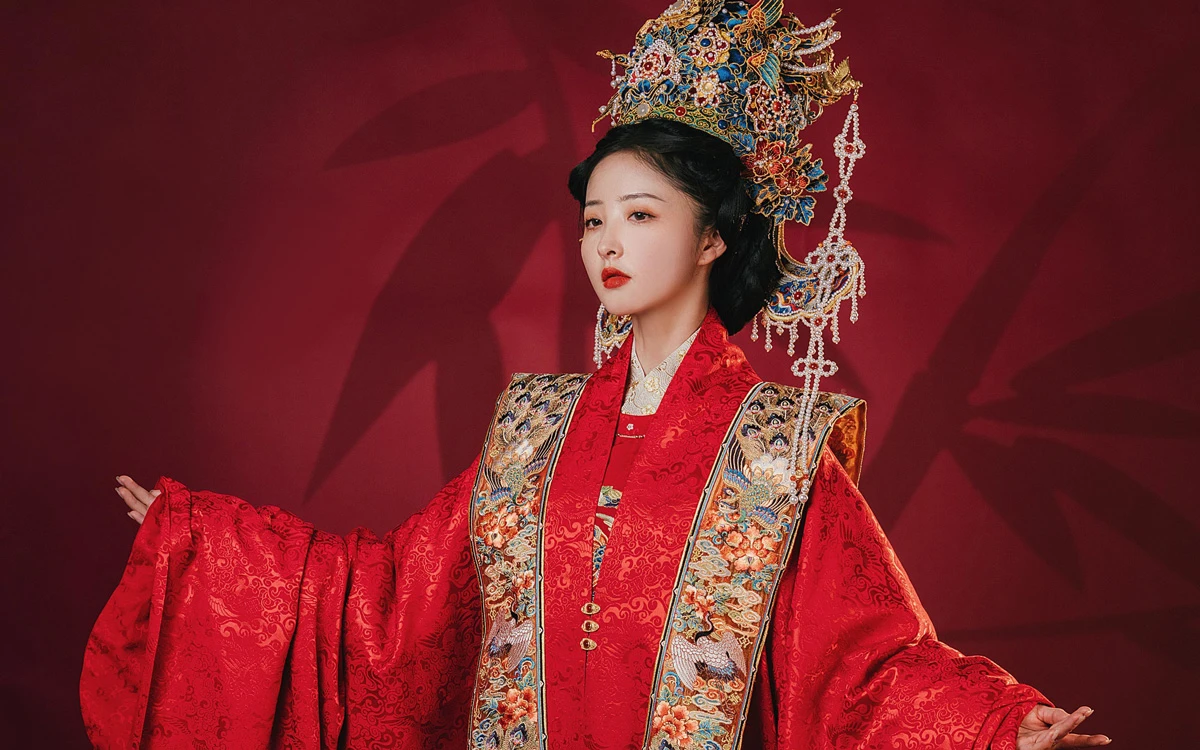
Nine kilometres of river still separate a bride in Doumen from the house she will live in, and the party covers that distance by boat. The water wedding of Zhuhai’s Doumen district is a custom more than four centuries old and the city’s first national-level intangible heritage item, and it keeps a bride’s departure, her songs and her arrival on water rather than on a road.
Thirteen Steps, and a Boat in the Middle
The sequence is fixed and long: matchmaking, tea and gifts, choosing the day, setting the day, building the kitchen, the groom’s night of song, the hair combing, the bride’s send-off, the flower boat, the bowing hall, the river meal, the wedding night and the third-day return. Thirteen steps, in an order households in the district can still recite, with the boat sitting in the middle of them.
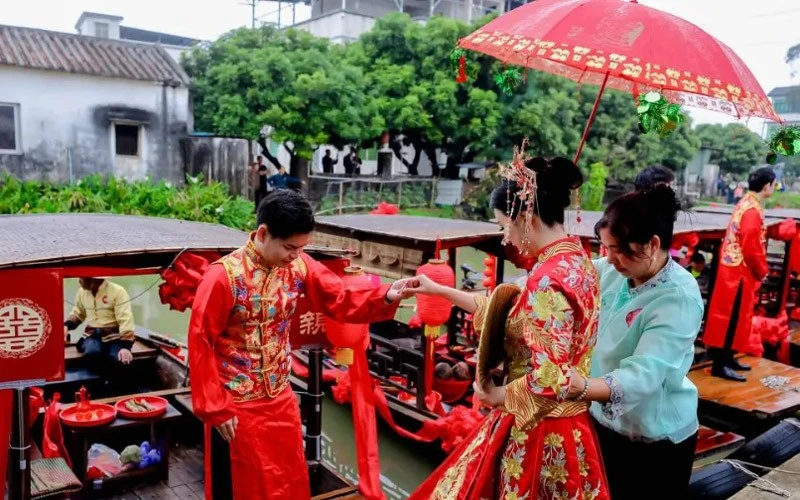
On the water the codes are specific. The groom’s boat carries gifts, a pair of red lanterns lettered with his family name and a red flag; a trumpet sounds the approach; a firecracker announces arrival and is answered from the bride’s side before the boat may come alongside. Halfway, the bride pours three cups of wine into the river, for a marriage that holds, for safe passage, for a household that grows. She steps ashore over a brazier, offers tea to her parents-in-law, bows, and the feast that follows is held on the water.
Songs Do the Work a Speech Would Do
No part of this runs without singing. The groom’s side keeps a night called sitting in the high hall, with candles lit until morning and guests answering each other in high-hall songs. The bride’s side holds a farewell in which her friends sing in the oldest tune of the sand-field repertory, going back through ancestors before they reach her parents, mixing parting, complaint and blessing. On the river the salt-water songs carry the boat, and at the wedding night the bride sings again to serve tea to her elders, after which her friends and the groom’s party answer each other, which is also how young people in the party once met.
The repertory has names: high-hall songs, lament tunes, salt-water songs, girls’ songs. The district heritage office describes the whole wedding as a frame built for them, which is why the custom survives as music as much as ritual. A wedding that lasts two days is also two days of rehearsal for singers who otherwise perform at no other occasion.
What the Bride Wears, and What Leaves With Her
Dressed and combed before daylight, the bride waits at the bow. Her hair is combed three times with a formula that runs through chinese hairstyles for brides across the region: one stroke to the end, a second to white hair shared, a third to grandchildren on the floor. Her dress is chinese traditional dress in the old cut, worn with a beaded crown, and beside her stands an elder aunt who keeps the sequence and the wording right. What leaves the house with her is a set of songs she will not sing again in that house.
The rest of the props carry the same weight: the brazier, the lanterns, gifts counted in even numbers, the meal spread on the water. The district heritage centre counts these objects as part of the item rather than as decoration, and a wedding is judged by whether the set is complete.
A Custom That Moved From Boats to Villages
Qu Dajun, writing in the seventeenth century, described the boat people of the delta: a family with an unmarried son set a bundle of grass on the stern, a family with an unmarried daughter set flowers, and a match was made through a go-between; a marriage was settled by song, and the man who won carried the woman to his boat. Doumen was sand-field country, and records place boat people there in the Ming; by the mid-Qing, reclamation brought households ashore to farm and fish, and the wedding followed them onto land, taking in Cantonese and Hakka elements on the way.
The form it took on land is what the district administers now. The custom entered the second national list in 2008. Lianzhou town, where most of the boats still launch, was named a home of Chinese folk art for 2021 to 2023 on the strength of it, and the collective version has run for more than a decade, the latest in Shilong village in January 2026 and on 23 and 24 November 2026 at Lianzhou, with nine couples taking part, a groom from Germany among them, a consul-general from Thailand attending, and a boatman born in Doumen joining eighteen years after his own wedding because the ritual had not been possible at the time.
Running a ritual to a schedule raises the obvious question. What the format protects is the sequence and the repertory, which is what a heritage listing can hold. What it cannot reproduce is the original constraint, that a boat was the only way to move a household’s most important day, and that the songs were sung by people who would not meet again often. The compensations are not trivial: the boat still leaves from a bank, the river route is still nine kilometres, and the tune has not been rearranged for a shorter attention span.
For anyone planning to watch rather than marry, the useful thing to know is that this is not a performance with a start time. The preparation is the event. Lanterns go up on the boat before dawn, the singing starts the night before, and the arrival is a stretch of bank rather than a gate, which is why the crowd on the water is part of the scene and not an audience in front of it.