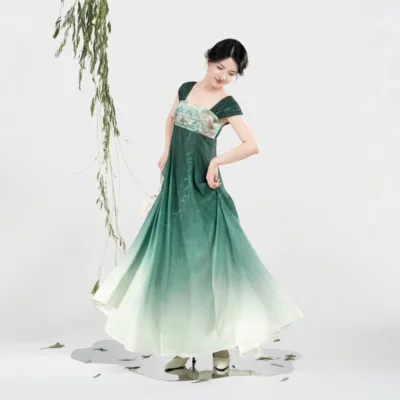
On October 10 and 11 the Liaoning Provincial Museum hosted a showcase organised by the provincial women’s federation and the provincial federation of industry and commerce, with the women entrepreneurs’ association handling arrangements. More than 100 works by craftswomen from 14 cities were displayed, alongside nearly 18 out-of-province manufacturers and 100 provincial enterprises, with about 300 guests from business and media attending.
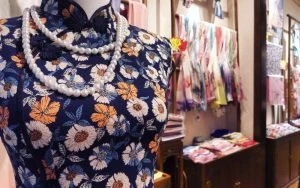
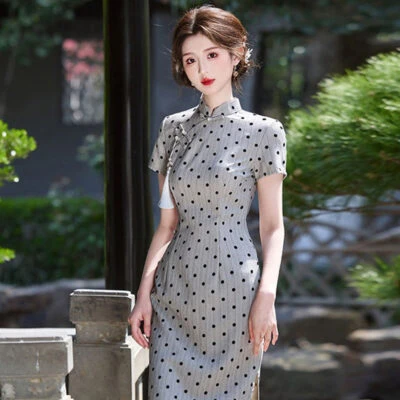
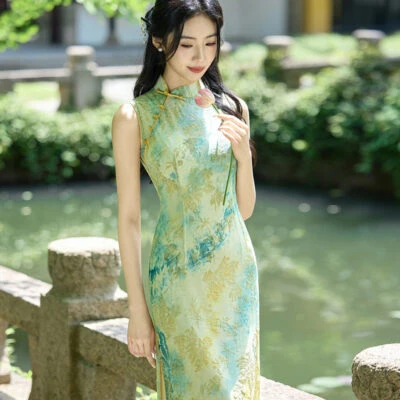
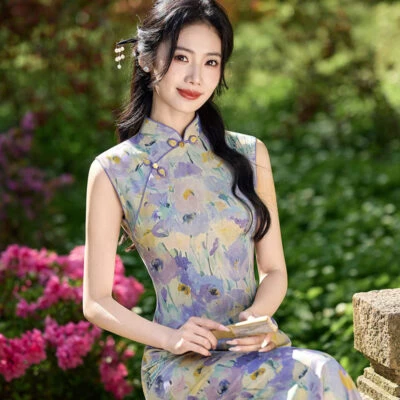
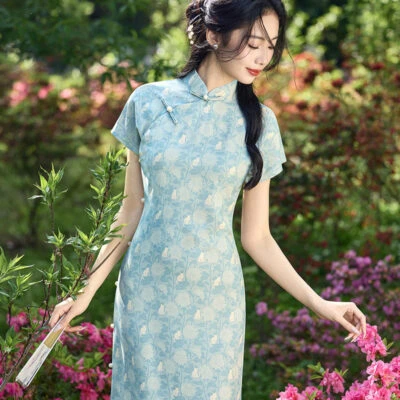
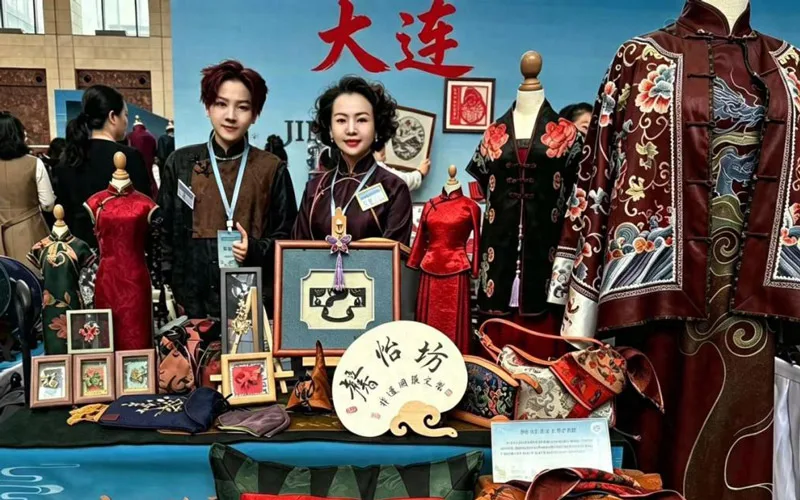
Among them, the qipao was the most direct object in the room, at once a piece of handwork and a segment of modern dress history. Yu Jianghong (于江红), named a provincial craftswoman by the Liaoning women’s federation and a fourth-generation inheritor of the municipal-level traditional hand-tailoring technique for qipao, brought a group of hand-finished dresses and a set of coiled Pankou knots from her studio in Ganjingzi District, Dalian.
What the Museum Showcase Added
Figures came from the provincial federation’s statement: works from 14 cities, more than 100 pieces, nearly 18 out-of-province manufacturers and 100 provincial enterprises, with exhibits spanning light-industry goods, speciality agricultural products, new techniques and smart equipment. Li Yueyang, head of the women’s development department at the All-China Women’s Federation, and Feng Ying, secretary of the provincial federation, attended. On the opening day the national women entrepreneurs’ chamber donated an embroidered reproduction scroll of “The Long March” to the museum, and a Liaoning craftswomen’s parlour was formally opened.
The pairing in the event’s title, “when craftswomen meet artefacts”, is the part worth noting. Handwork was not arranged beside museum objects as decoration. The two kinds of object were set up to check each other: the collection supplies period, form and technical standard, and the craftswoman’s work demonstrates that the standard can still be executed by hand. For qipao that check matters, because the process is too complex to convey in a photograph.
Four Steps That Make a Qipao
Yu’s pieces follow the old sequence in full: cutting, binding, inlay and coiled embroidery. Each step has a separate job. Cutting fixes the silhouette, and the fit of a qipao is decided almost entirely at the point where the scissors commit. Binding wraps the raw edges at collar, cuff and vent with bias-cut strips, and the width of that single line of binding sets the refinement of the finished dress. Inlay adds a second narrow edge or piping outside the binding to create depth. Coiled work joins the Pankou knot to embroidery, so that the fastening is also an ornament.
The generational detail came from the studio itself. Dalian Xinyifang, the intangible-heritage qipao space, brought both generations: Yu as fourth-generation inheritor and her daughter Jiang Yuting (姜羽庭) as the fifth, showing hand-made dresses, traditional knots, Xiangyunsha fabric and small merchandise lines, all following the five techniques of trim, inlay, binding, coiling and embroidery. Yu walked visiting officials through the transmission of Dalian’s hand tailoring, its recent development and current state.
Two generations on one provincial stage says something about how the craft moves. It is not taught as a course but as a sequence of operations: measuring, drafting, pasting, sewing, knotting, one after another, for enough years to count as learned. Having the fourth and fifth generations in the same room means the chain is currently unbroken.
Pankou, the Part That Cannot Be Printed
Of all the components on a qipao, the Pankou knot is the smallest and the most demanding. A single strip of cloth goes through starching, pressing, folding, coiling and stitching before it becomes a fastening that can hold, bear load and carry a pattern. The repertoire runs well past the plain bar knot: flower knots, Ruyi knots and butterfly knots each have their own coiling logic, and the position of the foot and the tension of the loop must match the thickness of the facing. A little slack and the knot opens; a little extra and it will not close.
This is why hand-coiled knots remain the part by which a qipao’s standard is judged, even now that machines can press fastenings in quantity. It is the one component that cannot be replaced by printing or applique; it has to be coiled loop by loop. Xiangyunsha raises the difficulty further. The fabric is dyed repeatedly in gambier juice and then sun-cured under river mud, black on the face and brown-red on the reverse, and it rustles as it moves, which is why it is also called ringing gauze. It is crisp, it resists the needle, and every closure on the binding and the knots has to be right the first time.
A District Looking Beyond Its Borders
For Ganjingzi District the purpose was stated plainly: to take a strong local heritage project outside its own jurisdiction and onto a higher platform, and to create openings for promotion and brand building. The district women’s federation said it would keep identifying and supporting craftswomen, deepening the local industry and building channels for display, exchange and sales.
Stack the three layers and the route is legible. The provincial federation builds the stage, the museum supplies cultural authority, the inheritor arrives with objects and process, and enterprises on the business side connect production to sales. In this pairing the qipao is both a cultural symbol and a trade that can support the people who make it; the craft survives only while both hold. Outside the gallery the present situation is equally clear. Qipao appear in couture shows and at weddings, and they appear in modified versions for the commute. Whether hand-coiled knots, Xiangyunsha and bound edges survive scaled production depends on whether anyone continues to pay for an edge they cannot see. The answer offered by this exhibition is not grand, at 14 cities, just over 100 works and 56 named craftswomen, but it is specific.