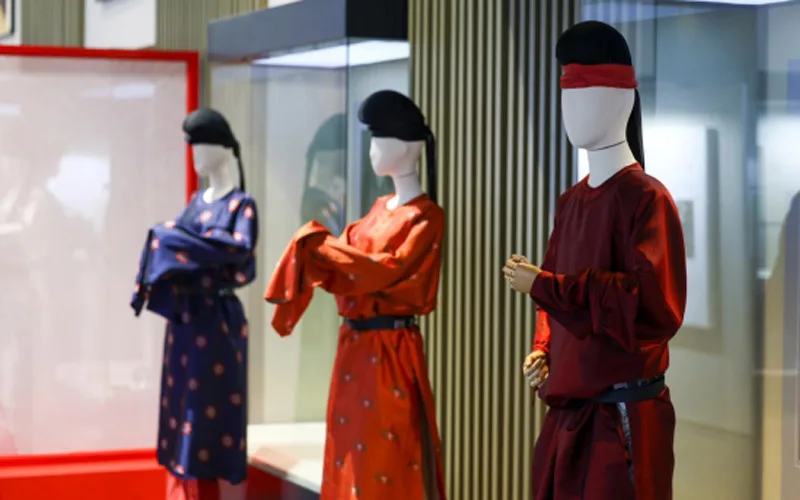
Twelve sets of reconstructed clothing went on display at the Jiangxi Institute of Fashion Technology’s costume museum on October 12, the second stop for a project that began in Yanbian. The exhibition, “Liuhe Tongfeng: Reconstructed Dress from the Tomb Mural of Princess Zhenxiao of Balhae (渤海国)”, is funded for 2026 by the China National Arts Fund under its touring programme. It runs to November 12.
Tang Xinqiang, the institute’s president, and Jia Ronglin (贾荣林), former head of the Beijing Institute of Fashion Technology and the project’s lead, unveiled the show together. Inside the hall the twelve outfits stand in a row, each accompanied by the original mural image, documentary extracts and a panel setting out the production process. The arrangement is deliberate: the visitor sees the research trail as well as the result.
A Tomb on a Hill in Helong
The tomb belongs to a daughter of King Mun, the third ruler of Balhae (Dae Heummu), and sits on Longtou Hill in Helong, Jilin province. Its murals preserve the most complete group of Balhae aristocratic figures yet found in China: twelve people, among them guards, attendants, serving staff and musicians, arranged along the chamber walls.
Their value is that they are primary. Balhae held territory on the Tang dynasty’s north-eastern frontier between 698 and 926, and its dress code carried both central-plain institutions and local tradition at once. Textiles from the kingdom barely survive, which leaves the murals as almost the only material that allows a group of garments to be read together for cut, layering and colour. For the study of frontier dress systems and of how Tang ritual order travelled outward, the twelve figures are a core image source rather than an illustration.
Rebuilding Twelve Figures
Jia described how the team worked. A cross-disciplinary group at the Beijing institute combined documentary research, image analysis and comparison with surviving objects, completed a systematic study and physical reconstruction of the twelve figures’ dress, and passed its acceptance review in March 2025. The project then applied for the 2026 national arts fund touring grant, which turned a research result into a travelling exhibition.
Min Yue, assistant to the president at Jiangxi, supplied the earlier stage. In 2025 the Yanbian culture, tourism and broadcasting bureau and the ethnic affairs commission worked with the Beijing institute to produce twelve reconstructed Balhae outfits. That body of work became the basis of the fund application. Assembling murals, documents and archaeological material, the team spent about a year completing the twelve sets and restoring the kingdom’s cut, technique and cultural character.
Distinction between a reconstruction and a design piece rests entirely on method. Documentary study fixes institutions and terminology. Image analysis reads structure from silhouette, layering and the position of pattern on each figure. Comparison with objects corrects the reading against known fabrics and technical parameters. Cutting and weaving come last, and only after those three steps. That order is why the displays include process panels: the answer to “what cloth, what seam, was the pattern woven or embroidered, how does the palette match mineral pigment” is the exhibit.
Why the Second Stop Is a Fashion College
The show is hosted by the Beijing Institute of Fashion Technology with Jiangxi as co-host, supported by the China Women’s University’s school of cultural communication, and staged by Jiangxi’s costume museum and garment engineering school. Tang drew on the Han History for the exhibition’s title, “one wind across the six directions, the nine provinces bound as one”, and then quoted the Tang poet Wen Tingyun on roads that run inland though rivers and seas divide them. Looked at a thousand years later, he said, these twelve outfits show that dress was never only covering: it is institutional history, ritual history and aesthetic history worn on the body. Jia added that placing the second stop inside a specialist fashion college carries its own logic, since research returns to teaching through exactly this kind of exhibition.
Guests reflected the project’s mixed disciplinary base. Four supervision experts sent by the national arts fund attended, alongside provincial heritage specialists from the Jiangxi institute of cultural relics and archaeology, the Nanchang museum and the Haihunhou archaeology department. Scholars came from history, archaeology, dress history and design: Ma Shengjie of the Luoyang Hanfu Research Institute, Wang E of Nanjing Normal University, Zheng Yan of Peking University, Song Yubin of Heilongjiang University’s Balhae institute, Zhao Lianshang of the Chinese Academy of Social Sciences, Wang Lu of the China Women’s University and Jiang Yuqiu of the Beijing institute’s ethnic costume museum. Zhang Xiaohong, a national-level inheritor of xiabu grass-cloth embroidery, attended with staff and students from four institutions. A symposium on traditional material culture and fashion innovation ran alongside the show, with keynote sessions and parallel panels on reconstruction, material culture research and design.
For Hanfu reconstruction in practice, the lesson is technical. A mural is a flat image, and the way a collar overlaps, how wide a sleeve falls, where the waist sits and how a skirt layers are all obscured by pigment and loss. Turning that image into a garment that can be worn, and that obeys Tang textile conditions, requires answers about fibre, seam type, woven versus embroidered pattern and the dye or mineral colour being matched. The second stop is Nanchang, after the opening run in Yanbian, and the twelve figures are now close enough to walk around. For the researchers the point is narrower: Balhae occupies little space in the histories, and these outfits supply the part that was worn.