Rome, October 16. A row of tea tables filled the ground-floor gallery of the UN Food and Agriculture Organization’s headquarters, laid with celadon cups, glass pitchers and tins of leaf. The occasion was World Food Day, which fell on the same date as the organisation’s 81st anniversary, and the stall sat just outside the hall where the anniversary session was opening. FAO set aside the space in Building A for the day.
It was organised by the China International Tea Culture Research Association, the Zhejiang Daily group’s Tide News and the Zhejiang International Communication Centre, with the magazine Tea Exposition handling the practical side. Attendance figures differ by source: the China Farmer Network counted more than 600 visits from delegates and guests representing over 70 countries, while Tide News put the number of guests at more than 700. Both point to the same fact, which is that for one day the busiest corner of the building was a tea stall.
A Tea Table Beside the Plenary Hall
Programming began the afternoon before, outdoors, on October 15. Senior tea masters from the research association demonstrated the sequence of warming the bowl, dropping in leaf, pouring and decanting, working through China’s six tea categories one after another in front of a Roman audience.
Guang Defu (广德福), vice-chairman of the association and China’s first permanent representative to the UN food agencies in Rome, framed the intent plainly. “Tea stands for daily life and it stands for something good,” he said. “We brought all six categories, because we want Italian coffee and Chinese tea to strike something off each other.” Jiang Zhonghua, principal of a Chinese language school in Rome, recalled how different the starting point was in 2000, when she arrived and found the Chinese community widely read as closed. She took students to perform tea pouring at an international arts festival, and the neighbours’ impression shifted: the Chinese were not only working, they also had quieter hours in their day.
Two local voices made the case in their own terms. Pierluigi, a doctor who has drunk tea for fifteen years, keeps coffee and tea in separate compartments of the day. Coffee belongs to the morning, to breakfast and a two-minute chat, he said; tea has a time of its own. His advice to Italians is specific: a green tea after lunch makes the afternoon’s work clearer. Jacopo, born in Rome and a Chinese learner for several years, now teaches friends to drink Chinese tea without sugar or lemon, and his recommendation for younger Europeans is to begin with cold-brewed leaf.
Cups That Carry a Kiln’s Argument
The vessels did as much work as the tea. Yue ware celadon, Yaozhou ware and wood-leaf tenmoku bowls were laid out together, and guests picked them up to look at glaze and body rather than to drink. One bowl drew a queue: a real leaf fired into the porcelain at over 1,000 degrees, so that the leaf sits inside the glaze as an image of itself.
Qu Dongyu (屈冬玉), the FAO director-general, and King Letsie III of Lesotho left the session floor during a break and came to the stall, where they tasted West Lake Longjing (西湖龙井) and a Kaihua black tea called Kaimen Hong, and spent time over the leaf bowl. The line-up behind it ran through Jiuqu Hongmei (九曲红梅), Pingyang yellow tea, a golden-brick fu tea and Tiantai cloud-mist tea, with tea-themed merchandise at one end. A UN official who tasted the black teas said simply that it was very good; several guests found Longjing’s clean profile the easiest entry point for an after-meal cup; and Tiantai cloud-mist drew interest once its high-altitude growing conditions were explained.
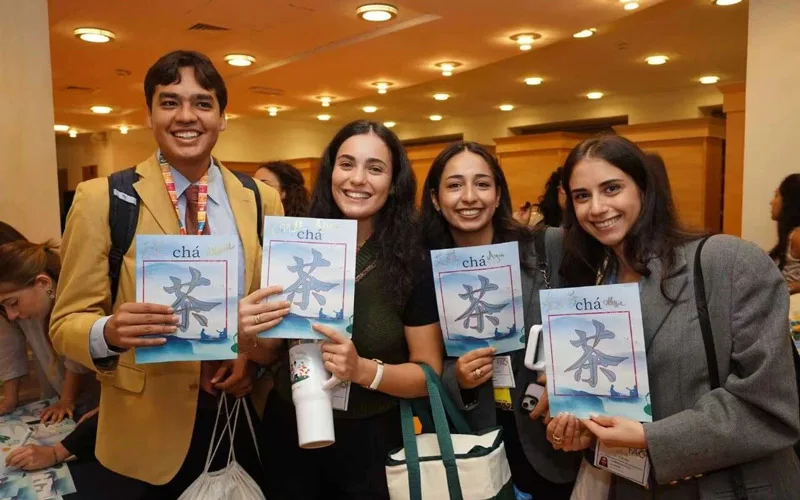
A side table invited guests to trace the character for tea in red ink on paper scented with osmanthus black tea, printed with the word in many languages and one blank space for the Chinese character. Guests from Brazil and Colombia took up brushes. An English edition of Tea Exposition was laid out alongside, organised around three axes the magazine uses for international readers: tea culture, the tea industry and tea technology.
What Exporters Still Have to Learn
Conversation moved quickly from tasting to market entry. Sara, from Iran, said she prefers tea without sugar or honey because only then does the leaf taste of itself. Lina, from Indonesia, started with green tea and now leans toward white tea for its lightness and layers. Martina, after a black tea, said it was the best she had drunk and unlike anything on a supermarket shelf.
Obstacles were named as readily as the enthusiasm. Coffee culture holds the European and Latin American markets, and the Indonesian guest Saidin proposed bubble tea, tea ice cream and tea-leaf salad as low-friction routes in, with health as the hook. Wu Xiduan, who heads the AI application centre at Zhejiang University’s tea research institute, argued that Chinese tea had spent years cultivating domestic habits and must now return to the international market. A century ago, he noted, Chinese tea set fashions in London; the opening now, in his reading, is convenience, because new tea drinks let more people reach a cup of Chinese tea easily. Zhang Xinzhong, of the Hangzhou tea industry innovation centre, was blunter: Chinese producers still lack research on overseas consumers, and product and brand are travelling on separate tracks from the buyers they want.
Mao Limin, a member of the national tea standards committee, set out a three-step route. First, agree on international standards covering composition, mutual recognition of organic certification and full traceability. Second, place tea inside scenes overseas drinkers already have: coffee replacement at breakfast, low-caffeine afternoons, cold brew for the gym, pairing with dessert, office wellness. Only then explain the cultural origin, and do it through flavour anchors that cross languages, such as nutty, citrus, creamy or roast finish, rather than through untranslatable terms for mouthfeel and rock aroma. Song-style whisked tea, the Jingshan tea banquet and the tea horse road, in his view, are notes explaining why the tea is different, not a threshold to clear first.
The Numbers Behind the Leaf
Once a tea table sits inside an FAO session, the subject stops being a beverage. With the King of Lesotho and the director-general at the same stall, the conversation moved to farmer incomes, rural poverty and green development, a line FAO has run before: its 2024 International Tea Day programme in Rome made the same points, that tea growing supports agricultural economies, that women are central to the sector, and that the crop carries environmental value.
The supporting figures come from Zhejiang. In 2025 the province held 3.28 million mu of tea gardens, roughly 218,000 hectares, produced 214,000 tonnes and recorded output value of 31.53 billion yuan. Measured against 2016, volume rose 29.7 per cent and value 84.3 per cent, with value growing far faster than volume. The same comparison is credited with a million jobs and ten billion yuan in added rural income. On the environmental side, Anji white tea carried the country’s first time-of-use carbon footprint label in the 2026 spring season, cutting the labelled footprint by more than 45 per cent through stored-energy load shifting, at 3.14 kg of CO2 per jin of finished leaf; Anji had earlier been designated an FAO One Country One Product demonstration base for ecological low-carbon tea.
Yang Xiufang, head of the Hangzhou tea research institute under the national supply and marketing cooperative, put the next step in standards terms: China needs to lead the writing of international tea rules and convert domestic technique into globally usable standards, so that exports move beyond raw material. A delegate from Gambia offered a different kind of ending. The green of the teapots and the leaves, he said, reminded him of home, where people share what they grow, and where that green makes people love one another.