Guanyang county in Guangxi opened its 2026 Powang Festival and Oil Tea Culture Week on October 5, filling the streets of the county seat with a folk parade, a hundred-meter long-table banquet, bonfires and fireworks. The county sits on land the Yao people treat as an ancestral home, and this year’s holiday programme was built around the Yao oil-tea custom, with the festival running as a showcase for oil-tea utensils, ingredients and etiquette alongside local opera, dance and handicrafts.
Eleven Formations Open the Parade
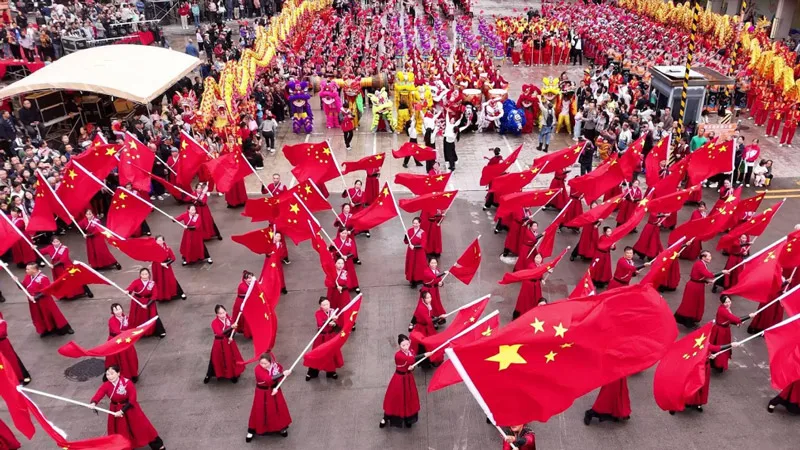
At about 9 a.m. the folk parade set off from the county sports ground. Eleven formations drawn from Guanyang’s townships filed along the busiest stretch of the town and gathered for a performance at Hongdoushan Square. Guanyang town led with a hundred-meter dragon and a drum formation: 21 drums struck together, eight lions leaping and eight dragons coiling through the street. Behind them came Huangguan’s banner dance, Wenshi’s martial arts troupe, the bamboo-pole dance of Guanyang, a tea ceremony formation from Shuiche, and the Guiju opera formation from Xinjie, whose performers worked through sung passages, recited lines and staged combat. The Powang procession itself arrived with the most ceremony, followed by the lion troupe of Guanyinge, coin-decorated dances, the lantern dance of Dongjing, a Yao formation from Xishan and banners from Xinxu. The parade closed with the whole group singing an anthem to the country as a flag formation brought up the rear.
“I drove over specially to watch the parade,” said Wei Bin, a visitor from Liuzhou. “Guiju opera and the Yao performances came one after another. You really feel what the folk traditions of an ethnic minority look like.”
Steaming Two Tons of Oil Tea in One Wok
By noon the long table was laid out and the square took on the feel of a fair. A wok 3.3 meters across, 2.5 meters tall and weighing three tonnes sat at the centre, capable of brewing two tonnes of oil tea in a single batch, and visitors queued for a free bowl. Beside it stood 18 stone mortars and 36 wooden mallets with more than 1,000 jin of steamed glutinous rice, and adults and children took turns pounding rice cakes until the square rang with the sound. A ceremonial rice cake two meters wide, stamped with auspicious characters, drew a steady line of people wanting a photograph and a piece for luck.
“I come to Guanyang for the oil tea often,” said Tang Yanfang, a visitor from downtown Guilin. “The oil tea here has so many ingredients, and it smells wonderful.” Along Binhai East Road, stalls sold Guanyang oil tea alongside rice-milk tea and mushroom tea, and more than a hundred local dishes and traditional rice noodles were on offer. In the craft display area, sweet potato noodles, bamboo weaving and pottery were demonstrated on site, so that people eating their way down the street could also watch the county’s crafts being made.
After Dark, a Bonfire and a Retro Stage
At 7:30 p.m. a show titled “Back to the 1980s and 1990s” took over Hongdoushan Square, and performers moved through a run of familiar songs that had the crowd singing along. A bonfire was lit afterwards and performers and residents danced around it, before fireworks over Liulin Park closed the first day of the festival.
Activities continue through October 7, with the oil-tea industry street, the long-table banquet, the rice-cake pounding and the bonfire gatherings running daily in the county seat. On the morning of October 10, Guanyinge Township held a Powang procession of its own, extending the programme into a second town. The organisers ran the week as a socially funded festival and paired it with craft performances, stage shows and agricultural sales, an approach they say widens outlets for local produce and lifts incomes while giving residents a reason to revisit their own traditions and visitors a reason to travel in.