Fifty-one winners of the Shanhuajiang Award, China’s top prize for folk literature and art, put 150 works on show at the Sea World Culture and Art Center in Shekou, Shenzhen, on 3 November. The exhibition runs to 22 November, admission is free, and it is the first time the award has been presented as a group show of laureates in Guangdong.
| Dates | 3 November to 22 November 2026 |
| Venue | Sea World Culture and Art Center, Wanghai Road, Nanshan District, Shenzhen |
| What it is | Group exhibition of Shanhuajiang Award winners, with the 16th Guangdong Folk Craft Exhibition on another floor |
| Scale | 51 laureates, 150 works, more than ten provinces and municipalities |
| Admission | Free; talks, round tables and craft workshops run inside the run |
| Getting there | Metro Line 2 or 12 to Sea World station, then a short walk into the Sea World complex |
The Route Runs Through Material, Hand and Time
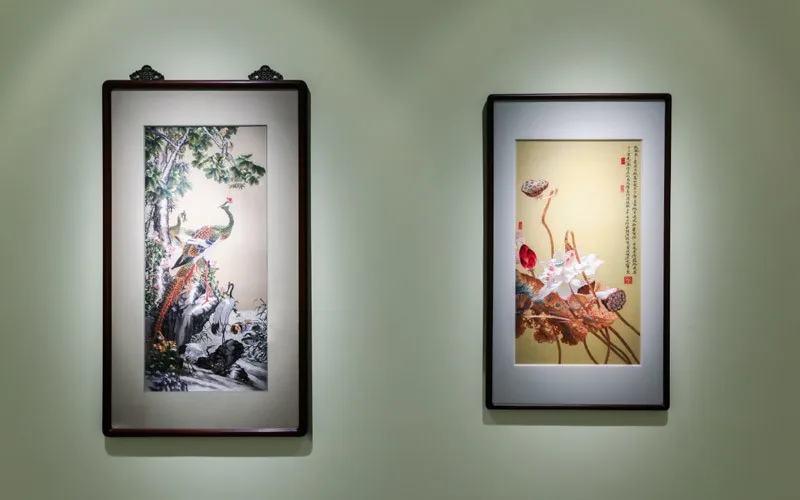
Curators divided the hall into three linked rooms. The first looks at material. Chen Mingliang, a Dehua porcelain maker from Fujian, rebuilt two glaze families that had nearly stopped being produced, the ivory-white and the child-red. Zhou Guixin and Jin Yingping, a husband-and-wife team working Dongyang bamboo-root carving in Zhejiang, cut along whatever shape the root already had, a discipline they describe as seven parts nature and three parts hand. Henan wheat-straw artist Huang Yanyong took the hardest route: in her bird-and-branch panel, a single square centimetre of plumage carries more than eight hundred straw filaments.
The second room is about handwork under pressure. Yao Jianping, a Su embroidery laureate who has won the award four times, developed a blended stitch that pulls Western painting’s handling of light into a needle technique; two of her panels hang here. Shaanxi shadow-puppeteer Xue Hongquan works through more than thirty steps, from soaking and scraping hide to engraving and dyeing, and shadow puppetry entered UNESCO’s representative list in 2011.
Transformation fills the third room. Wu Jianmei put bronze vessels into Hunan embroidery for the first time. Liu Guanyu, a paper-cutter born in the 1990s from Xuzhou, cut ordinary daily scenes into a series he calls “Notes on Ordinary Paper”. Geng Dengcai, from Qinghai, gave northwestern religious painting a new carrier with a twelve-animal zodiac set. Lin Xia, working in Taizhou embroidery, broke the flatness of the medium so that her wave panel reads as relief.
Nineteen Guangdong Laureates, Twelve Crafts
Lingnan is the densest part of the show. Nineteen laureates from Guangdong brought work across twelve crafts, among them bead embroidery, Chaozhou embroidery, nut and bone carving, clay sculpture, brick carving, paper-cutting, farmer painting, festival lanterns and Shiwan ceramics. In the 17th round of the award, announced in March, Guangdong took three Shanhuajiang prizes, more than any other province.
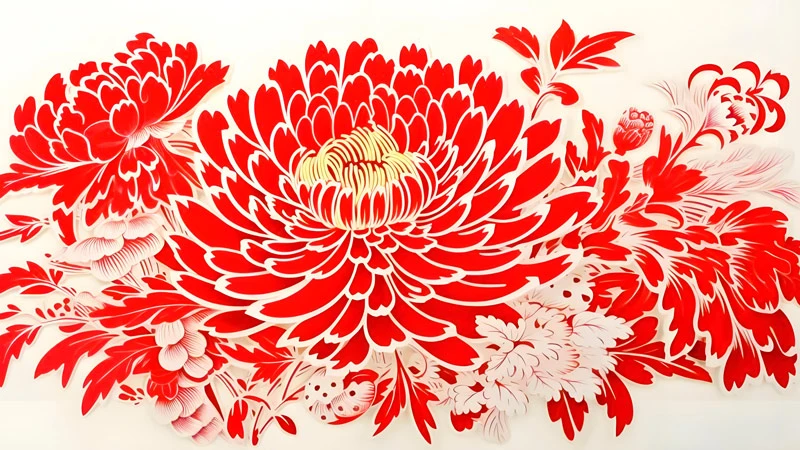
Each name carries a technique. Zhang Minhui opened a new transmission path for bone carving with a landscape panel. He Shiliang, a national-level craftsman in brick, carried woodcarving’s cutting logic into brick and won the 12th award for a theatrical scene. Kang Huifang has worked Chaozhou embroidery for more than sixty years and invented a raised double-sided stitch that filled a gap in the craft’s two-faced repertoire. Zeng Wanchun, with Lu Hanrong and Zhu Shuping, lifted Chaozhou’s traditional gatehouse into paper-cutting so that a flat medium gained volume. Fan Anqi mapped opera gesture onto Shiwan clay, and Wang Hanchi wrote Hakka mountain-song lyrics into Longmen farmer paintings. Chen Dizhen and Lin Yanhua kept the full lantern sequence, from frame-binding to silk-stretching to finishing, in a single peony lamp. Wu Guangrang, his son Wu Wenxin and grandson Wu Hongcheng hold one of China’s three major clay traditions, alongside Tianjin’s Clay Figure Zhang and Wuxi’s Huishan figures.
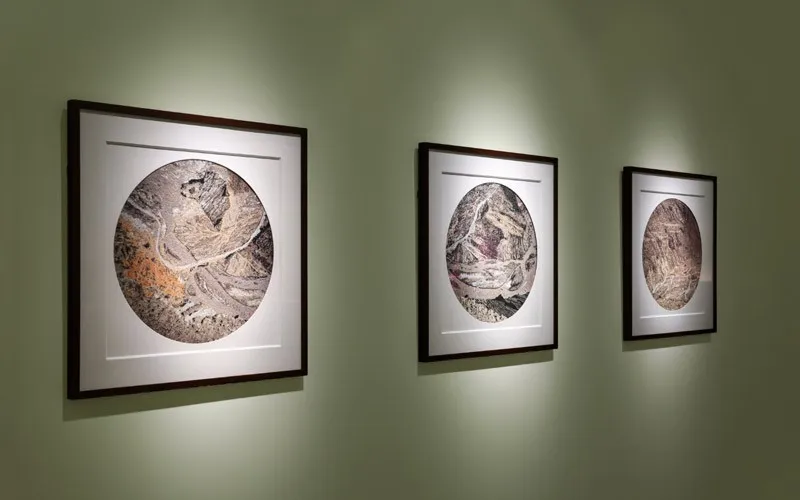
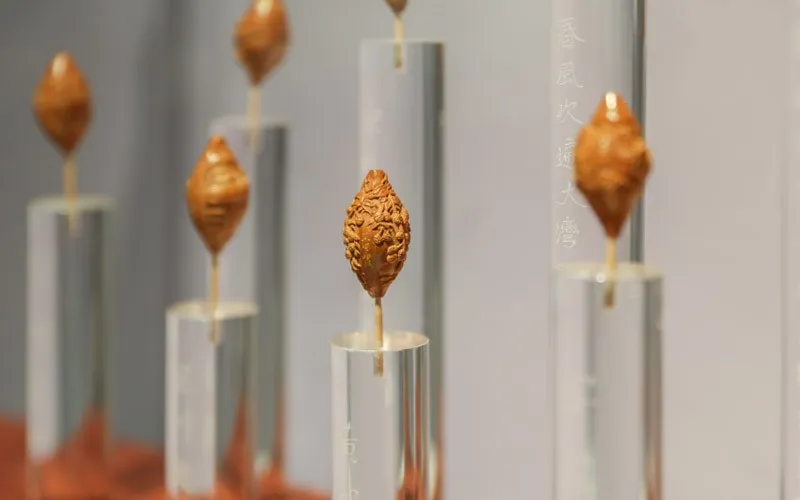
Shenzhen itself supplies two entries: a bead-embroidery canyon series by Huang Yilin and Huang Weixiong, and an olive-pit carving of the city in spring by Hu Tangshan and Zhong Xiuqin.
A Provincial Show on the Floor Above
The same day, the 16th Guangdong Folk Craft Exhibition opened on the garden floor of the same building and runs to the same closing date. From 310 submissions sent by cities across the province, 70 were chosen, covering Canton enamelling, embroidery, carving, ceramics, lacquer, paper-cutting, lanterns and clay. Its four sections are built around water and soil, craft, object and daily life.
Two shows, one building, no ticket: the pairing lets a visitor read the national prize and the provincial density against each other. It also gives the APEC year a cultural exhibit in Shenzhen, which hosts the 2026 leaders’ meeting.
Why the Schools Split Along Technique
Read the labels in sequence and the divisions inside Chinese craft stop looking like regional rivalries. They are arguments about a single step in the process. Within embroidery alone, Su embroidery solves the transition of light, Chaozhou embroidery solves thickness and relief on both faces, Taizhou embroidery solves the move from plane to space, and Hunan embroidery solves the fit between an unfamiliar subject and an existing stitch. Four technical languages sit under one word, and the same four workshops also supply much of the embroidery that ends up on traditional Chinese clothing.
Porcelain works the same way. Ivory-white and child-red are not colour names but the end points of long experiments in glaze recipe and kiln curve, which is why restarting them means restarting the experiments. Bamboo carving puts the material’s own shape ahead of the knife. Wheat-straw work takes the cheapest material available and cuts it into its smallest usable unit before rebuilding an image.
That layer of knowledge outlasts the show, and it is the practical use of a group exhibition: it turns a loose adjective back into a sequence of checkable steps. Pan Lusheng, vice-chairman of the China Federation of Literary and Art Circles, opened the show with Xu Yuechun, Wang Chuilin and Liu Wenbin. Qi Zhe, the academic adviser and dean of Guangzhou Academy of Fine Arts’ craft school, framed the collection as a moderate, harmonious language, one he placed close to APEC’s own vocabulary.