MINISO runs more than 8,600 stores in 113 countries and regions, chairman Ye Guofu said in an interview published by Xinhua on 4 November, and he now frames the company’s next ten years around characters it owns rather than licenses.
What the Store Count Says
The retailer started with a single shop in Guangzhou’s Zhonghua Plaza in 2013. It now counts more than 3,600 stores outside China, which brought in 8.63 billion yuan of overseas revenue. Group revenue for the first half of the year reached 11.5 billion yuan, up 22.4 percent, and gross merchandise value rose by 25 to 30 percent in the third quarter, faster than in the first half. Sales over the National Day holiday grew 20 to 25 percent at home, a period when many small-goods chains were competing on low price and low quality.
Ye traced the opening position to a gap he saw in the market: design, reliable quality and low price were not available in the same product. The early model was narrow and deliberate, thin margins, fast turnover, direct contracts with factories in the Pearl River Delta, no distributors in between, and volume purchasing to press unit costs. Within two years the chain had more than a thousand shops in China. Overseas stores followed in Southeast Asia in 2015; the global count passed 4,000 in 2019; a Times Square flagship followed in May 2023, with Paris and London after it.
The Licence Deal That Opened 123 Countries
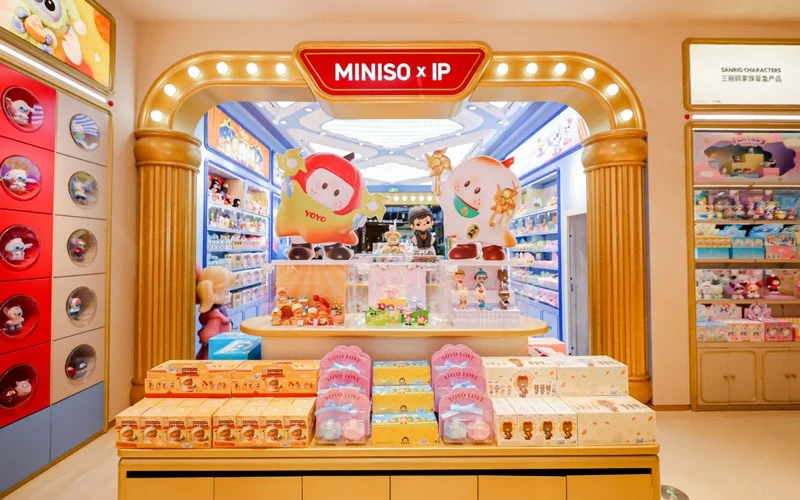
The shift came in 2020, when Ye put what the company calls interest-driven consumption at the centre of strategy. His reading was that buyers had stopped evaluating goods on function alone and had begun paying for mood and pleasure, which is why blind boxes, jewellery and licensed characters occupy the front of a store rather than the back. At the MINISO LAND branch on Beijing Road in Guangzhou, more than 80 percent of the merchandise is IP-led, drawn from the company’s own artist characters YOYO and CHOUCHOU as well as from Harry Potter and Disney.
Licensing, not design, is the hard gate in that business. Ye recalled the 2018 push for Marvel: his team flew to the Disney headquarters, camped there, and stayed until an agreement was reached. The outcome was a licence covering 123 countries at once, and the company describes itself as the first Chinese firm to hold a global Marvel IP licence. A Marvel store in Guangzhou followed in 2019, where, as Ye put it, the licensed lines cost more than standard stock and still drew queues every day. Store format moved next. The playground model tested in 2024 has a Shanghai flagship that peaked above 16 million yuan in monthly sales and passed 300 million yuan over two years, and a Guangzhou Grandview Mall branch that drew close to 10,000 visitors on its opening day. In two years the chain added about 150 playground stores, reaching Australia, Malaysia, Thailand and Singapore; the first American branch arrived in Columbus, Ohio, in October. The company works with more than 180 entertainment IP owners and has signed over 30 designer-toy artists.
Owned Characters Change the Arithmetic
A licensed character is rented. It sells, but the role and the story belong to someone else, and the terms are renegotiated when the contract ends. An owned character is an asset: once established, it can be applied across categories and countries at falling marginal cost. That difference is why Ye describes the goal as moving from a retail company to a culture company, and why the company has launched what it calls an IP talent scheme, offering supply chain, distribution and operations to creators in exchange for characters.
YOYO is the first test. The character passed 1 billion yuan in gross merchandise value over the first three quarters and is sold in 53 countries, which the company calls one of the fastest runs for a Chinese original character in recent years. Ye’s stated timetable is 100 Chinese characters abroad within a decade. A second set of figures came from the Guangzhou city government: MINISO entered the 2026 list of China’s top 500 private enterprises for the first time, and Tu Yujun, the group’s party secretary and vice president, told a city business forum that the company expects to keep building the brand across global markets over the next ten years. Both accounts agree on the store count and the country count.