The Hehe Renjian Cultural Park in Tiantai county, Taizhou, Zhejiang, has moved into the Beijing Diplomatic Duty Free Shop and opened a Yigenteng counter inside it, the first time the Ming-dynasty woodworking technique has been sold as a retail line to diplomatic missions and foreign staff in the capital. Shen Shenggang, who runs the park, introduced the arrangement to reporters on the morning of 26 October.
Wooden strips that carry each other, curve back on themselves and meet end to end, held together entirely by mortise and tenon joints with no nail or rivet, is the whole technique in one sentence. Run a finger along any line in a finished panel and it will not break: it bends, turns and arrives back where it started.
How a Single Strip of Wood Loops Back
The name comes from that shape. Yigenteng, one vine, describes a lattice woven from a single family of interlocking members that closes into an auspicious motif without visible fixings. Shen put the physics plainly: “This is what hehe looks like at its plainest. Not the absence of difference, but difference holding each other up.”
Records place the craft in the Ming dynasty, credited to Zhang Wenyu, a vice minister in the ministry of works. In the Qing, Qi Zhaonan folded Buddhist, Daoist and Confucian elements into the repertoire, and the result is what people now call the hehe vine. Traditional use was architectural and heavy: door and window panels, and the thousand-work bed, a piece of furniture built up from hundreds of joined members. Both categories are the reason overseas distribution was always difficult. A door panel cannot be shipped as a souvenir, and a bed cannot be sold in an airport.
Shrinking the Product for a Suitcase
What entered the duty-free shop is not the same stock that fills the gallery in Tiantai. The team miniaturised the format for diplomatic gifts and retail shelving, then widened the subject matter beyond classical auspicious patterns to modern wishes: bright prospects, a thriving enterprise, paired wings, the qilin. The logic is commercial and unsentimental. A duty-free customer stays for minutes, has limited luggage space and decides on first sight, so a component that needs five minutes of explanation has no chance on the shelf; scaled down to a table screen, a hanging panel or a small stand, it enters the range of things that can be carried away.
One example shows how the translation works. A table screen called National Treasure Brings Auspiciousness sets a panda holding bamboo inside the lattice, with an Hehe Erxian (和合二仙) bronze inlaid into the frame. A foreign buyer recognises the panda first, then asks what the two figures are, and the conversation moves from shape to meaning without a guide. The park describes the counter as a display-and-sell window that doubles as a market test: which subjects appeal in which region, which sizes and price points suit gift procurement, all of it feeding back to the workshop in Tiantai and to the design end.
A Workshop, a Museum and a Wedding Hall
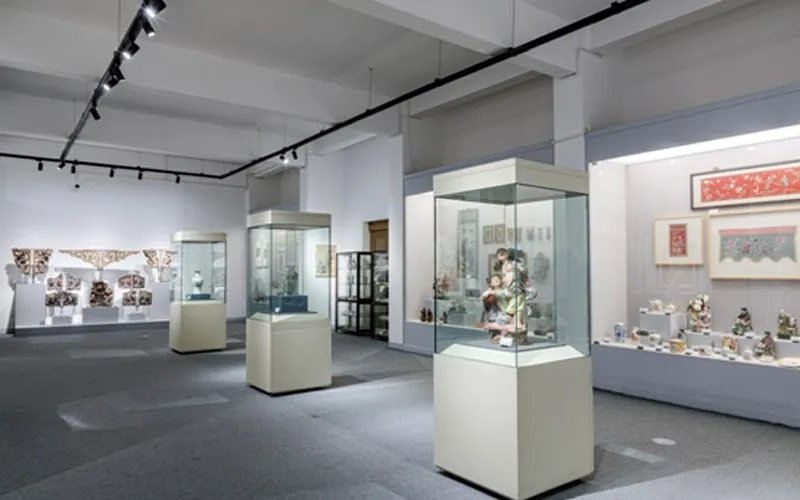
None of this would be possible without the base the county built first. The park has run since 2015 on the strength of founder Shen Zhongming’s collection of more than 1,000 hehe objects, which runs from marriage certificates and cigarette boxes to pencil cases and wedding candy jars, all carrying the paired figures. Its Hehe Museum is described as the first in China devoted to the theme, holding over 1,000 pieces across painting, ceramics, jade, documents and craft. A separate Yigenteng gallery shows more than 500 works by period, with door panels, consoles, screens and beds laid out in sequence. Local saying has it that Dongyang carves and Tiantai works in strips.
Skill supply is the constraint. The craft is on Zhejiang’s provincial intangible heritage list, and by the account of Wang Weiquan, who works at the park, fewer than ten masters can still make it. The park brought those masters back into a dedicated workshop, which is what makes a retail line possible at all: a counter in Beijing needs repeatable output, and repeatable output needs people who can cut a joint that holds without glue. The Hanshan Annex on the same site runs as Taizhou’s hehe cultural creative centre, pairing exhibitions with retail and tea, and the Hehe Hall carries a sign naming it an outdoor marriage registration site. A Song-style collective wedding held there for Qixi in 2023 followed the full sequence of rites, and the county has issued more than 5,000 hehe marriage certificates in recent years.
Four businesses sit inside one county-level park: a museum that keeps the material, a workshop that produces, a retail operation that converts, and a wedding and study-tour programme that brings people in. Export is one outlet among them, and the reason a woodworking technique went abroad before a garment or an embroidery did is structural. It has joints, it carries a wish, it can be shrunk to a suitcase, and it can be told as a story about a line that always returns to where it began.
Shen closed his account with that image. “Wherever the Yigenteng starts, it comes back to the origin, and hehe grows together,” he said. “May the world be like this vine, looping and returning, settling into harmony.” For a press release that is a closing line. For a product team it is also the sales argument: it turns a furniture component into a wish that can be handed to a foreign guest.