The seventh Liuxia village culture and arts carnival ran on 24 and 25 October at two sites in Haicheng district, Beihai, Guangxi, and for the first time put the southern pearl, shell carving and Zhuang brocade on a single programme.
| Dates | 24 and 25 October 2026 |
|---|---|
| Venue | Liuxia village and Waisha Island, Haicheng district, Beihai, Guangxi |
| What it is | Seventh Liuxia village culture and arts carnival, part of the eighth Culture Beihai week |
| Programme | Craft market, themed costume show, craft exchange, Tanka wedding re-enactment, seaside music evening |
| Scale | Three Guangxi crafts on one platform; market set in the village bar quarter |
| Hours | Market opens 10:00 on the first day; music evening closes at 20:00 on 25 October |
| Getting there | Liuxia sits in Haicheng district and pairs with Guantouling and Waisha Island for half a day |
Three Crafts on One Table
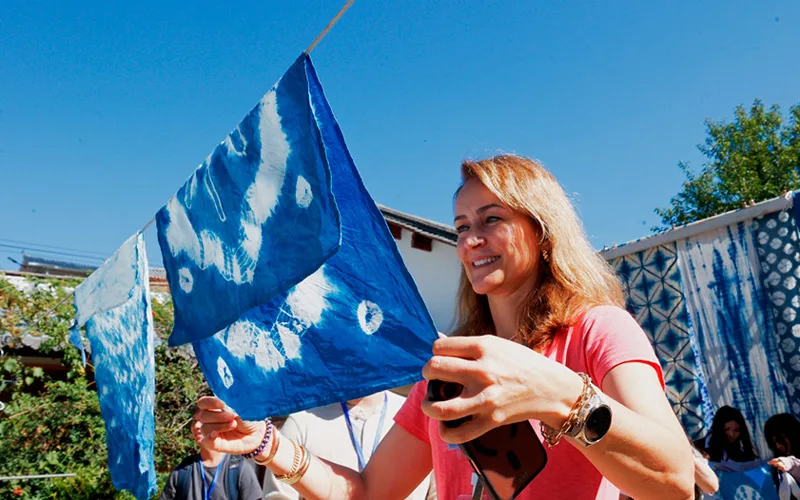
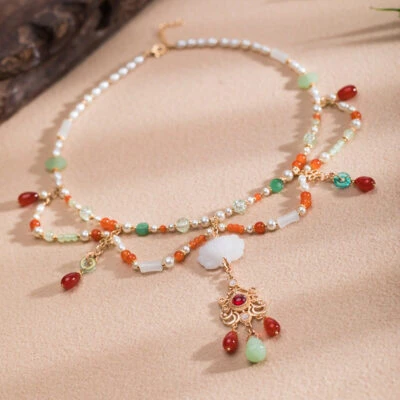
By ten on the first morning the craft market in Liuxia’s bar quarter was ringed with people. Zhuang brocade lay on a wooden table, blue and white weave threaded with small pearl and mother-of-pearl inlays. Visitors crouched at the stall with half-finished strands of pearl in hand, following the artisan through a bracelet of their own, pearl dust on their fingertips while the stallholder talked about the old pearl port. At the lane entrance a photograph show on migrating raptors over Guantouling drew parents reading the panels to their children.
Each craft was given a separate job rather than a shared label. The southern pearl, the name Beihai gives the pearls cultured off this coast, supplied material and lustre; shell carving supplied the cutting; Zhuang brocade supplied woven pattern. Each had spent most of its life in its own museum case or its own county, and the carnival put them on the same table, under an event brief that named three functions at once: tracing the pearl trade, reading the sea, and selling the city.
An Evening on Waisha Island
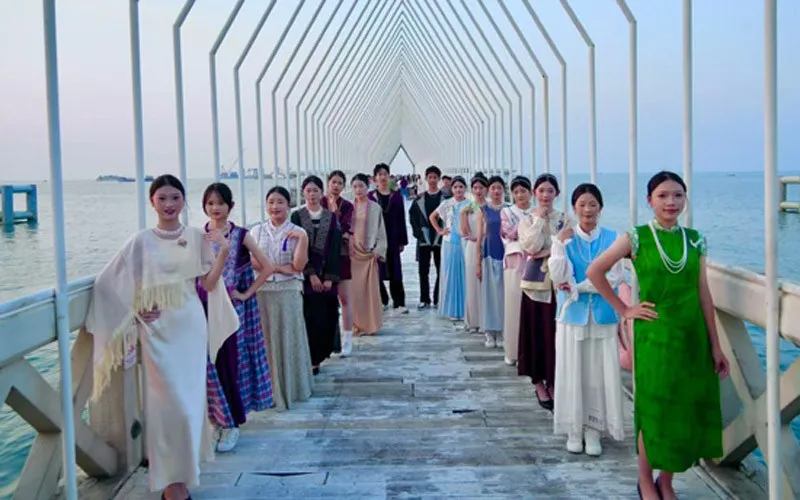
A themed costume show opened the programme, Zhuang brocade sashes lifting with each step and undyed pearl catching the afternoon light. When the models left, a pearl farmer of more than thirty years sat down with a Zhuang brocade weaver to talk about what survives and what has to change, and took questions from the crowd. A visitor who had driven up from Nanning said she had been to plenty of tourism events and this was the first time the city’s own culture had come across as something made for her.
After dark on Waisha Island the stage ran a show of its own: costume, dance, saltwater songs and short Tanka sketches, with quiz rounds on shell carving, brocade and pearl between acts. The closing piece was a Tanka wedding, the boat-dwelling community’s ceremony restaged with antiphonal singing and a bride rowed in rather than carried. Residents and visitors crowded the stalls afterwards, handling the weave, trying bracelets and learning to knot a small brocade charm.
Making Shell Carving Small Enough to Wear
Chen Chengjie, a municipal-level inheritor of Beihai shell carving, put the craft’s commercial problem in one line: make it small, small enough to be a brooch, a hairpin, a table lamp, so that shell carving becomes a way of living rather than an exhibit. A piece behind glass is looked at; a piece pinned to a lapel is bought, worn and given away.
Prices track the size. Large shell screens and standing pieces depend on a room to display them and a price that narrows the buyer pool. Cut down to a brooch or a hairpin, the same shell enters daily dress, the unit price falls and repeat purchase and portability rise, while a lamp turns the material’s translucency into a function. Zhuang brocade faces a comparable wall: woven dense on a slow loom, sold as a full bolt it prices itself out of a visitor’s budget, but cut into a sash or a small charm it lands inside one.
Weddings carry the part that outlasts the weekend. Tanka families lived on boats, so the songs were sung across water and the bride arrived by oar, which separates the rite from the sedan-chair forms of farming villages inland. The practice survives in Tanka settlements around Beihai and Qinzhou, and the staged version keeps the antiphonal structure and the boat route intact, which makes it a usable entry into how the Gulf of Tonkin’s sea peoples organised a marriage.
One practical note for anyone planning a visit: the carnival is a dated event, so check whether the market and shows are still running before travelling. Liuxia itself is small and takes an hour or two, which suits a half day combined with Guantouling and Waisha Island.