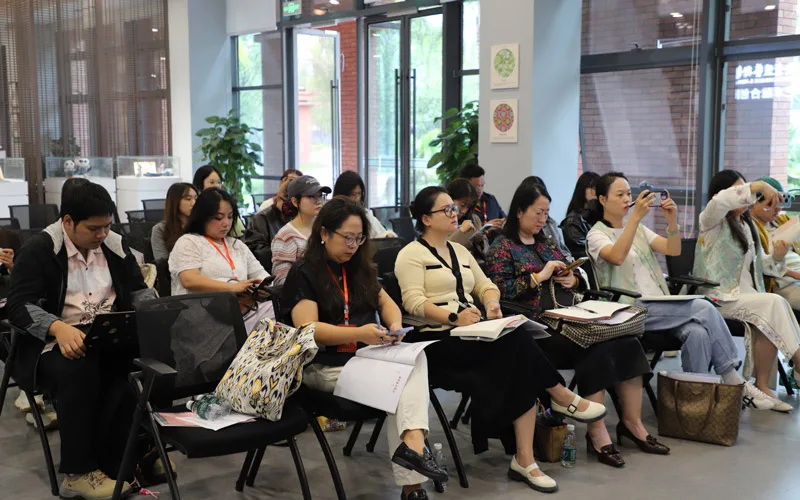
On paper the course runs as four stages: classroom study, workshop operation, field research and a final piece. The 20 people taking it are not beginners. They include front-line designers and technical staff from Shu brocade producers, art teachers from primary and secondary schools, people already working in the garment trade, and postgraduate students still on campus. On October 9 the cohort assembled at the College of Chinese and ASEAN Arts at Chengdu University for a programme that lasts nearly a month.
Chengdu University hosts the intake, run by the Chengdu Intangible Cultural Heritage Protection Centre under a municipal plan known as double cultivation and double training. What distinguishes it from earlier rounds is not the length but the two tracks inside it, and the two digital modules added to the syllabus.
The Two Tracks Inside One Class
Rather than teach everyone the same thing, the organisers split the 20 into two groups and sent them in opposite directions. Young practitioners from the industry leave their jobs and study full time on campus, working through the history of Shu brocade, the traditional weaving craft and digital innovation design. The university students do the reverse: they leave the classroom for the workshop floor, where they work on design landing and market conversion inside real production settings.
Seminars, field research and project discussion bring the two groups back around the same subject. Peng Yunsi, deputy director of the Chengdu Intangible Cultural Heritage Protection Centre, framed the problem the programme is meant to answer. Shu brocade, she said, is Chengdu’s signature craft, and the trade is dealing with a gap in its talent pipeline, limited innovation and a weak link between product and market. The design of the intake follows provincial and municipal industrial policy, she added, by folding digital design into the curriculum and building a route for finished work into the market.
Two of the people in the room spoke to what that means at bench level. Shen Rui, a student representative who has worked in the craft for years, said the difficulty of keeping and passing on a skill of this kind is easy to underestimate, and that Shu brocade now needs young hands to make it work again in a modern idiom. Zhou Xiaoji, executive vice-dean of the college, said the institution would draw on three of its own strengths, in art disciplines, digital innovation and international exchange, to support design, product development and overseas communication.
AI and Textile CAD Join the Curriculum
Where the change shows is the module list. Alongside art theory and aesthetic appreciation, Shu brocade culture and weaving technique, field study and enterprise exchange, and the graduation project, the timetable now carries AI-assisted innovation design and textile CAD, the software used to build woven jacquard patterns on screen before they reach a loom.
Trainees are asked to use those tools for pattern development and product design rather than for illustration, with the aim of testing how a traditional weave behaves in contemporary use. Teaching is shared between Shu brocade specialists, representative inheritors and mentors from companies, so a design produced on a screen is checked against what the loom will actually carry.
What follows the course is deliberate as well. Strong final pieces are to be shown to enterprises, and the organisers say those pieces have a chance of being taken up and produced rather than filed away. That closing mechanism is the reason the syllabus keeps a market module at all: the programme is not only trying to raise the level of individual work, but to shorten the distance between a graduate piece and an order.
A Three-Year Plan Behind the Intake
None of this was arranged at short notice. At the end of 2024 the Chengdu municipal government issued a three-year action plan for high-level protection and high-quality development of Shu brocade and Shu embroidery covering 2025 to 2027. The document names the double cultivation and double training programme directly, and asks for regular training classes for inheritors of both crafts as a way of closing the talent gap. This month’s intake is one execution of that clause.
Its stated aims are two-sided: to raise the overall competence and innovative capacity of people already in the trade, and to give students a grounding in the culture and the practice of the craft. For a weaving tradition whose production lines need both designers and technically trained hands, the test will come when the first cohort’s graduation pieces meet a company’s order book.