A selection rule comes before the artist list. A project opening this month at Parkview Green Fangcaodi, the art and lifestyle block in Beijing, admits work on four conditions: it must be quietly and seriously made, it must be handmade at its core, it must carry a story, and it must hold its quality. Everything else about the show follows from that filter, including the decision to give it almost no marketing apparatus at all.
Called MW Life Artist, the project is curated by Wang Xiaocan, whose work sits between cultural strategy and art direction. Its opening exhibition brings designers, contemporary artists and inheritors of intangible heritage crafts into one space, and its organisers describe it as an answer to a specific condition: the difficulty of being seen at all when attention is allocated by traffic.
Why the Show Is Built to Stay Quiet
Two readings sit inside the name, both intended. MW stands for Master Works, on the argument that each object is a product of time and each process a footnote to the maker’s attention. It also stands for Master Without Noise, which is the project’s actual working principle: strip out commercial noise, marketing clamour and information overload so that the craft is the only thing speaking.
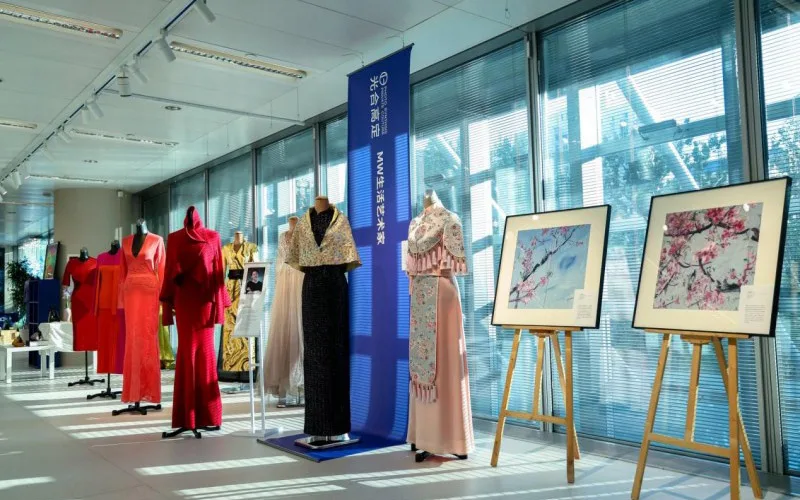
Wang has translated that principle into space. There is no sales patter and no traffic-driven exposure. The galleries are silent and mostly empty, on the argument that the work does not need a caption to hold a visitor. The noise reduction is applied to four channels at once: visually, through restrained display and white space; acoustically, through a deliberately low background sound level; informationally, through craft cards that carry only what is necessary; and in interaction, by leaving out the pitch.
What is left is a measure. In a market where handmade work is usually explained before it is looked at, this show asks the viewer to supply the first minute of attention. Whether that reads as confidence or as silence is the risk the curators have taken deliberately.
The Three Groups on the Roster
Three fields supply the opening exhibition. Among the designers, Wang Xiaocan is an expert adviser to the UNESCO programme on intangible cultural heritage as fashion, heads the intangible-heritage future innovation centre at the trend forecaster WGSN, teaches as a visiting professor at the international campus of ESMOD, the French fashion school, and founded Guanghe Haute Couture. She took the 2024 WGSN visionary award and a Greater Bay Area fashion personality award, served as chief planner of the Greater Bay Area technology-fashion culture week and of China West Haute Couture Week, and has brought Shu brocade and Shu embroidery to exhibitions abroad.
Guo Ruiping is a professor and doctoral supervisor at the Beijing Institute of Fashion Technology, one of China’s top ten fashion designers, director of the national knitwear design research and development centre and founder of the label Duxi. She was invited to work on the clothing worn by leaders at APEC meetings, and her work has been shown at the Florence International Design Biennale. Jiang Xi is a long-term associate professor at the same institute, founder and creative director of the labels CICICHEUNG and CIBYCIER, an APEC leaders’ apparel designer, the first independent designer to hold a solo brand show inside the Forbidden City, a guest collaborating artist with Hermès, and a designer whose work has appeared at Milan, Paris, Tokyo and China Fashion Week.
From contemporary art, Sun Huawei trained in printmaking at the Central Academy of Fine Arts, works as a professional artist and heads the China Bofang Painting Academy; he was in the official specially invited exhibition of the 61st Venice Biennale, and shows a new piece here. Zhang Dongchu is an independent photographer whose work has appeared at the Paris contemporary art exhibition and the China-Australia contemporary art biennale; his long-exposure series turns sea and rock into the blank space a Chinese painting leaves for the eye. Xiao Fang is a ceramic designer who has worked out of Beijing’s Songzhuang art district since 2008, across sculpture, mural, animation art and oil painting; his colour manuscript on humans and nature entered the collection of the Great Hall of the People, and his gold-foil paintings have been given as state gifts.
Craft forms the third group. Bai Hua is a provincial representative inheritor of Shu embroidery and a Sichuan arts and crafts master who works embroidery as painting; she shows parrot, peach blossom and spotted leopard pieces made from canvases by the contemporary oil painters Zhou Chunya, Tang Ke and Zhao Wenjing, and her work has been given as a state gift to President Vladimir Putin of Russia. Zhu Liqun is a provincial representative inheritor of Wu luo weaving in Jiangsu, founder of the label Su Luo and the person credited with reopening Chinese flower luo gauze as a craft; he has restored more than 200 specifications of the fabric, including jacquard two-warp twisted gauze, supplied restored fabric to the CCTV Spring Festival Gala two years running, and made costume material for the television productions National Treasure and Serenade of Peaceful Joy.
Ni Dongkan directs the Beijing Dongyun Silk Culture and Art Museum and has spent more than 30 years reproducing excavated silk and applying the craft to new work, with partners including the Palace Museum, the National Museum of China and the archaeology institute of the Chinese Academy of Social Sciences. Hu Guangjun is a provincial representative inheritor of Shu brocade weaving, a Sichuan arts and crafts master and director of the Chengdu Ancient Shu Brocade Research Institute. He commands four trades and close to 70 processes, from pattern design and loom preparation to silk handling and weaving, was the lead maker of the medal ribbons for the Chengdu Universiade, and worked with the video creator Li Ziqi on a panda Shu brocade skirt. His position is blunt: craft should not be put in a museum, it should be kept alive.
Four Brocades and a Second Track
Rather than a single lineage, the exhibition sets out the brocade family. The four famous Chinese brocades appear together, Shu, Yunjin, Song and Zhuang, alongside the weaving of the Miao, Dong, Dai, Li, Buyi and Maonan peoples, and with Shu embroidery, Su embroidery, Su Luo and Yi embroidery shown as adjacent crafts. The reference points run from the Han-dynasty brocade arm guard whose woven text reads that five stars rising in the east benefit China, through Yunjin Zhuanghua weaving, whose density produced the saying that an inch of brocade costs an inch of gold, to Li brocade, still worked after three thousand years and often described as a living fossil of the loom.
A second track runs alongside the objects. A fashion-technology project begun by Guanghe Haute Couture and Yidian Pinqu is showing products built on the theme of craft meeting artificial intelligence, among them AI trend toys, AI pets, cultural-creative goods, crystal accessories and beauty items. The plan for the next stage is specific: extract patterns and process characteristics from craft work, use AI to reconstruct the motifs, extrapolate styles and generate proposals, then hand the result to craftspeople to finish by hand, and offer buyers customised products for the home, the office and leisure.
Five services are meant to hold the whole thing together, covering display space, documentary shorts and artisan stories in place of fragmented marketing, online and offline sales through limited pop-ups, online sections and VIP pre-orders, brand positioning and product narrative, and community work through face-to-face sessions and workshops. The organisers say the project is not a commercial pop-up but a long experiment in reviving handwork, and that they intend to keep adding makers to it as they build what they call a low-noise ecosystem for Chinese craft labels.